Why in News?
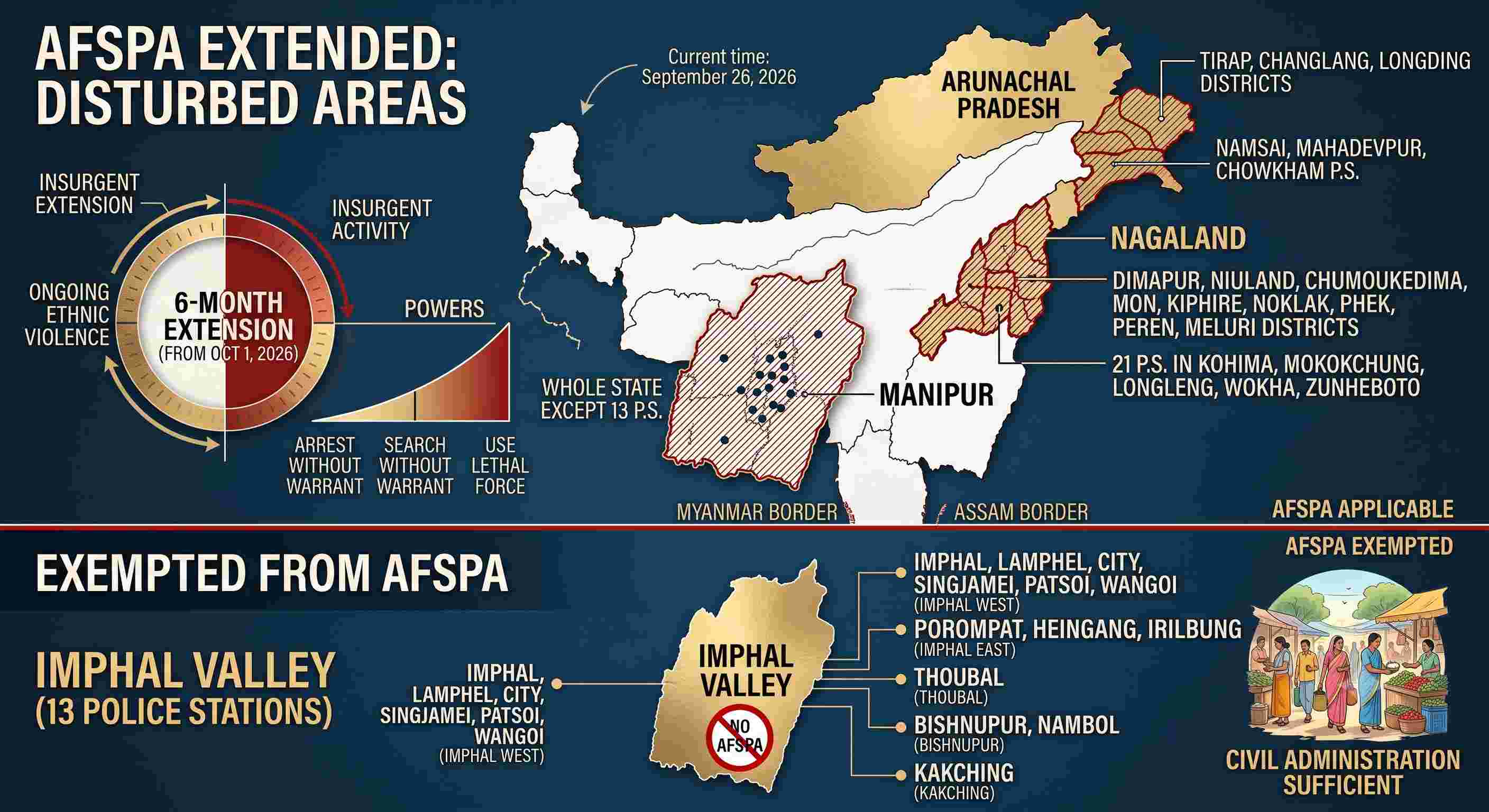
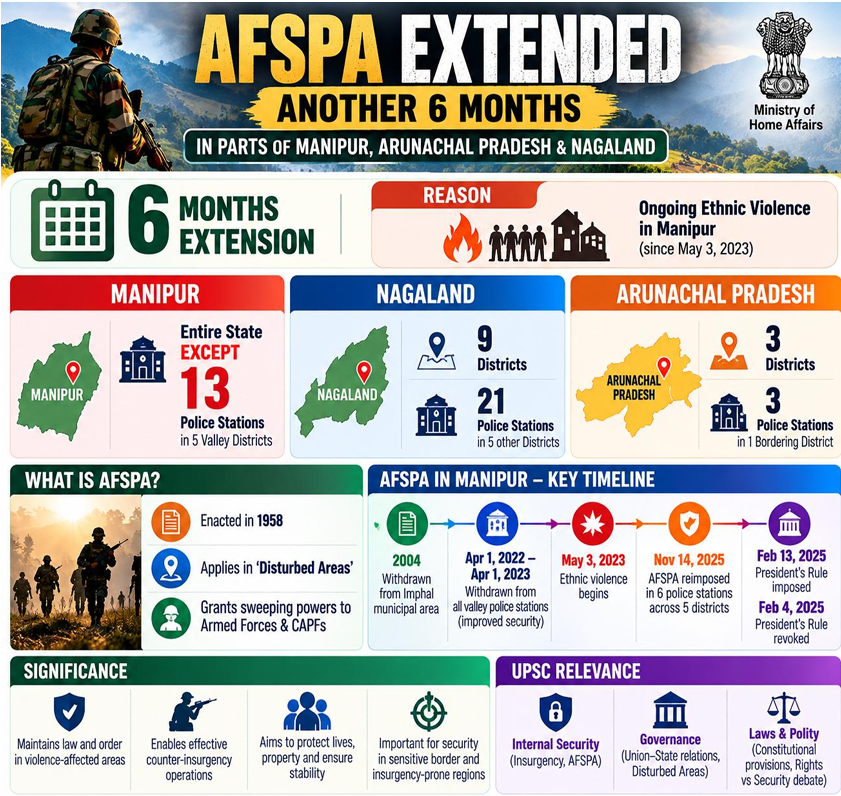
The Union Home Ministry has extended the Armed Forces (Special Powers) Act (AFSPA) for another six months in specified areas of Manipur, Arunachal Pradesh and Nagaland, citing continuing security concerns and the need for armed forces assistance in maintaining public order.
What Is AFSPA?
Key Provisions
Once AFSPA is applicable in a disturbed area, authorised personnel may:
Use force, including lethal force, after giving due warning where legally justified.
Arrest persons without a warrant under specified circumstances.
Search premises without a warrant.
Destroy arms dumps, fortified positions or shelters used by armed groups.
Enjoy certain legal protection, with prosecution for acts done under the Act requiring prior sanction of the Central Government.
Declaration of a "Disturbed Area"
A disturbed area can be declared by:
Governor of a State
Administrator of a Union Territory
Central Government
The declaration is made when an area is considered to be in such a disturbed or dangerous condition that the use of armed forces is necessary.
Current Extension
Manipur
AFSPA continues across most of the State.
Certain areas under 13 police stations in five valley districts are excluded.
The continuation is linked to persistent security concerns following the ethnic violence that began in May 2023.
Nagaland
Extended in nine districts and specified police-station areas in five other districts.
Arunachal Pradesh
Extended in three districts and specified police-station areas in another district bordering Assam.
Why Is AFSPA Controversial?
Human-rights concerns — Allegations of excessive use of force, arbitrary detention and custodial abuses have generated significant criticism.
Accountability concerns — The requirement of Central Government sanction for prosecution can make legal accountability difficult.
Civil–military relationship — Prolonged deployment of armed forces can blur the distinction between military functions and civilian policing.
Alienation — Perceived impunity may deepen distrust between local communities and the state, potentially affecting counter-insurgency efforts.
Indefinite continuation — Critics argue that extraordinary legislation intended for exceptional circumstances should not become a permanent governance mechanism.
Arguments in Favour
Provides operational flexibility to security forces in insurgency-affected areas.
Enables rapid response where ordinary policing capacity is inadequate.
Helps protect civilians and critical infrastructure against armed groups.
Can support restoration of public order in areas affected by organised violence.
Way Forward
Periodic and objective review of disturbed-area notifications.
Apply AFSPA only where genuine security necessity exists.
Strengthen state police and local intelligence capabilities.
Ensure transparent investigation of alleged abuses.
Improve coordination between civil administration, police, armed forces and local communities.
Pursue political dialogue, peace agreements and socio-economic development alongside security measures.
Develop a credible roadmap for phased withdrawal when security conditions improve.
Constitutional & Governance Perspective
AFSPA highlights the difficult balance between:
National Security ↔ Fundamental Rights
Operational Effectiveness ↔ Accountability
Military Response ↔ Democratic Civilian Governance
The objective should therefore be not simply the continuation or abolition of AFSPA, but ensuring that its application remains necessary, proportionate, geographically limited and
Practice Questions
Prelims Questions
Q. With reference to the Armed Forces (Special Powers) Act (AFSPA), consider the following statements:
AFSPA can be made applicable only after an area has been declared a "disturbed area".
The Governor of a State and the Central Government can declare an area as a disturbed area under the Act.
AFSPA provides armed forces personnel with power to arrest without a warrant in specified circumstances.
Prosecution of personnel for acts done under AFSPA requires prior sanction of the concerned State Government.
Which of the statements given above are correct?
(a) 1, 2 and 3 only (b) 1 and 4 only (c) 2, 3 and 4 only (d) 1, 2, 3 and 4
Answer: (a) 1, 2 and 3 only
Explanation: AFSPA operates in areas declared "disturbed" and provides specified powers, including arrest without warrant. Prosecution for acts done under the Act requires prior sanction of the Central Government, not the State Government. Hence, Statement 4 is incorrect.
Mains Question
Q. "The continuation of AFSPA represents a difficult balance between the imperatives of national security and the protection of fundamental rights." Critically examine the need for AFSPA in India's Northeast. (150 words, 10 marks)