Awarded To
Henri Kagan — France
Kenso Soai — Japan
Core Contribution
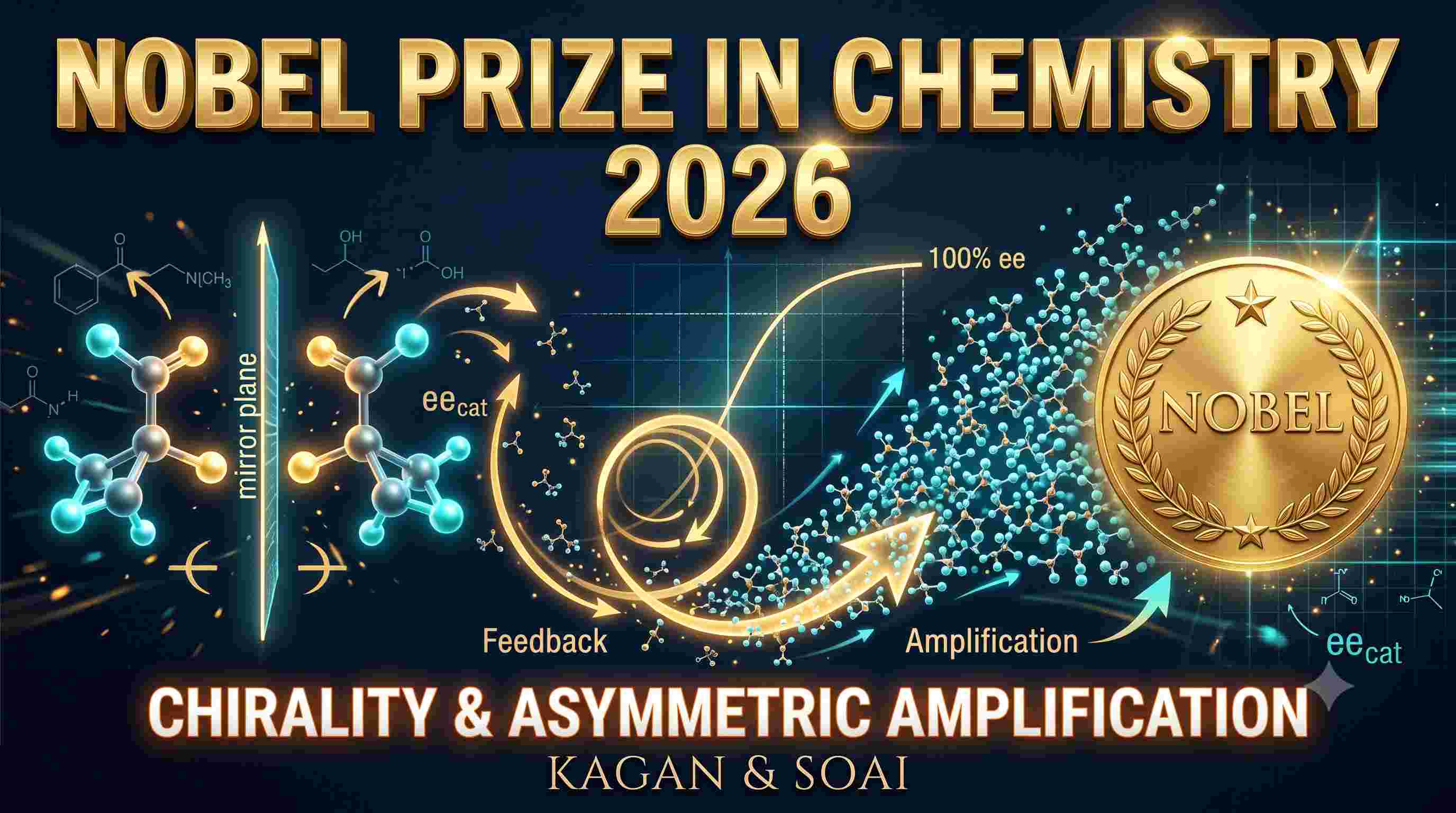
Understanding how small molecular asymmetries can be amplified through chemical reactions, particularly in chiral molecules.
Key Concept: Chirality
Chiral molecules exist in two forms that are mirror images of each other, similar to the left and right hands.
These mirror-image forms are called enantiomers.
The two forms can interact differently with biological systems.
Major Contributions
Henri Kagan (1986): Showed that a small imbalance in the chirality of a catalyst can produce a much larger imbalance in the reaction products.
Kenso Soai: Demonstrated asymmetric autocatalysis, where a chiral molecule can promote the formation of more molecules having the same handedness.
This helped explain why many biologically important molecules predominantly occur in one chiral form.
Significance
Pharmaceuticals: Helps manufacture the desired form of medicines.
Agrochemicals: Improves precision and effectiveness.
Fragrances: Enables production of specific molecular forms.
Biology: Helps understand molecular homochirality, i.e., the preference for one molecular handedness in living systems.
Practice Questions
Prelims Question
Q. Consider the following statements regarding chiral molecules:
Chiral molecules can exist in two mirror-image forms.
The two enantiomers necessarily have identical biological effects.
Chirality is important in pharmaceutical drug development.
Which of the statements given above is/are correct?
A. 1 and 2 only
B. 1 and 3 only
C. 2 and 3 only
D. 1, 2 and 3
Answer: B
Mains Question
Q. What is molecular chirality? Discuss its significance in pharmaceuticals and explain how asymmetric catalysis and autocatalysis have advanced modern chemistry. (10 marks, 150 words)