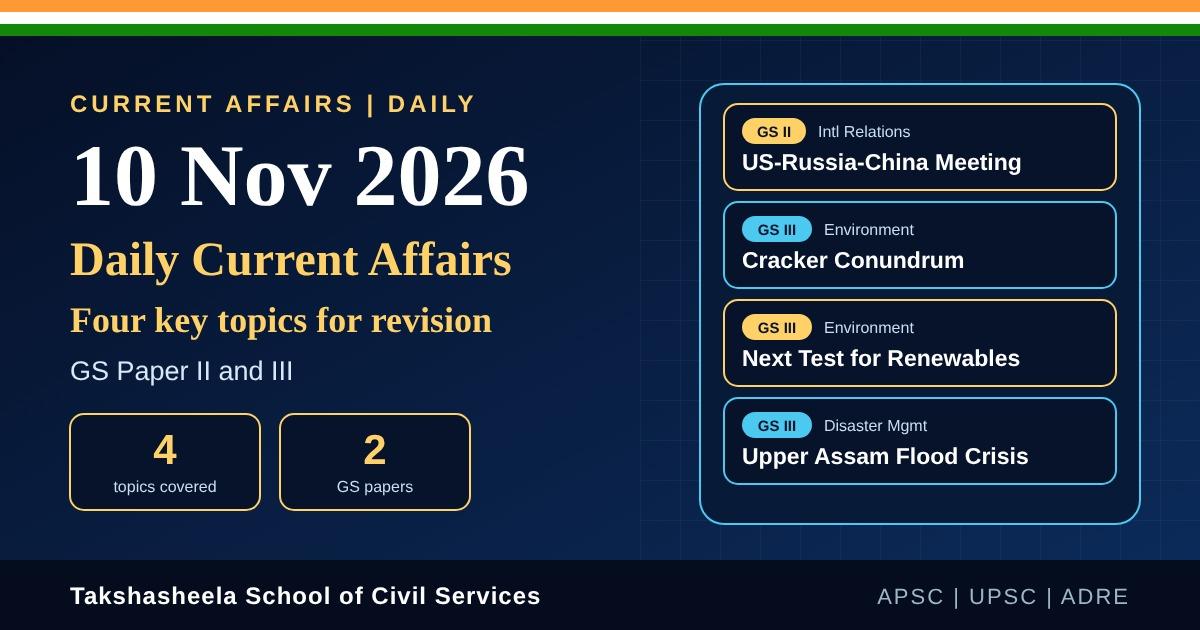
Proposed Trilateral Meeting: USA, Russia and China
GS Paper II – International Relations
Key Highlights
US President Donald Trump has indicated the possibility of a trilateral meeting with Chinese President Xi Jinping and Russian President Vladimir Putin.
The proposed meeting may take place on the sidelines of the APEC Summit in Shenzhen, China, on November 18–19, 2026.
China has stated that it is in communication with relevant parties regarding the possibility of the meeting.
Major Issues on the Agenda
Russia–Ukraine War: Possibility of negotiations and diplomatic efforts to end the conflict.
Iran Issue: Discussions on regional tensions and ending the Iran conflict.
Nuclear Arms Control: Cooperation on nuclear disarmament and reducing nuclear risks.
Global Security: Strengthening diplomatic engagement among major powers.
Significance of the Meeting
For Global Politics
May strengthen diplomatic engagement among major powers.
Could contribute to resolving international conflicts.
May encourage nuclear arms control.
For International Security
Could reduce geopolitical tensions.
May promote peaceful conflict resolution.
Could influence the global strategic balance.
For India
India’s strategic autonomy may become increasingly important.
Developments may affect India’s relations with the USA, Russia and China.
The outcome could influence global energy security and geopolitical stability.
Important Organisations and Concepts
Term | Significance |
|---|---|
APEC | Asia-Pacific Economic Cooperation |
Nuclear Arms Control | Measures to regulate and reduce nuclear weapons |
Trilateral Diplomacy | Diplomatic engagement among three countries |
Strategic Autonomy | Independent foreign policy decision-making |
Multipolar World | International system with multiple centres of power |
APEC: Important Prelims Facts
Full form: Asia-Pacific Economic Cooperation.
Established: 1989.
Headquarters: Singapore.
Nature: Regional economic forum.
Members: 21 member economies.
Main objective: Promote regional economic cooperation, trade and investment.
Practice Questions
Prelims Questions
Q1. Consider the following statements about APEC:
APEC was established in 1989.
Its headquarters is located in Singapore.
It has 21 member economies.
Which of the statements given above is/are correct?
A. 1 only
B. 1 and 2 only
C. 2 and 3 only
D. 1, 2 and 3
Answer: D. 1, 2 and 3
Mains Questions
(10 Marks | 150 Words) Discuss the significance of trilateral diplomatic engagement among the USA, Russia and China in maintaining global peace and security.
Cracker Conundrum: Air Pollution and Regulation of Firecrackers
GS Paper III: Environment
Key Highlights
An article titled “Cracker Conundrum” highlights the environmental and health impacts of firecrackers during Deepavali.
Following the Supreme Court’s temporary relaxation of the cracker ban, Delhi and several North Indian cities witnessed a rise in air pollution.
The article calls for strict enforcement of firecracker regulations and a time-bound policy to control their manufacture, sale and use.
Key Facts and Data
Delhi’s AQI reached the ‘Severe’ category on Diwali night.
PM2.5 concentrations reportedly exceeded 1,000 in some monitoring stations in Delhi and surrounding areas.
Major Causes of Air Pollution
Firecrackers – release particulate matter and harmful gases.
Vehicular emissions – major source of urban air pollution.
Industrial pollution – releases harmful pollutants.
Construction dust – increases PM10 and PM2.5.
Stubble burning – contributes to seasonal pollution in North India.
Weather conditions – low wind speed and atmospheric dryness trap pollutants.
Green Crackers
Developed by CSIR-NEERI (National Environmental Engineering Research Institute).
Designed to reduce emissions compared to conventional firecrackers.
Under stringent laboratory conditions, they reduce emissions by approximately 30–45%.
However, green crackers do not eliminate air pollution.
Supreme Court’s Role
The Supreme Court has considered the environmental and health consequences of firecrackers.
The debate involves balancing religious practices with public health and environmental protection.
The article argues that religious customs cannot override constitutional protections relating to health and life.
It calls for a final, time-bound policy on the manufacture, sale and use of firecrackers.
Constitutional Provisions
Article | Provision |
|---|---|
Article 14 | Right to Equality |
Article 19(1)(a) | Freedom of Speech and Expression |
Article 21 | Right to Life and Personal Liberty |
Article 25 | Freedom of Religion, subject to public order, morality and health |
Article 48A | State shall protect and improve the environment |
Article 51A(g) | Fundamental duty to protect the natural environment |
Important Environmental Laws
Environment (Protection) Act, 1986.
Air (Prevention and Control of Pollution) Act, 1981.
National Green Tribunal Act, 2010.
Major Challenges
Illegal manufacturing and sale of firecrackers.
Weak implementation of existing regulations.
Difficulty in monitoring emissions.
Public health risks, especially for children and elderly people.
Conflict between religious practices, livelihoods and environmental protection.
Limited public awareness about green alternatives.
Way Forward
Strict enforcement of firecracker regulations.
Promote certified green crackers where permitted.
Strengthen monitoring of air quality.
Control vehicular and industrial emissions.
Prevent illegal manufacturing and distribution.
Promote public awareness and environmentally responsible celebrations.
Develop a comprehensive, time-bound national policy.
Practice Questions
Prelims Questions
Q1. Consider the following statements about green crackers:
They are developed by CSIR-NEERI.
They completely eliminate air pollution.
They are designed to reduce emissions compared to conventional crackers.
Which of the statements is/are correct?
A. 1 only
B. 1 and 2 only
C. 1 and 3 only
D. 1, 2 and 3
Answer: C
Mains Questions
(10 Marks | 150 Words) Discuss the environmental and public health impacts of firecrackers. Suggest measures to control pollution during festivals.
The Next Test for Renewable Energy
GS Paper III: Environment and Climate Change
Key Highlights
India hosted the Bharat Renewable Energy Summit, highlighting its progress in renewable energy development.
India has achieved near-universal household electricity access and developed the world’s third-largest renewable energy capacity.
The upcoming COP31 climate negotiations have proposed a global electrification target called 35 by 35.
The target aims to increase electricity’s share in global final energy consumption to 35% by 2035.
Global Renewable Energy Scenario
Indicator | Important Data |
|---|---|
Global renewable energy capacity (2025) | 5,149 GW |
New capacity added in 2025 | 692 GW |
Contribution of solar and wind | Nearly 97% |
Growth since 2020 | Around 80% |
China’s share of new deployment | Nearly two-thirds |
Africa’s share of new deployment | 1.6% |
Three Major Challenges of Renewable Energy
A. Reliability
Existing electricity grids were designed mainly for centralised fossil-fuel power plants.
Solar and wind energy are intermittent sources.
Insufficient battery storage creates difficulties in maintaining a continuous power supply.
Weak transmission infrastructure leads to wastage of renewable electricity.
B. Energy Security
Cleantech manufacturing and supply chains are concentrated in a few countries.
Dependence on imported solar components and critical minerals creates strategic vulnerabilities.
Local manufacturing and diversified supply chains are necessary.
C. Digitalisation
Increasing AI and data-centre activities are raising electricity demand.
Smart grids and smart meters can improve electricity management.
AI can forecast renewable energy generation and optimise power distribution.
Important Government Initiatives in India
Initiative | Objective |
|---|---|
National Solar Mission | Promote solar energy |
PM Surya Ghar: Muft Bijli Yojana | Promote rooftop solar in households |
PM-KUSUM | Promote solar energy in agriculture |
National Green Hydrogen Mission | Promote green hydrogen production |
National Critical Minerals Mission | Strengthen critical mineral supply chains |
Green Energy Corridor | Improve renewable energy transmission |
National Smart Grid Mission | Modernise electricity infrastructure |
Battery Energy Storage Systems | Store electricity for future use |
Significance of Renewable Energy for India
Energy Security: Reduces dependence on imported fossil fuels.
Climate Action: Helps reduce greenhouse gas emissions.
Economic Growth: Encourages investment and industrial development.
Employment: Creates green jobs and skill-development opportunities.
Energy Access: Improves electricity availability in remote areas.
Atmanirbhar Bharat: Promotes domestic manufacturing of solar cells, batteries and other clean technologies.
Challenges for India
Intermittency of solar and wind energy.
Inadequate battery storage infrastructure.
High dependence on imported critical minerals.
Financial problems of electricity distribution companies (DISCOMs).
Land acquisition and environmental concerns.
Inadequate transmission infrastructure.
Increasing electricity and water demand from data centres.
Way Forward
Develop reliable battery storage infrastructure.
Modernise transmission and distribution networks.
Promote domestic manufacturing of solar cells and batteries.
Diversify critical mineral supply chains.
Use AI and smart-grid technologies.
Encourage public-private partnerships.
Promote research and development.
Ensure affordable and reliable electricity for all.
Practice Questions
Prelims Questions
Q1. Consider the following statements about renewable energy:
Solar and wind energy are intermittent sources.
Battery storage helps improve grid stability.
Renewable energy completely eliminates the need for transmission infrastructure.
Which of the statements is/are correct?
A. 1 only
B. 1 and 2 only
C. 2 and 3 only
D. 1, 2 and 3
Answer: B
Mains Questions
(10 Marks | 150 Words) Discuss the major challenges in India’s transition towards renewable energy.
Flood-Hit Areas of Upper Assam Face Economic Crisis
GS Paper III: Disaster Management
Why in News?
Three months after devastating floods, several areas of Upper Assam are facing an economic crisis.
Agricultural land has become unsuitable for cultivation due to heavy silt and sand deposition.
Farmers are facing crop damage, soil degradation and shortage of cattle fodder.
The worst-affected areas include parts of Sivasagar and Charaideo districts.
Major Impacts of Floods
A. Agricultural Impact
Agricultural land covered with silt and sand.
Soil fertility and structure affected.
Crops showing signs of distress.
Farmers uncertain about the next cultivation cycle.
B. Livestock Impact
Shortage of natural grass and cattle fodder.
Increased difficulties in maintaining livestock.
Risk of reduced dairy and livestock productivity.
C. Economic Impact
Loss of agricultural income.
Increased cost of agricultural restoration.
Risk of rural unemployment and indebtedness.
Threat to farmers’ livelihoods.
Soil Degradation
Soil samples are being collected from affected areas.
Silt and sand deposits have reached approximately 3–4 feet in some locations.
Two major types of deposits have been identified:
Clay Loam Soil: Contains a mixture of clay, sand and silt.
Sandy Loam Soil: Contains a higher proportion of sand than clay.
Major Challenges
Loss of fertile agricultural land.
Heavy siltation and sand deposition.
Poor crop growth and reduced productivity.
Shortage of cattle fodder.
Financial difficulties for farmers.
Uncertainty regarding the next agricultural season.
Way Forward
Conduct scientific soil testing.
Remove excessive sand and silt wherever technically feasible.
Restore soil fertility through organic manure and suitable soil amendments.
Promote flood-resilient crop varieties.
Provide quality seeds and agricultural inputs.
Ensure fodder supply for affected livestock.
Provide compensation and agricultural credit support.
Strengthen flood forecasting and early-warning systems.
Develop long-term flood management strategies.
Important Government Initiatives
Scheme / Programme | Objective |
|---|---|
PMFBY | Crop insurance against specified risks |
PM-KISAN | Income support to eligible farmer families |
Soil Health Card Scheme | Provides information on soil health and nutrients |
MGNREGA | Provides rural wage employment |
National Disaster Response Fund (NDRF) | Disaster response and relief assistance |
State Disaster Response Fund (SDRF) | Provides financial assistance for notified disasters |
National Mission for Sustainable Agriculture | Promotes climate-resilient agriculture |
Practice Questions
Prelims Questions
Q1. Consider the following statements about soil:
Sandy loam soil generally has better drainage than clay-rich soil.
Excessive sand deposition can reduce agricultural productivity.
Heavy silt deposition always increases soil fertility.
Which of the statements is/are correct?
A. 1 only
B. 1 and 2 only
C. 2 and 3 only
D. All three
Answer: B
Mains Questions
(10 Marks | 150 Words) Examine the socio-economic consequences of recurrent floods on agricultural communities in Assam.