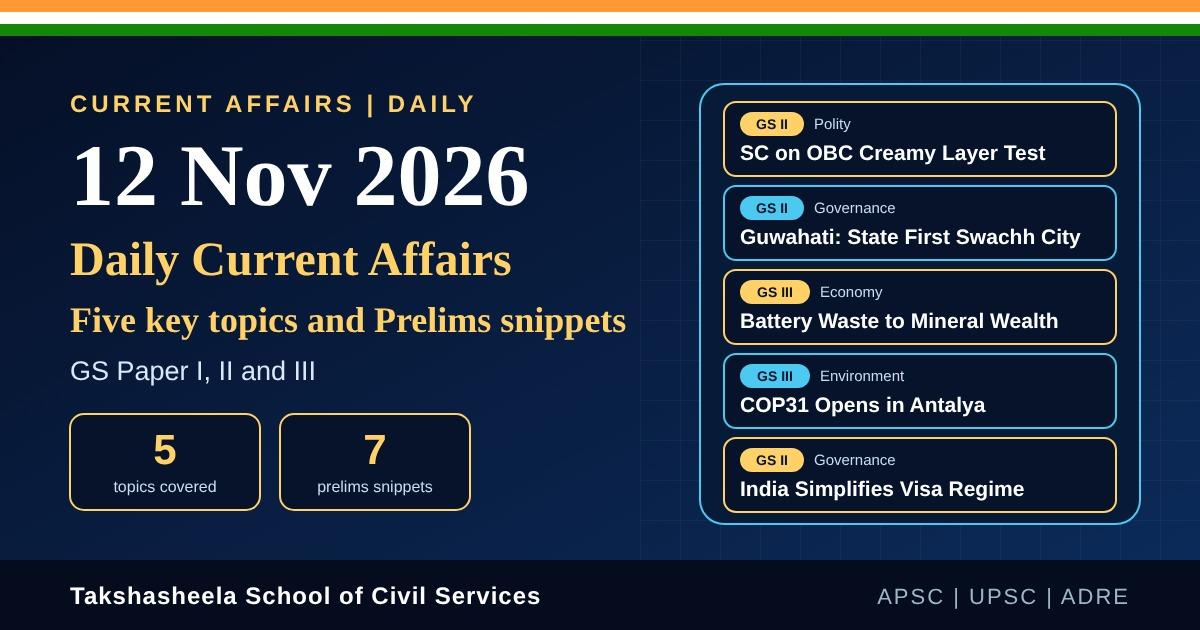
Today’s Topics at a Glance
| Topic | UPSC Relevance | APSC Relevance |
|---|---|---|
| 1. SC Clarifies OBC Creamy Layer Test | GS Paper II – Polity, Social Justice | GS Paper II |
| 2. Swachh Survekshan 2025-26: Guwahati is Assam’s State First Swachh City | GS Paper II – Governance; GS Paper III – Urban Waste Management | GS Paper II; GS Paper V (Assam) |
| 3. Turning Battery Waste into Strategic Mineral Wealth | GS Paper III – Economy, Environment | GS Paper III |
| 4. COP31: World Leaders Call for Climate Action in Antalya, Türkiye | GS Paper III – Environment; GS Paper II – International Relations | GS Paper III; GS Paper II |
| 5. Union Government Simplifies India’s Visa Regime | GS Paper II – Governance, International Relations; GS Paper III – Tourism, Investment | GS Paper II |
| 6. Prelims Snippets | GS Paper I, GS Paper III & Prelims | Prelims; GS Paper V (Assam) |
SC Clarifies OBC Creamy Layer Test: Parental Salary Alone Not Decisive
GS Paper II – Polity and Social Justice
Relevance: UPSC – GS Paper II (Polity, Social Justice) | APSC – GS Paper II | Prelims: Polity
Why in News?
- On November 6, 2026, the Supreme Court reaffirmed its March 11, 2026 judgment on determining the non-creamy layer (NCL) status of Other Backward Classes (OBC) candidates.
- A Bench of Justices P.S. Narasimha and R. Mahadevan delivered the ruling on applications filed by the Union government seeking clarification of the March judgment.
- The ruling will apply to the service allocation of OBC candidates selected through the Civil Services Examination (CSE) 2025.
Background: The March 11, 2026 Judgment
- The Court upheld the 1993 Office Memorandum (OM) of the DoPT, which excluded parental salary and agricultural income from the Income/Wealth Test.
- The case arose after CSE-qualified candidates were denied OBC-NCL benefits because the DoPT counted the salaries of parents employed in public sector undertakings (PSUs) and other organisations.
- The Court held that parental salary cannot, by itself, determine creamy layer status. The status and category of the post held by the parent are also relevant.
- The 2004 clarificatory letter cannot introduce a substantive condition that was absent from the original 1993 framework.
- The Court noted that creamy layer criteria are “status-based rather than purely income-based”.
- It directed reconsideration of claims within six months and recorded the government’s assurance that supernumerary posts could be created.
What the Court Said Now (November 6, 2026)
- No reopening: Completed selections, appointments, promotions and service allocations need not be reopened.
- Binding principle: Pending claims of similarly placed candidates can be considered on merits by the relevant court, tribunal or authority.
- Future selections: Selections and appointments made after March 11 must follow the 1993 OM as interpreted by the Court.
- CSE 2025: Results were declared on March 6, but service allocation had not been finalised, so the ruling applies.
- Timeline: The Court rejected the Centre’s request for two years to establish equivalence between PSU and government posts, calling it a policy matter for the executive and legislature. It extended the compliance deadline by two months.
Important Terms and Concepts
| Term | Meaning |
|---|---|
| Creamy Layer | Socially and economically advanced sections among OBCs who are excluded from reservation benefits |
| Indra Sawhney Case (1992) | Upheld 27% OBC reservation, mandated exclusion of the creamy layer and set a 50% ceiling on reservation |
| 1993 DoPT Office Memorandum | Laid down status-based criteria (posts held by parents) and the Income/Wealth Test |
| Income/Wealth Test | Income ceiling of ₹8 lakh per annum; salary and agricultural income are not counted |
| Supernumerary Posts | Posts created over and above the sanctioned strength to accommodate eligible candidates |
Constitutional Provisions
| Article | Provision |
|---|---|
| Article 15(4) | Special provisions for socially and educationally backward classes, SCs and STs |
| Article 16(4) | Reservation in appointments for backward classes not adequately represented in State services |
| Article 340 | Appointment of a Commission to investigate the conditions of backward classes |
| Article 338B | National Commission for Backward Classes (constitutional status by the 102nd Amendment, 2018) |
Significance
- Prevents arbitrary exclusion of children of PSU and private-sector employees.
- Reinforces that social advancement, not fluctuating salary levels, should decide creamy layer status.
- Balances administrative stability (no reopening) with justice for individual candidates.
- Brings clarity to recruitment, cadre allocation and admissions.
Challenges
- Equivalence between PSU, private-sector and government posts has still not been established.
- The income ceiling is not revised regularly.
- Litigation and uncertainty for candidates and recruiting agencies.
- Lack of updated data on the socio-economic status of OBCs.
Way Forward
- Frame a clear policy on post equivalence in a time-bound manner.
- Revise the income ceiling periodically in line with inflation.
- Use digital and transparent systems for issuing NCL certificates.
- Ensure benefits reach the most backward among the OBCs.
Practice Questions
Prelims Questions
Q1. Consider the following statements about the OBC creamy layer:
- Under the 1993 Office Memorandum, salary income and agricultural income are excluded from the Income/Wealth Test.
- The concept of excluding the creamy layer was laid down in the Indra Sawhney case.
- The National Commission for Backward Classes got constitutional status through the 102nd Constitutional Amendment Act.
Which of the statements given above is/are correct?
A. 1 only
B. 1 and 2 only
C. 2 and 3 only
D. 1, 2 and 3
Answer: D. 1, 2 and 3
Mains Questions
- (10 Marks | 150 Words) “The creamy layer test should be status-based rather than purely income-based.” Discuss in the light of the recent Supreme Court judgment on OBC non-creamy layer status.
Swachh Survekshan 2025-26: Guwahati is Assam’s State First Swachh City
GS Paper II – Governance (Assam Focus)
Relevance: UPSC – GS Paper II (Governance), GS Paper III (Urban Waste Management) | APSC – GS Paper II, GS Paper V (Assam)
Why in News?
- Guwahati received Assam’s State First Swachh City Award under the Swachh Survekshan 2025-26 awards, announced by the Ministry of Housing and Urban Affairs (MoHUA).
- President Droupadi Murmu presented the awards at a ceremony at Vigyan Bhawan, New Delhi, on November 11, 2026.
- The awards list names one leading urban local body from each of the eight Northeastern States.
- The President said the government should focus on tier-two and tier-three cities.
Northeast: State First Swachh Cities (as reported)
| State | City |
|---|---|
| Assam | Guwahati |
| Mizoram | Aizawl |
| Meghalaya | Williamnagar |
| Sikkim | Mangan |
| Tripura | Khowai |
| Manipur | Jiribam |
Other Key Results
- Swachh Coastal Town: Puri (Odisha) came first, followed by Alappuzha (Kerala) and Ratnagiri (Maharashtra).
- Himalayan cities: Rudrapur (Uttarakhand) was named the cleanest Himalayan city, with Jammu second.
About Swachh Survekshan
- An annual cleanliness survey of urban areas conducted by MoHUA under the Swachh Bharat Mission–Urban (SBM-U).
- Conducted since 2016; the 2025-26 survey is the 10th edition.
- Ranks cities on sanitation, solid waste management, citizen feedback and overall cleanliness.
- Aims to encourage healthy competition among cities and improve urban sanitation.
Significance for Assam and the Northeast
- Puts Guwahati at the forefront of urban cleanliness efforts in the region.
- Recognises municipal sanitation and solid waste management by the Guwahati Municipal Corporation.
- Spreads the cleanliness drive beyond the major urban centres of the Northeast.
- Encourages smaller towns to improve waste processing and public sanitation.
Challenges in Urban Sanitation
- Waste is not segregated properly at source.
- Landfills and legacy waste dumps, such as the Boragaon dumpsite near Deepor Beel, threaten wetlands.
- Urban flooding and blocked drains in Guwahati.
- Urban local bodies have limited money and staff.
- Rapid urbanisation and growing plastic waste.
Way Forward
- Mandatory segregation of waste at source and decentralised composting.
- Bio-remediation of legacy waste under SBM-U 2.0.
- Integrate solid waste management with flood and drainage planning.
- Strengthen the finances and capacity of urban local bodies.
- Promote citizen participation and behavioural change.
Practice Questions
Prelims Questions
Q1. Consider the following statements about Swachh Survekshan:
- It is conducted by the Ministry of Housing and Urban Affairs under the Swachh Bharat Mission–Urban.
- Swachh Survekshan 2025-26 is the 10th edition of the survey.
- In Swachh Survekshan 2025-26, Guwahati was named the State First Swachh City of Assam.
Which of the statements given above is/are correct?
A. 1 only
B. 1 and 2 only
C. 2 and 3 only
D. 1, 2 and 3
Answer: D. 1, 2 and 3
Mains Questions
- (10 Marks | 150 Words) Discuss the challenges of solid waste management in the cities of Assam. How can initiatives like Swachh Survekshan help improve urban sanitation in the State?
Turning Battery Waste into Strategic Mineral Wealth
GS Paper III – Economy and Environment
Relevance: UPSC – GS Paper III (Economy, Environment, Energy Security) | APSC – GS Paper III
Why in News?
- An article in The Hindu argues that recycling end-of-life (EoL) lithium-ion batteries can help India secure critical mineral supplies.
- At the 18th BRICS Summit in New Delhi on September 13, 2026, Prime Minister Narendra Modi warned against the “weaponisation of technology and critical minerals”.
- Demand for lithium, nickel and cobalt is rising as transport and other sectors shift to electricity.
Key Facts and Data
| Indicator | Data |
|---|---|
| EVs on Indian roads (FY 2025-26) | More than 8.7 million |
| Material recovery – informal recycling | 10%–20% |
| Material recovery – formal recycling | Over 90% |
| Share of India’s lithium demand for EV batteries that recycling could meet | About 10%–12% |
| Country dominating critical mineral processing | China |
The Problem
- Critical minerals are either scarce or their supply chains are concentrated in a few countries.
- Supplies are exposed to geopolitical tensions, resource nationalism and trade restrictions.
- India depends heavily on imports and lacks processing capacity.
- Many EoL batteries end up in landfills or in informal channels run by kabadiwalas, which are inefficient and unsafe.
Battery Recycling: Opportunities
- Waste to wealth: EoL batteries contain valuable minerals.
- Secondary source: Recycled minerals can supplement mining and overseas sourcing.
- Processing capability: Recycling can help India build critical mineral processing capacity.
- Circular economy: Reduces environmental harm from battery waste.
Challenges
- Low volumes of EoL batteries today make recycling plants run below capacity.
- Diverse battery chemistries make recovery technically difficult.
- Long gestation periods and financing risk for recyclers.
- Many recyclers produce only an intermediate product called “black mass” instead of recovering minerals.
- Weak collection systems for retired batteries.
Suggested Strategy
- Stockpile: Include a mandated share of recycled minerals in the proposed national critical mineral stockpile.
- R&D: Invest in technologies that give higher recovery and purity.
- Standards: Set standards for battery characterisation, recycled mineral quality and second-life uses; promote “design for repurposing and recycling”.
- Collection: EV makers and dealers should offer take-back or buy-back options.
- Finance: Provide patient capital for recycling plants.
Important Government Initiatives
| Initiative | Objective |
|---|---|
| Battery Waste Management Rules, 2022 | Extended Producer Responsibility (EPR) for battery producers |
| National Critical Mineral Mission (2025) | Secure critical mineral supply chains, including recycling |
| KABIL (Khanij Bidesh India Ltd.) | Acquire critical mineral assets abroad |
| PLI Scheme for ACC Batteries | Promote domestic manufacturing of advanced chemistry cell batteries |
| E-Waste (Management) Rules, 2022 | Regulate the collection and recycling of e-waste |
Practice Questions
Prelims Questions
Q1. Consider the following statements:
- The Battery Waste Management Rules, 2022 are based on the principle of Extended Producer Responsibility.
- “Black mass” is an intermediate product obtained during the recycling of lithium-ion batteries.
- Informal recycling recovers more material from batteries than formal recycling.
Which of the statements given above is/are correct?
A. 1 only
B. 1 and 2 only
C. 2 and 3 only
D. 1, 2 and 3
Answer: B. 1 and 2 only
Mains Questions
- (15 Marks | 250 Words) “Recycling of end-of-life batteries can be a strategic secondary source of critical minerals for India.” Examine the opportunities and challenges in building a circular battery economy.
COP31: World Leaders Call for Climate Action in Antalya, Türkiye
GS Paper III – Environment and Climate Change
Relevance: UPSC – GS Paper III (Environment), GS Paper II (International Relations) | APSC – GS Paper III, GS Paper II
Why in News?
- World leaders began formal talks at COP31, the UN Climate Change Conference, in Antalya, Türkiye. The summit opened on Monday.
- UN Secretary-General António Guterres warned that the slow international response to climate change has put the world on a path to destruction, and that fast action is needed.
- A new report warned of a widening gap between countries’ climate pledges and actual emission cuts.
- More than 70 world leaders and senior officials are speaking at the leaders’ summit, though some key leaders are absent.
Key Issues on the Agenda
- 1.5°C goal: Limiting global warming to 1.5°C above pre-industrial levels remains a focus of negotiations.
- Emissions gap: Countries’ Nationally Determined Contributions (NDCs) fall short of what is needed.
- Climate finance: Financial support from wealthy nations to developing countries coping with climate change.
- Fossil fuel transition: Implementing the COP28 (Dubai, 2023) agreement to transition away from fossil fuels.
- Adaptation and Loss & Damage: Support for vulnerable countries facing climate-driven disasters.
Important Background
| Term / Event | Significance |
|---|---|
| UNFCCC (1992) | Framework treaty adopted at the Rio Earth Summit; COP is its supreme decision-making body |
| Kyoto Protocol (1997) | Binding emission targets for developed countries |
| Paris Agreement (2015) | Limit warming to well below 2°C, pursuing 1.5°C; countries submit NDCs |
| COP28 – Dubai (2023) | Global Stocktake; agreed to transition away from fossil fuels |
| COP29 – Baku (2024) | New Collective Quantified Goal (NCQG) on climate finance |
| COP30 – Belém (2025) | Hosted by Brazil in the Amazon region |
| CBDR-RC | Common But Differentiated Responsibilities and Respective Capabilities |
Significance for India
- India is highly vulnerable to heatwaves, floods and erratic monsoons.
- Climate finance and technology transfer are crucial for India’s energy transition.
- India pushes for equity and CBDR-RC on behalf of the Global South.
- India’s targets include net zero by 2070 and 500 GW of non-fossil capacity by 2030.
Challenges
- Gap between promises and implementation; past COPs have been criticised for unfulfilled pledges.
- Shortfall in climate finance from developed countries.
- Geopolitical conflicts distract from climate cooperation.
- Absence of key leaders weakens political momentum.
Way Forward
- Raise the ambition of NDCs in line with the 1.5°C goal.
- Deliver predictable and adequate climate finance.
- Strengthen adaptation and the Loss and Damage Fund.
- Ensure a just and equitable energy transition.
Practice Questions
Prelims Questions
Q1. Consider the following statements:
- COP31 is being held in Antalya, Türkiye.
- The agreement to transition away from fossil fuels was reached at COP28 in Dubai.
- The Paris Agreement aims to limit global warming to well below 2°C above pre-industrial levels.
Which of the statements given above is/are correct?
A. 1 only
B. 1 and 2 only
C. 2 and 3 only
D. 1, 2 and 3
Answer: D. 1, 2 and 3
Mains Questions
- (10 Marks | 150 Words) Despite repeated climate summits, the gap between climate pledges and actual emission reductions keeps widening. Discuss the reasons and suggest measures to bridge this gap.
Union Government Simplifies India’s Visa Regime
GS Paper II – Governance and International Relations
Relevance: UPSC – GS Paper II (Governance, International Relations), GS Paper III (Economy – Tourism, Investment) | APSC – GS Paper II
Why in News?
- The Ministry of Home Affairs (MHA) has simplified India’s visa regime by cutting the number of visa categories and making application forms leaner.
- On August 27, 2026, main visa categories were reduced from 13 to 9 and sub-categories from 49 to 23.
- Fields in the visa application have been cut by 65%–70%.
- Visas will be granted under the new system by the end of the year, once IT systems are updated.
Key Changes
- Visitor Visa: The “Tourist Visa” has been renamed “Visitor Visa” to cover a wider range of purposes beyond tourism.
- V-1 Visa: Short-term visits such as business meetings, medical consultations, wellness retreats and short courses in Indian languages, music, art and craft; valid for 30 days with multiple entries.
- V-2 Visa: Longer visits, valid for one, five or ten years; covers V-1 activities and mountaineering.
- Production Investment Business Visa: A new provision for foreign experts, engineers and technical staff engaged in installation, quality checks, maintenance, IT, training and technology transfer.
- Medical Visa: M-1 for conventional treatment and M-3 for AYUSH treatment; granted for one year with multiple entries by default.
Evolution of Visa Rationalisation
| Stage | Main Categories | Sub-categories |
|---|---|---|
| Before October 2025 | 22 | 63 |
| October 2025 | 13 | 49 |
| August 2026 | 9 | 23 |
Important Facts
- The e-visa facility is available to nationals of 172 countries.
- E-visas are processed through Electronic Travel Authorisation (ETA) under 13 sub-categories.
- The government studied the visa systems of developed countries and global standards before making the changes.
Significance
- Ease of travel: Clearer categories make it easier to choose the right visa.
- Investment and manufacturing: Foreign experts can come in quickly for plant set-up and technology transfer.
- Tourism and soft power: Boosts tourism, medical value travel and AYUSH.
- Administrative efficiency: Leaner forms allow more focused scrutiny and faster processing.
Challenges
- Balancing easier visas with security concerns.
- Upgrading IT systems smoothly across missions and ports of entry.
- Preventing misuse of broad visa categories.
Practice Questions
Prelims Questions
Q1. Consider the following statements regarding India’s revised visa regime:
- The “Tourist Visa” has been renamed “Visitor Visa”.
- The M-3 Visa is meant for medical treatment under AYUSH systems.
- The e-visa facility is available to nationals of all countries.
Which of the statements given above is/are correct?
A. 1 only
B. 1 and 2 only
C. 2 and 3 only
D. 1, 2 and 3
Answer: B. 1 and 2 only
Mains Questions
- (10 Marks | 150 Words) How can rationalising the visa regime help India’s goals in tourism, investment and manufacturing? Discuss the security concerns that need to be addressed.
Prelims Snippets
Quick Facts from Today’s Newspapers
1. Yuge Yugeen Bharat Museum (GS Paper I – Art & Culture)
- The Cabinet Committee on Economic Affairs (CCEA), chaired by PM Narendra Modi, approved the ₹3,230-crore project.
- It will be developed by adaptively reusing the historic North and South Block complex in New Delhi.
- Built-up area of about 1,78,509 sq. m; it will be the largest museum display area in the world, according to the government.
- About 1.8 million objects have been identified for display; the first gallery, on the theme of “Adornment”, is expected to open in the latter half of 2027.
- It will be implemented in phases from FY 2026-27 to FY 2030-31. The PM announced it on May 18, 2023.
2. Janjatiya Gaurav Divas – Birsa Munda (GS Paper I – Modern History)
- Observed on November 15 every year since 2021 to mark the birth anniversary of Bhagwan Birsa Munda.
- Birsa Munda was born on November 15, 1875, at Ulihatu village in Khunti district, Jharkhand.
- He led the Ulgulan (Great Tumult) against British oppression and gave the slogan “Abua Dishum, Abua Raj” (Our Country, Our Rule).
- He died in Ranchi Jail on June 9, 1900, at the age of 25.
3. INS Betwa Refit (GS Paper III – Security)
- The Defence Ministry signed a ₹498.58-crore contract with Cochin Shipyard Ltd. for the refit and re-powering of INS Betwa.
- INS Betwa is a Brahmaputra-class guided-missile frigate; its steam-based propulsion will be replaced with a diesel engine-based system.
- The project is expected to involve more than 50 MSMEs and supports Aatmanirbhar Bharat.
4. Credit Guarantee Fund for Micro Units (GS Paper III – Economy)
- The Union Cabinet extended the Credit Guarantee Fund for Micro Units (CGFMU) for five years, up to March 2031.
- The CGFMU has been a major catalyst for loans under the Pradhan Mantri Mudra Yojana (PMMY).
- The Cabinet also approved a fertiliser subsidy of ₹623.70 billion (about $6.65 billion) for the winter (rabi) crop season.
5. Kolkata–Sairang Express Derails at Digaru, Assam (APSC – GS Paper V)
- The locomotive and five coaches of the Kolkata–Sairang Express (Train No. 13125) derailed at Digaru station, on the outskirts of Guwahati, on November 11.
- Eight passengers were injured; no deaths were reported. The train was entering the loop line to give way to another train.
- Sairang, near Aizawl, became Mizoram’s railhead with the Bairabi–Sairang rail line.
6. Deepavali Air Pollution Data (GS Paper III – Environment)
- An analysis of CPCB data found that about 70% of the 551 reporting stations recorded peak PM2.5 in the ‘severe’ category (250 µg/m³ or above) during Deepavali.
- The CPCB runs 634 Continuous Ambient Air Quality Monitoring Stations (CAAQMS); its analysers are calibrated up to 1,000 µg/m³.
7. Ladakh: Protests Barred Ahead of Local Polls (GS Paper II – Polity)
- Ladakh’s Chief Electoral Officer prohibited protests within the municipal limits of Leh and Kargil, citing the Model Code of Conduct.
- The local body elections will be held between November 21 and December 4.