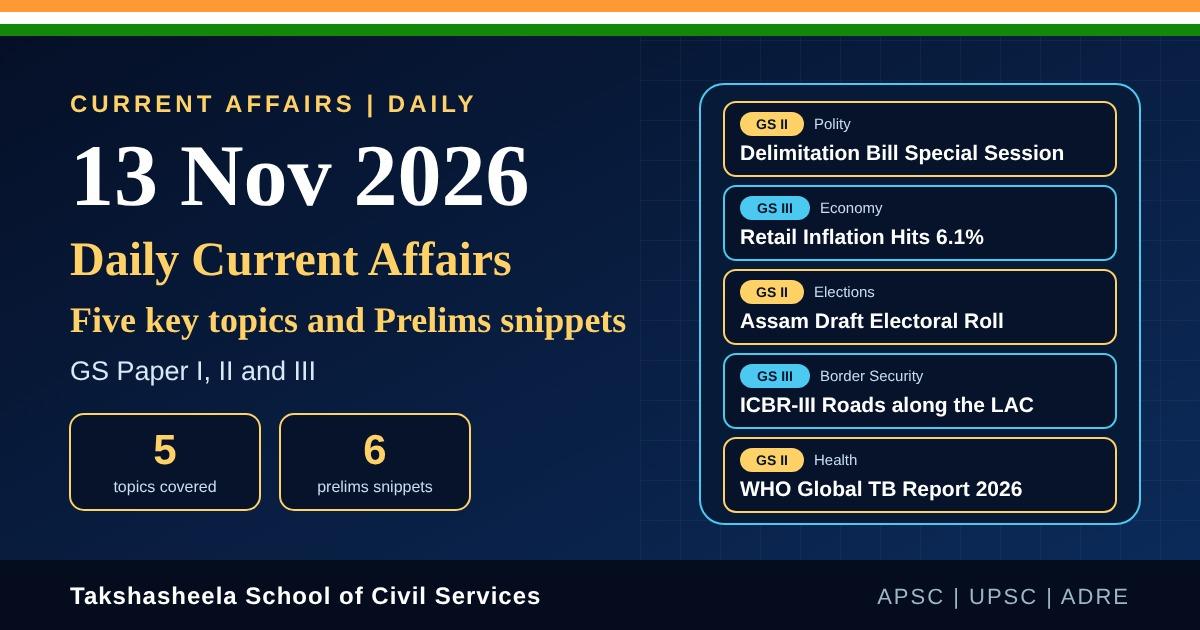
Today’s Topics at a Glance
| Topic | UPSC Relevance | APSC Relevance |
|---|---|---|
| 1. Centre Mulls Special Session to Pass Delimitation Bill | GS Paper II – Polity, Parliament, Women’s Reservation | GS Paper II |
| 2. Retail Inflation Crosses RBI’s Limit at 6.1% | GS Paper III – Economy, Monetary Policy | GS Paper III |
| 3. Assam’s Draft Electoral Roll under Special Summary Revision | GS Paper II – Elections, Representation | GS Paper II; GS Paper V (Assam) |
| 4. ICBR-III: New Border Infrastructure in Arunachal Pradesh | GS Paper III – Internal & Border Security; GS Paper II – India–China | GS Paper III; GS Paper V (Northeast) |
| 5. WHO Global TB Report 2026: India’s Progress | GS Paper II – Health, Social Sector | GS Paper II |
| 6. Prelims Snippets | GS Paper I, II, III & Prelims | Prelims; GS Paper V (Northeast) |
Centre Mulls Special Session of Parliament to Pass Delimitation Bill
GS Paper II – Polity and Governance
Relevance: UPSC – GS Paper II (Parliament, Constitutional Amendments, Women’s Reservation) | APSC – GS Paper II
Why in News?
- The Centre is considering a Special Session of Parliament to pass the Delimitation Bill, 2026, which the government links to operationalising the Women’s Reservation Act, 2023.
- Government sources claim they have “at least 15–16 more votes than needed”, but the dates and duration of the session have not been disclosed.
- A similar Constitution Amendment Bill failed to get the required numbers in the Lok Sabha during a special sitting of the Budget Session on April 17.
Key Features of the Proposal
- Lok Sabha strength: Increase from 543 seats to a maximum of 850 through delimitation.
- Women’s quota: Paves the way for 33% reservation for women in Parliament and State Legislative Assemblies.
- Census base: The fresh delimitation will be based on the 2011 Census.
- State shares: In April, the Centre told Opposition parties, especially from South India, that it proposed raising every State’s seats by 50% to keep the existing inter-State ratios based on the 1971 Census. There is now talk of an amendment to this effect.
Parliamentary Arithmetic
- A two-thirds majority of members present and voting is needed; the government needs 361 votes.
- The Lok Sabha has 543 seats with three vacancies at present.
- The Monsoon Session was adjourned sine die on August 13 but has not been prorogued. At 91 days, this breaks the previous record of 87 days set in 2008, and allows Parliament to be reconvened at short notice.
Important Concepts
| Term | Meaning |
|---|---|
| Delimitation | Redrawing the boundaries and number of constituencies to reflect population changes |
| Delimitation Commission | Set up under the Delimitation Commission Act; its orders cannot be challenged in court |
| Article 82 / 170 | Readjustment of Lok Sabha and State Assembly seats after each Census |
| Seat freeze | Inter-State allocation frozen on the 1971 Census by the 42nd (1976) and 84th (2001) Amendments |
| 106th Amendment Act, 2023 | Nari Shakti Vandan Adhiniyam – one-third reservation for women, effective after delimitation |
| Sine die vs Prorogation | Sine die ends a sitting indefinitely; prorogation by the President ends the session itself |
Significance
- Enables early implementation of women’s reservation in legislatures.
- Updates representation that has been frozen for five decades.
- A larger House can reduce the very high number of voters per MP.
Challenges
- Southern and smaller States fear a loss of political weight for successfully controlling population.
- Political consensus is lacking; the April attempt failed.
- A larger Parliament needs new infrastructure and changes in procedure.
- Linking women’s reservation to delimitation delays its implementation.
Way Forward
- Build consensus through all-party meetings and consultations with States.
- Protect the federal balance, for example by keeping inter-State ratios.
- Consider separating women’s reservation from the delimitation timeline.
Practice Questions
Prelims Questions
Q1. Consider the following statements:
- The Constitution (106th Amendment) Act, 2023 provides one-third reservation for women in the Lok Sabha and State Legislative Assemblies.
- The inter-State allocation of Lok Sabha seats is currently based on the 1971 Census.
- A Constitution Amendment Bill requires only a simple majority of members present and voting in each House.
Which of the statements given above is/are correct?
A. 1 only
B. 1 and 2 only
C. 2 and 3 only
D. 1, 2 and 3
Answer: B. 1 and 2 only
Mains Questions
- (15 Marks | 250 Words) “Delimitation is a balance between democratic representation and federal fairness.” Discuss in the context of the proposal to expand the Lok Sabha to implement women’s reservation.
Retail Inflation Crosses RBI’s Upper Limit at 6.1% in October
GS Paper III – Indian Economy
Relevance: UPSC – GS Paper III (Inflation, Monetary Policy) | APSC – GS Paper III
Why in News?
- Retail inflation, measured by the Consumer Price Index (CPI), rose to 6.1% in October 2026, crossing the RBI’s upper tolerance limit of 6% for the first time in two years.
- The rise, driven first by food and fuel, has now spread to nearly all sectors; most categories hit highs in the new CPI series.
- The last breach was in October 2024, when inflation was 6.2%.
Category-wise Inflation (October 2026)
| Category | Inflation |
|---|---|
| Food and beverages | 8.5% (series high) |
| Restaurants and accommodation | 10.1% (first double digit) |
| Transport | 5.8% (series high) |
| Clothing and footwear | Nearly 5% (from 3.9%) |
| Education | 4% |
| Information and communication | 3.2% |
| Housing, water, electricity, gas | 2.9% |
| Recreation, sports and culture | 2.5% |
| Health | 2.05% |
Causes
- Supply-side: Higher food and fuel prices; lower sown area for rice, maize, oilseeds, cotton and sugarcane; possible fall in tur output.
- Demand-side: Stronger consumer demand during festive-season buying.
- Spill-over: Higher food and transport costs pushed up restaurant and accommodation prices.
Monetary Policy Framework
- Under Flexible Inflation Targeting, the RBI targets 4% CPI inflation with a band of 2% to 6%.
- The Monetary Policy Committee (MPC) raised the repo rate by 25 basis points to 5.50% in October; analysts expect another 25 bps hike at the December meeting.
- The new CPI series has 2024 as the base year, so sector-wise data is available only from January 2026.
Impact
- Erodes the purchasing power of poor and middle-class households.
- Higher interest rates can slow investment and growth.
- Real wages and savings fall.
Way Forward
- Use buffer stocks and open market sales to cool food prices.
- Ease import duties on pulses and edible oils where needed.
- Coordinate fiscal and monetary policy.
- Invest in storage, cold chains and crop diversification for long-term price stability.
Practice Questions
Prelims Questions
Q1. Consider the following statements regarding inflation targeting in India:
- The RBI’s inflation target is 4% CPI inflation with a tolerance band of ±2%.
- The new CPI series has 2024 as its base year.
- The repo rate is decided by the Union Finance Ministry.
Which of the statements given above is/are correct?
A. 1 only
B. 1 and 2 only
C. 2 and 3 only
D. 1, 2 and 3
Answer: B. 1 and 2 only
Mains Questions
- (10 Marks | 150 Words) Retail inflation in India has crossed the RBI’s tolerance band despite being largely supply-driven. Examine the limits of monetary policy in tackling such inflation and suggest complementary measures.
Assam’s Draft Electoral Roll Published under Special Summary Revision
GS Paper II – Elections (Assam Focus)
Relevance: UPSC – GS Paper II (Elections, Election Commission) | APSC – GS Paper II, GS Paper V (Assam)
Why in News?
- The Draft Electoral Roll for the Special Summary Revision (SSR) of Photo Electoral Rolls, with January 1, 2027 as the qualifying date, was published on November 12 for all 126 Assembly Constituencies of Assam.
- The draft roll shows a net increase of 2,18,771 electors over the previous final roll.
Key Figures
| Category | Number |
|---|---|
| Total electors | 2,51,76,910 |
| Male electors | 1,25,87,650 |
| Female electors | 1,25,88,939 |
| Third gender electors | 321 |
| Persons with Disabilities | 2,05,962 |
| Young electors (18–19 years) | 2,87,233 |
| Electors aged 85 and above | 1,22,198 |
| Previous final roll (Feb 10, 2026) | 2,49,58,139 |
| Added / Deleted | 4,12,344 / 1,93,573 |
Key Observations
- Gender balance: Female electors slightly outnumber male electors in the draft roll.
- Youth: Nearly 2.9 lakh electors are in the 18–19 age group.
- Clean-up: About 1.94 lakh names were deleted during continuous revision, for reasons such as deaths, shifting or duplication.
About Electoral Roll Revision
- Summary Revision: Done every year; the existing roll is published as a draft and claims and objections are invited.
- Intensive Revision: The roll is prepared afresh through door-to-door enumeration, as in the ongoing Special Intensive Revision (SIR) in several States.
- Electoral Registration Officer (ERO): Prepares the roll for each constituency under the Representation of the People Act, 1950.
- Four qualifying dates: Since 2022, young citizens can apply in advance with January 1, April 1, July 1 or October 1 as the qualifying date.
Constitutional and Legal Provisions
| Provision | Content |
|---|---|
| Article 324 | Superintendence, direction and control of elections by the ECI |
| Article 325 | One general electoral roll; no exclusion on grounds of religion, race, caste or sex |
| Article 326 | Elections on the basis of adult suffrage (18 years) |
| RP Act, 1950 | Preparation and revision of electoral rolls |
Significance for Assam
- An accurate roll is vital in a State where citizenship and illegal migration are politically sensitive.
- Inclusion of first-time voters, women and PwD electors strengthens participation.
- Claims and objections let citizens correct errors before the final roll.
Challenges
- Wrongful deletions and duplicate entries.
- Low registration among migrant workers and people in char (riverine) areas.
- Disputes linked to ‘D’ (doubtful) voters and the NRC process.
Practice Questions
Prelims Questions
Q1. Consider the following statements:
- Article 326 of the Constitution provides for elections on the basis of adult suffrage.
- Electoral rolls are prepared under the Representation of the People Act, 1950.
- In Assam’s draft electoral roll published in November 2026, male electors outnumber female electors.
Which of the statements given above is/are correct?
A. 1 only
B. 1 and 2 only
C. 2 and 3 only
D. 1, 2 and 3
Answer: B. 1 and 2 only
Mains Questions
- (10 Marks | 150 Words) “An accurate electoral roll is the foundation of free and fair elections.” Discuss the challenges in maintaining clean electoral rolls in a State like Assam.
ICBR-III: New Border Infrastructure Sanctioned along the LAC in Arunachal Pradesh
GS Paper III – Internal Security and Border Management
Relevance: UPSC – GS Paper III (Border Security), GS Paper II (India–China Relations) | APSC – GS Paper III, GS Paper V (Northeast)
Why in News?
- The Indo-Tibetan Border Police (ITBP) has sanctioned new border infrastructure in Arunachal Pradesh amid continuing face-offs with the Chinese Army along the Line of Actual Control (LAC) since late July.
- In February, the Cabinet Committee on Security (CCS) cleared the third phase of the India-China Border Roads (ICBR-III) project, under which 26 roads are to be built along the LAC in Arunachal Pradesh.
- This is only the second critical road project sanctioned along the China border since the 2020 Galwan clashes.
Phases of the ICBR Project
| Phase | Details |
|---|---|
| ICBR-I (2005) | Union Home Ministry to build 27 priority roads, 608 km long, along the China border |
| ICBR-II (Sept 21, 2020) | 32 roads, 683 km, approved months after the Galwan clashes |
| ICBR-III (Feb 2026) | 26 roads along the LAC in Arunachal Pradesh |
Other Recent Works
- Since September, the ITBP has authorised 15 pedestrian suspension bridges and 18 log bridges in Upper Subansiri and Kurung Kumey districts, which border China.
- In December 2020, the MHA approved 18 pedestrian tracks, with foot suspension bridges, log bridges and staging camps, totalling 598.27 km.
Context
- Former ITBP Director-General Shatrujeet Kapur said on October 22 that face-offs with Chinese troops were continuing at several locations in Arunachal Pradesh.
- He stressed investment in drone and counter-drone technology, since China has heavily modernised its weapons and infrastructure.
- At the 18th BRICS Summit in New Delhi (September 11–13), attended by President Xi Jinping, PM Modi said peace and tranquillity in border areas is essential for bilateral ties.
Significance
- Operational readiness: Faster movement of troops and supplies to forward posts.
- Countering China: China has built extensive roads, rail and ‘xiaokang’ border villages on its side.
- Border population: Better connectivity for remote villages, stopping out-migration (linked to the Vibrant Villages Programme).
Challenges
- Difficult terrain, landslides and a short working season.
- Environmental clearances in ecologically fragile Himalayan areas.
- Risk of escalation with China during construction.
Way Forward
- Time-bound completion with better coordination between the BRO, the ITBP and the States.
- Use technology such as drones and surveillance for border management.
- Combine infrastructure with economic development of border villages.
Practice Questions
Prelims Questions
Q1. Consider the following statements about the India-China Border Roads (ICBR) project:
- The first phase of ICBR was initiated in 2005.
- The second phase of ICBR was approved in 2020, after the Galwan clashes.
- Upper Subansiri and Kurung Kumey districts of Arunachal Pradesh border China.
Which of the statements given above is/are correct?
A. 1 only
B. 1 and 2 only
C. 2 and 3 only
D. 1, 2 and 3
Answer: D. 1, 2 and 3
Mains Questions
- (15 Marks | 250 Words) Border infrastructure is central to India’s strategy along the LAC. Discuss the significance of projects like ICBR in Arunachal Pradesh and the challenges in their implementation.
WHO Global TB Report 2026: India Records 38% Drop in TB Mortality since 2015
GS Paper II – Health and Social Justice
Relevance: UPSC – GS Paper II (Health, Government Schemes), GS Paper III (Science) | APSC – GS Paper II
Why in News?
- According to the World Health Organization’s Global Tuberculosis Report 2026, India has recorded a 38% reduction in TB mortality since 2015, against a global average of 35%.
- India achieved a 94% treatment success rate among patients with drug-susceptible TB.
Key Findings of the Report
- Deaths: A total of 1.13 million people died of TB in 2025.
- Regions: South-East Asia recorded the most new TB cases (35%), followed by the Western Pacific (27%) and Africa (25%).
- High-burden countries: About 88% of new cases occurred in 30 countries.
- Catastrophic costs: About 50% of TB patients and their households face total costs above 20% of household income.
- Risk factors: HIV, undernutrition, diabetes and tobacco use raise the risk of falling ill.
- MDR-TB: Multidrug-resistant TB remains a public health crisis and a health security threat.
Share of New TB Cases (Top Countries)
| Country | Share |
|---|---|
| India | About 25% |
| Indonesia | 10% |
| Philippines | 6.8% |
| China | 6.5% |
| Pakistan | 6.4% |
| Nigeria | 4.9% |
| DR Congo | 3.9% |
| Bangladesh | 3.7% |
India’s Initiatives
| Initiative | Objective |
|---|---|
| National TB Elimination Programme (NTEP) | Goal to end TB ahead of the SDG target of 2030 |
| TB Mukt Bharat Abhiyaan | Intensified screening; over 25 crore people screened (Dec 7, 2024 – Nov 8, 2026) |
| Ni-kshay Poshan Yojana | Monthly nutrition support to TB patients via DBT |
| Pradhan Mantri TB Mukt Bharat Abhiyaan | Ni-kshay Mitras adopt patients for community support |
| Ni-kshay portal | Online notification and tracking of TB patients |
Challenges
- India still carries the highest TB burden in the world.
- Drug-resistant TB needs long and costly treatment.
- Under-reporting from the private sector.
- Malnutrition and poverty fuel the disease; high out-of-pocket costs.
Way Forward
- Expand rapid molecular testing and newer short regimens for MDR-TB.
- Strengthen nutrition support and social protection.
- Involve the private sector and communities in notification and care.
- Address social determinants such as housing, sanitation and tobacco use.
Practice Questions
Prelims Questions
Q1. Consider the following statements regarding the WHO Global Tuberculosis Report 2026:
- India’s TB mortality has declined by 38% since 2015.
- The African Region recorded the largest share of new TB cases.
- About half of TB patients and their households face catastrophic costs.
Which of the statements given above is/are correct?
A. 1 only
B. 2 only
C. 1 and 3 only
D. 1, 2 and 3
Answer: C. 1 and 3 only
Mains Questions
- (10 Marks | 150 Words) India has made notable progress in reducing TB mortality, yet remains the country with the highest TB burden. Critically examine the gaps in India’s TB elimination strategy.
Prelims Snippets
Quick Facts from Today’s Newspapers
1. India–Bangladesh Consular Dialogue Postponed (GS Paper II – International Relations)
- The fifth India–Bangladesh consular dialogue, scheduled for November 17–18 in Dhaka at the level of Directors-General, has been postponed.
- The main reason is tension over former PM Sheikh Hasina’s announcement that she will return to Bangladesh next month; she has been in India since August 5, 2024.
- The agenda included border management, visa procedures and repatriation of detained citizens. The last dialogue was held in New Delhi on May 29, 2024.
2. Ladakh: Leh Apex Body Begins Indefinite Protest (GS Paper II – Polity)
- The Leh Apex Body (LAB) began an indefinite sit-in at the NDS Memorial Park in Leh over the MHA’s failure to resume talks and the holding of hill council elections in peak winter.
- Its six demands include a meeting of the MHA Sub-Committee, release of the judicial inquiry report on the September 24 incident, withdrawal of cases and an independent Delimitation Commission.
- Climate activist Sonam Wangchuk was restricted to his residence under Section 163(1) of the BNSS.
3. Caste Enumeration in Census 2027 (GS Paper II – Social Justice)
- The All India Caste Census Coordination Committee called for a nationwide protest at Ramlila Maidan, New Delhi, on November 28.
- It wants a drop-down menu with unique codes for all castes (SC, ST, OBC and General) in the Population Enumeration phase.
- The Centre has decided to record caste through an open column for everyone other than SCs and STs.
4. Chhath Puja and Pushkar Fair (GS Paper I – Art & Culture)
- Chhath Puja is a four-day festival dedicated to the Sun God, observed mainly in Bihar, Uttar Pradesh, West Bengal and Jharkhand.
- In Delhi, an 11-km Chhath ghat along both banks of the Munak Canal was inaugurated at a cost of ₹115.29 crore.
- The annual Pushkar fair in Ajmer, Rajasthan, features folk music, dance and livestock (camel) trading.
5. Northeast in News (APSC – GS Paper V)
- Manipur boxer L. Ambekar Meetei won a historic gold medal at the Youth Olympics.
- Manipur’s draft electoral rolls under the Special Summary Revision list 19.94 lakh voters.
- A Kuki woman was killed and two men injured in an attack near Taphou Kuki village, on the Kangpokpi–Senapati boundary.
6. Science, Tech & Business (GS Paper III)
- IIT-Kharagpur will offer postgraduate (PG) medical courses.
- Nvidia CEO Jensen Huang resigned; CFO Colette Kress was named interim chief executive.
- OpenAI now allows enterprises to process AI requests within India, expanding its data residency offer.