Karbi Anglong Dances into the Guinness World Records
Source: The Assam Tribune
Syllabus: GS Paper I – Indian culture: folk dances; tribal communities of Assam | GS Paper II – Sixth Schedule and autonomous councils | GS Paper III – Internal security: peace accords in the Northeast
Why in News?
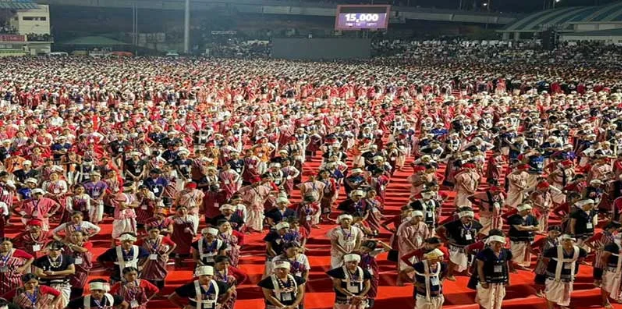
Around 15,000 dancers from 17 indigenous tribes and communities performed the Karbi Nimso Kerung folk dance at KASA Stadium, Diphu, on 16 November 2026, setting a Guinness World Record for the largest folk dance performance.
The event marked the 75th Karbi Anglong Day (Platinum Jubilee), commemorating the creation of the district on 17 November 1951.
About Nimso Kerung
Meaning: “Nimso” means maiden and “kerung” refers to picking up the maiden for the dance.
Ritual context: Traditionally performed by the village youth during Chomangkan, the Karbi ceremony held in honour of deceased family members. It is a joyful dance even in a ritual for the dead.
The Karbi People: Society and Culture
Origin and Distribution
Identity: The Karbis call themselves “Arleng” (people); they were earlier called “Mikir”. Racially Mongoloid and linguistically Tibeto-Burman, they speak the Karbi language.
Migration: Tibeto-Burman speakers are believed to have originated in western China near the Yangtze and Huang He (Hwang-ho) rivers, and to have moved down the Brahmaputra, Chindwin and Irrawaddy into India and Myanmar.
Distribution: The principal tribe of Karbi Anglong; also found in Dima Hasao, Kamrup, Morigaon, Nagaon, Golaghat, Sribhumi (formerly Karimganj), Lakhimpur and Sonitpur districts of Assam, in Papum Pare (Arunachal Pradesh), the Jaintia, Ri Bhoi and East Khasi Hills (Meghalaya) and Dimapur (Nagaland).
Population: About 4.21 lakh enumerated as Scheduled Tribe in the 2011 Census, with about 5.29 lakh Karbi speakers; the third largest tribal community of Assam, after the Bodos and the Mishings.
Society, Belief and Way of Life
Clans: A patriarchal society divided into five major clans (kur): Ingti, Terang, Enghee (Lekthe), Teron and Timung, each with many sub-clans. Clans are exogamous: members of a clan regard one another as brothers and sisters and cannot marry within it.
Belief system: A large majority follow the traditional animistic faith, Hemphu Mukrang, which believes in reincarnation and honours ancestors.
Youth institution: The Jirkedam (also Terang Ahem or Farla) is the traditional bachelors’ dormitory where the young learn songs, dances and social duties.
Livelihood: Traditionally practised jhum (shifting) cultivation, clearing and burning forest patches; in earlier times villages moved once the soil of an area was exhausted.
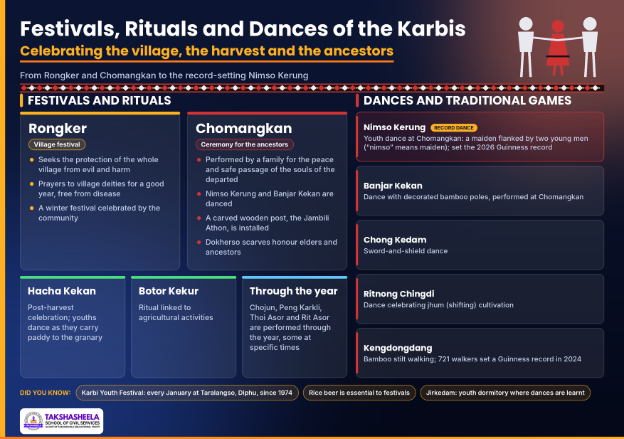
Festivals, Rituals and Dances of the Karbi People
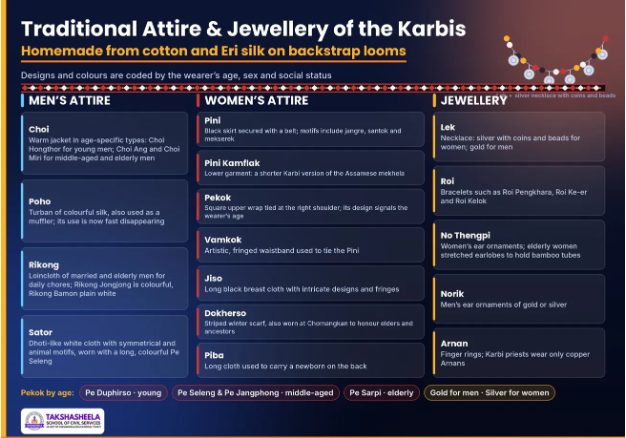
Traditional Attire and Jewellery
Evolution of the Karbi Anglong Autonomous Council
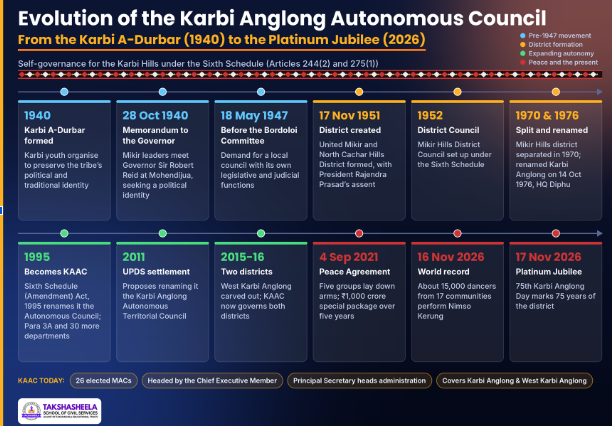
Karbi Anglong Peace Agreement, 2021
Signatories: Centre, Assam government and five groups: KLNLF, PDCK, UPLA, KPLT and KLF; signed on 4 September 2021 in New Delhi.
Surrender: More than 1,000 armed cadres had laid down arms in February 2021.
Package: A special development package of ₹1,000 crore over five years (₹500 crore each from the Centre and Assam).
Significance
Unity in diversity: The participation of 17 tribes and communities in a Karbi dance projects inter-community harmony in a district with a history of ethnic tension.
Tourism and livelihoods: Boosts cultural and eco-tourism (Karbi Youth Festival, Kaziranga’s hills) and demand for handloom attire and traditional instruments.
Soft power and Act East: Northeast culture becomes part of India’s cultural diplomacy with South-East Asia.
Conclusion
The Guinness World Record achieved through the Nimso Kerung performance is more than a celebration of cultural heritage; it reflects the enduring vitality of Karbi traditions and the spirit of collective identity. Preserving such indigenous practices, alongside strengthening autonomous governance and post-peace accord development, is essential to ensuring that cultural recognition translates into inclusive growth, social harmony and lasting peace in the Northeast.
Asam Sahitya Sabha Confers ‘Sadasya Mahiyan’
Syllabus: GS Paper I – Indian culture: language and literature | GS Paper II – Eighth Schedule and official languages
Why in News?
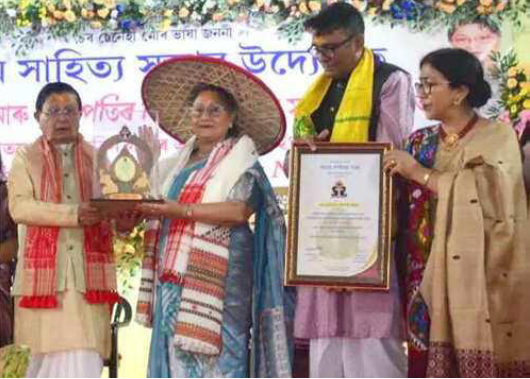
The Asam Sahitya Sabha has conferred its apex honorary title, ‘Sadasya Mahiyan’, for the 2025–27 term on Dr Malini Goswami. She is a researcher, translator and critic, and was the first Vice-Chancellor of Assam Women’s University.
About Dr Malini Goswami
Dr Malini Goswami belongs to a rare group of Assamese scholars who move easily between Sanskrit and Assamese. Her work covers classical texts, manuscripts, dictionaries and translation. Her career shows how strong classical (Oriental) scholarship supports the modern literary identity of a regional language.
About the Asam Sahitya Sabha
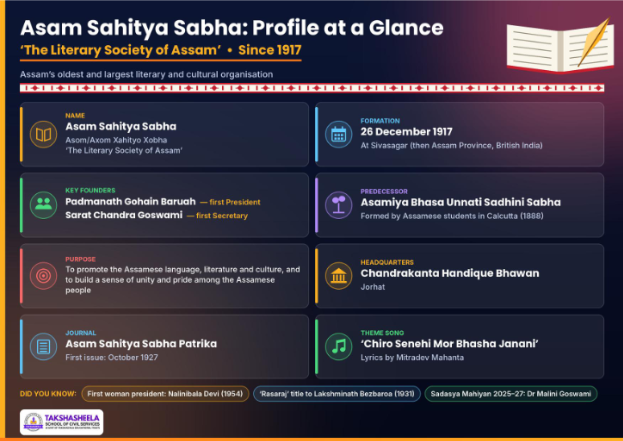
The Asam Sahitya Sabha (অসম সাহিত্য সভা), known as ‘The Literary Society of Assam’, is a non-governmental, non-profit literary organisation. It was founded in December 1917 to promote the language, literature and culture of Assam. It is the state’s oldest and largest literary and cultural body and is widely treated as the standard-setting authority for the Assamese language.
Assamese Language and Literature: From Charyapada to Classical Status
Family: Indo-Aryan, from the eastern branch of Magadhi Prakrit. It is closely related to Bengali and Odia.
Constitutional status: One of the original 14 languages in the Eighth Schedule.
Official language: Under the Assam Official Language Act, 1960 (with Bengali in Barak Valley and Bodo in the Bodoland region).
Classical status: Conferred on 3 October 2024 along with Marathi, Pali, Prakrit and Bengali. This brought India’s classical languages to 11.
Quad Leaders Meet in Manila
Syllabus: GS Paper II – Bilateral, regional and global groupings and agreements involving India | GS Paper III – Maritime security, cyber security, critical minerals, emerging technologies
Why in News?
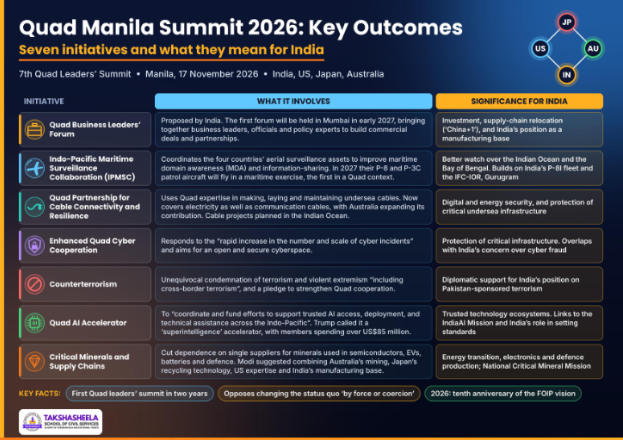
The Quad Leaders’ Summit was held in Manila on 17 November 2026, on the sidelines of the ASEAN-led summits. It was the leaders’ first meeting in about two years, and the 7th Quad Leaders’ Summit overall. Prime Minister Narendra Modi, US President Donald Trump, Japan’s PM Sanae Takaichi and Australia’s PM Anthony Albanese attended.
Outcomes of the Manila Quad Summit
About the Quad
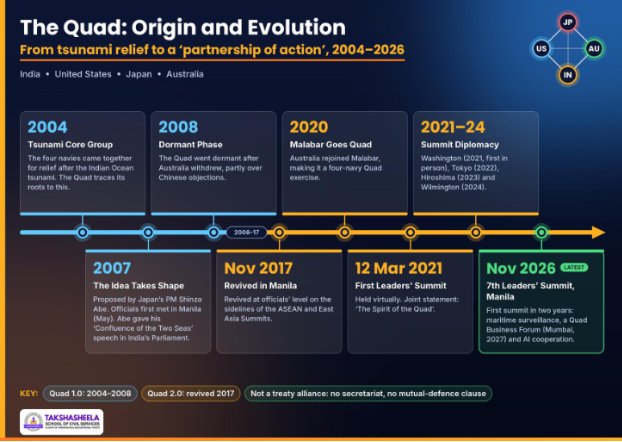
The Quadrilateral Security Dialogue (Quad) is an informal strategic forum of four maritime democracies: India, the United States, Japan and Australia. It works for a free, open, inclusive and rules-based Indo-Pacific. It is not a treaty alliance: it has no mutual-defence clause, no secretariat and no charter. It works through leaders’ summits, foreign ministers’ meetings, senior officials’ meetings and working groups.
Origin and Evolution
The Quad’s Flagship Initiatives
Area | Initiatives |
|---|---|
Health | Quad Vaccine Partnership (2021); Quad Cancer Moonshot (2024), on cervical cancer in the Indo-Pacific |
Maritime | Indo-Pacific Partnership for Maritime Domain Awareness (IPMDA) (Tokyo, 2022); Quad-at-Sea Ship Observer Mission; MAITRI training initiative; Ports of the Future Partnership; IPMSC (2026) |
Technology | Critical and Emerging Technology Working Group; semiconductor supply chain initiative; Open RAN and 5G; principles on technology standards; AI Accelerator |
Infrastructure and connectivity | Quad Infrastructure Fellowships; Partnership for Cable Connectivity and Resilience (2023); Fiji port project (2026) |
Economic security | Critical Minerals Initiative (2025) and Framework (2026) |
HADR and climate | Quad HADR partnership; Indo-Pacific Logistics Network; climate and clean-energy cooperation |
Defence-adjacent | Malabar naval exercise – its 30th edition was held near Japan in November 2026, focused on anti-submarine and anti-surface warfare; maritime patrol aircraft exercise planned for 2027 |
Significance of the Quad
1. Strategic and Geopolitical
Balancing in the Indo-Pacific: The Quad helps maintain a balance of power in which no single country can dominate the region’s sea lanes, choke points or rules.
Rules-based order: It upholds UNCLOS (1982), freedom of navigation and overflight, peaceful settlement of disputes, and respect for sovereignty and territorial integrity. These principles matter for the South China Sea, the East China Sea and the Taiwan Strait.
2. Maritime Security
Maritime domain awareness: IPMDA (Indo-Pacific Partnership for Maritime Domain Awareness) gives Indo-Pacific partners commercial satellite data to track ‘dark shipping’ and illegal, unreported and unregulated (IUU) fishing.
Securing sea lanes: About 95% of India’s trade by volume travels by sea.
Undersea infrastructure: The cable partnership protects the submarine cables that carry most international data and, increasingly, electricity.
3. Economic Security and Supply Chains
De-risking: The Quad helps diversify supply chains for critical minerals, semiconductors, pharmaceuticals and clean-energy technology, reducing reliance on one dominant supplier. The 2026 Critical Minerals Initiative Framework pools Australia’s resources, Japan’s processing and recycling technology, US capital and India’s manufacturing scale.
Countering economic coercion: By naming “arbitrary export restrictions” as coercion, the Quad sets a collective norm against weaponising trade.
4. Technology and Cyber
Trusted technology: The Critical and Emerging Technology Working Group, Open RAN projects, technology standards principles and the AI Accelerator promote secure, transparent and rights-respecting technology.
Cybersecurity: Joint work on protecting critical infrastructure, software security and resilience against ransomware and state-sponsored attacks.
5. Public Goods for the Indo-Pacific
Health: The Quad Vaccine Partnership supplied COVID-19 vaccines to the region. The Cancer Moonshot targets cervical cancer, which India’s vaccine manufacturing helps address.
Disaster relief: The Quad’s roots in the 2004 tsunami response, its HADR partnership and its logistics network make it a first responder in a disaster-prone region.
Climate and clean energy: Green shipping, clean hydrogen, climate information services and disaster-resilient infrastructure (in line with India’s CDRI).
Challenges
Weak institutions: No secretariat, irregular summits and a hosting rotation that has effectively stalled; momentum depends on the personal priorities of leaders.
Transactional US policy: Tariffs, Trump’s outreach to Xi and Putin, and uncertain commitments raise fears of a US-China ‘G2’ that bypasses partners.
New maritime threats: Attacks on commercial shipping in West Asia, grey-zone tactics, and the vulnerability of undersea cables.
Cyber-scam industry: Transnational crime syndicates in weakly governed border zones of Southeast Asia are hard to dismantle without regional cooperation.
Way Forward
Regular summits: Agree a fixed calendar, with India hosting the next leaders’ summit, and a light coordination mechanism to ensure follow-through.
Delivery first: Set measurable targets for critical minerals (joint processing, recycling, stockpiles), cables and the AI Accelerator. Publish annual progress reports.
Work through ASEAN: Run projects through ASEAN mechanisms and the IPOI so the Quad is seen as a provider of public goods, not a bloc.
Conclusion
The Quad must evolve from a strategic dialogue into an outcome-oriented partnership that delivers tangible regional public goods. By strengthening maritime security, diversifying critical supply chains and fostering technological resilience while respecting ASEAN centrality, it can contribute to a stable, inclusive and rules-based Indo-Pacific.
Previous Years’ Questions
Q1. [UPSC CSE Prelims 2015] India is a member of which among the following?
Asia-Pacific Economic Cooperation
Association of South-East Asian Nations
East Asia Summit
Select the correct answer using the code given below:
(a) 1 and 2 only
(b) 3 only
(c) 1, 2 and 3
(d) India is a member of none of them
Answer: (b)
Explanation: India is a founding member of the EAS (2005). It is not a member of APEC or ASEAN; it is an ASEAN dialogue and comprehensive strategic partner.
Q2. [UPSC CSE Mains 2020, GS-II] ‘Quadrilateral Security Dialogue (Quad)’ is transforming itself into a trade bloc from a military alliance, in present times. Discuss. (250 words, 15 marks)
21st East Asia Summit and 23rd ASEAN-India Summit
Syllabus: GS Paper II – India and its neighbourhood; regional groupings and agreements involving India | GS Paper III – Maritime security; trade and connectivity
Why in News?
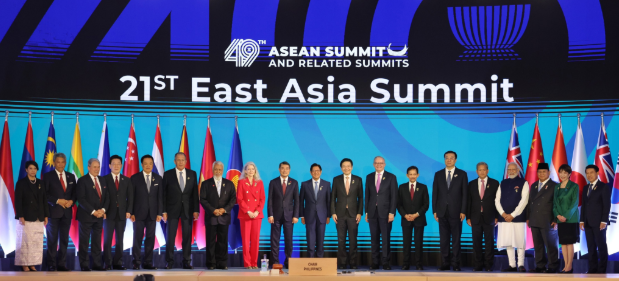
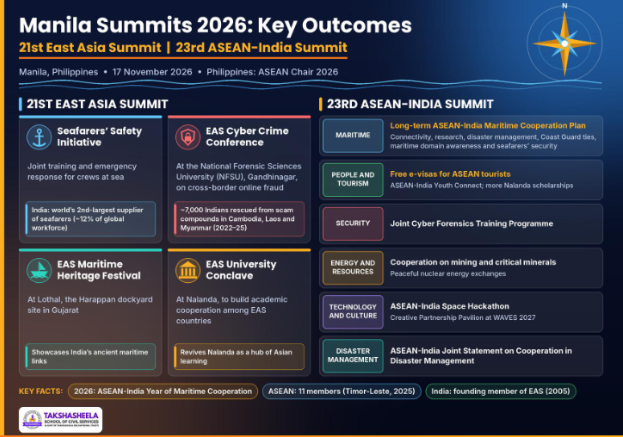
PM Narendra Modi attended the 23rd ASEAN-India Summit and the 21st East Asia Summit (EAS) in Manila on 17 November 2026. The Philippines hosted both as ASEAN Chair for 2026.
Key Outcomes
About the East Asia Summit and ASEAN
India-ASEAN Relations
Economic: Trade of about US$128.4 billion (2025–26), with a deficit of over US$50 billion for India.
Strategic: The ASEAN-India Maritime Exercise (since 2023), ADMM-Plus, BrahMos to the Philippines, and convergence between the IPOI and the ASEAN Outlook on the Indo-Pacific (AOIP).
Connectivity: The India-Myanmar-Thailand Trilateral Highway and the Kaladan project, with the Northeast as India’s land gateway to ASEAN.
People-to-people: Since 2014, over 100 initiatives, about 250 quick-impact projects and over 10,000 scholarships. Direct flights to nine ASEAN countries. Shared Buddhist and Ramayana heritage.
Significance of the East Asia Summit
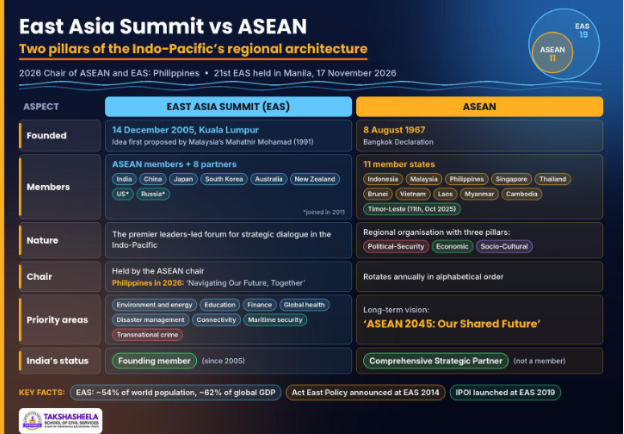
Unique membership: It is the only leaders-level forum that brings together all the major Indo-Pacific powers (the US, China, Russia, India, Japan) with ASEAN. EAS members account for about 54% of the world’s population and 62% of global GDP.
ASEAN centrality: Led by ASEAN, it gives smaller states a say and keeps great-power rivalry in a rules-based, consultative setting.
Platform for India: India used the EAS to announce the Act East Policy (2014) and the Indo-Pacific Oceans Initiative (2019), to revive Nalanda, and now to launch the seafarers’ initiative.
Link between the oceans: The EAS links the Indian Ocean and the Pacific, which supports India’s view of an integrated Indo-Pacific.
Way Forward
Strengthen the EAS: Turn statements into action through working groups with deadlines on maritime safety, cybercrime and disaster relief, while keeping ASEAN centrality.
Seafarer safety framework: Develop the initiative into a regional protocol: joint search and rescue, crisis hotlines and quick repatriation, linked to the IMO and the Maritime Labour Convention.
Joint fight against cyber fraud: An NFSU-led training network, intelligence-sharing, mutual legal assistance, action against money mules, and stricter regulation of overseas recruitment agents.
Economic rebalancing: Conclude a balanced AITIGA review (rules of origin, non-tariff barriers) and expand UPI and digital public infrastructure links.
Conclusion
The East Asia Summit and ASEAN-India Summit reaffirm the importance of ASEAN centrality in shaping an inclusive, stable and rules-based Indo-Pacific order. For India, deeper engagement with ASEAN is not merely a diplomatic priority but a strategic necessity for strengthening maritime security, diversifying economic partnerships and advancing its Act East Policy.
Previous Years’ Questions
Q1. [UPSC CSE Prelims 2015] India is a member of which among the following?
Asia-Pacific Economic Cooperation
Association of South-East Asian Nations
East Asia Summit
Select the correct answer using the code given below:
(a) 1 and 2 only
(b) 3 only
(c) 1, 2 and 3
(d) India is a member of none of them
Answer: (b)
Explanation: India is a founding member of the EAS. It is a Comprehensive Strategic Partner of ASEAN, not a member, and it is not in APEC.