Record FPI Inflows
Syllabus: GS Paper III – Indian economy: mobilisation of resources, investment and the external sector
Why in News?
Foreign Portfolio Investors (FPIs) bought a record US$11.3 billion of Indian equities in November 2026. This is the highest monthly FPI inflow ever.
About Foreign Portfolio Investment (FPI)
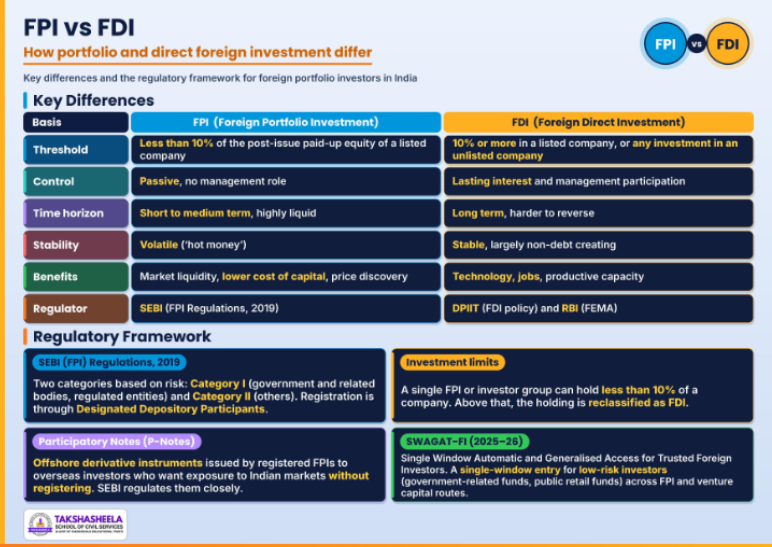
FPI is investment by non-residents in Indian financial assets, such as listed shares, bonds, government securities and mutual fund units, for financial returns rather than management control. Because it can enter and exit quickly, it is often called ‘hot money’.
Significance
Rupee and forex reserves: Large dollar inflows support the rupee and rebuild reserves after the pressure seen during the war months.
Balance of payments: Portfolio inflows help finance the current account deficit, especially when oil prices are volatile.
Cost of capital: Higher valuations make it cheaper for companies to raise equity through IPOs and follow-on offers, supporting investment.
Signal of confidence: Record inflows signal faith in India’s earnings growth and macroeconomic stability relative to other emerging markets.
Challenges and Risks
Dependence on external triggers: The drivers are mostly external (West Asia, the US dollar, AI cycles, crude). Any reversal could trigger sudden stops.
Valuation and bubble risk: Fast rallies can push prices ahead of earnings and leave retail investors exposed.
Pressure on monetary policy: Large flows complicate the RBI’s exchange-rate and liquidity management (the ‘impossible trinity’).
Narrow sector focus: Inflows concentrated in banking and large caps do little for MSMEs or manufacturing capacity.
Previous Years’ Question
Q1. [UPSC CSE Prelims 2020] With reference to Foreign Direct Investment in India, which one of the following is considered its major characteristic?
(a) It is the investment through capital instruments essentially in a listed company.
(b) It is a largely non-debt creating capital flow.
(c) It is the investment which involves debt-servicing.
(d) It is the investment made by foreign institutional investors in the Government securities.
Answer: (b)
Explanation: FDI is a non-debt creating, long-term flow. Option (d) describes portfolio (FPI) debt investment – ‘hot money’, not FDI.
Jan Aushadhi Kendras
Syllabus: GS Paper II – Health; welfare schemes for vulnerable sections | GS Paper III – Inclusive growth
Why in News?
The Pradhan Mantri Bhartiya Janaushadhi Pariyojana (PMBJP) now has 20,547 Jan Aushadhi Kendras (JAKs) (end of July 2026), up from 17,990 in December 2025. The target is 25,000 by March 2027.
Citizens are estimated to have saved about ₹9,000 crore in 2025–26 and about ₹45,000 crore over 12 years.
About PMBJP
Aspect | Details |
|---|---|
Origin | Launched in 2008 as the Jan Aushadhi Scheme; revamped in 2015 and renamed PMBJP in 2016 |
Ministry | Department of Pharmaceuticals, Ministry of Chemicals and Fertilizers |
Implementing agency | Pharmaceuticals and Medical Devices Bureau of India (PMBI) |
Objective | Quality generic medicines at affordable prices, lower out-of-pocket expenditure (OOPE), and self-employment for entrepreneurs |
Quality assurance | Supplies only from WHO-GMP-certified manufacturers; every batch is tested at NABL-accredited labs |
Other Health Sector Initiatives: Centre and Assam
[Insert image: 19nov-02-health-initiatives-centre-assam.png]
Significance
Lower out-of-pocket spending: Medicines make up about 60–70% of household OOPE on health. Outpatient drug costs are largely not covered by insurance schemes such as AB PM-JAY. Jan Aushadhi addresses this directly.
Protection from poverty: Lower drug bills reduce catastrophic health spending and distress borrowing among households close to the edge.
Use of India’s pharma strength: India supplies about one-fifth of the world’s generic medicines. The scheme turns this into domestic welfare.
Jobs and inclusion: Kendras create self-employment, with extra incentives for women, SC/ST entrepreneurs and the North East.
Path to universal health coverage: Affordable medicines complement Ayushman Arogya Mandirs and PM-JAY, in line with SDG 3.8.
Rational drug use: The scheme promotes generic names and counters brand-driven over-pricing.
Challenges
Low public spending on health: Government health expenditure was 1.43% of GDP in 2022–23 (National Health Accounts). This is far below the National Health Policy 2017 target of 2.5% by 2025.
Perception gap: Many people link low price with low quality. The “medicine for the poor” image puts off middle-class buyers.
Supply chain: Stock-outs, gaps in distribution to remote areas and limited product range in some therapeutic categories.
Wider drug quality concerns: Repeated alerts about substandard drugs in the open market hurt trust in generics as a whole.
Conclusion
Jan Aushadhi Kendras represent an important step towards democratising access to affordable healthcare by making quality generic medicines accessible to all. Affordable medicines must therefore become a cornerstone of universal health coverage, ensuring that no household is pushed into poverty merely because of the cost of treatment.
11 States and UTs Declared ‘Fully Literate’ under ULLAS
Syllabus: GS Paper I – Social empowerment | GS Paper II – Education; government policies and interventions
Why in News?
11 States and UTs have declared themselves “fully literate” under ULLAS – Nav Bharat Saaksharta Karyakram. A State or UT that reaches 95% literacy is treated as fully literate.
More than 90.96 lakh learners aged 15 and above have taken the Foundational Literacy and Numeracy Assessment Test (FLNAT) in 2026–27 so far. Madhya Pradesh leads with 20.43 lakh learners.
About ULLAS – Nav Bharat Saaksharta Karyakram
[Insert image: 19nov-03-ullas-fully-literate.png]
Significance
Empowerment and access to entitlements: Literacy lets citizens use welfare schemes, read official documents and make informed decisions, so they depend less on intermediaries.
Women’s empowerment and benefits for the next generation: Women are a large share of adult non-literates. Literacy among women is closely linked to better maternal and child health, nutrition and schooling.
Digital and financial inclusion: Basic literacy, together with life skills, helps people use digital payments, DBT and e-governance services effectively and safely.
Human capital and productivity: Basic literacy is needed before skilling and formal employment, and it is essential if India is to benefit from its demographic dividend.
Progress towards national and global goals: The programme advances the NEP 2020 vision of universal adult literacy and SDG 4.6. It also shows that a low-cost, community-driven approach can deliver results.
Challenges
Measurement and verification: Full-literacy status is based on State-level surveys and assessments. With no Census data since 2011, there is little independent verification.
Large States with high non-literacy: Populous States such as Madhya Pradesh, Rajasthan, Bihar and Uttar Pradesh account for a large share of adult non-literates, which makes universal literacy harder to reach.
Social and regional gaps: Gaps between men and women and between rural and urban areas remain. Tea garden workers, tribal communities and migrants need targeted programmes.
Conclusion
Achieving full literacy is not merely about the ability to read and write but about enabling individuals to participate meaningfully in social, economic and democratic life. ULLAS must therefore move beyond the attainment of the 95% literacy benchmark towards sustained learning, digital empowerment and equitable access to knowledge, ensuring that no section of society is left behind in India’s journey towards a Viksit Bharat.
Voyager 1 at One Light-Day
Syllabus: GS Paper III – Science and Technology: awareness in the field of space | GS Paper I – Physical geography: the solar system
[Insert image: Voyager 1 header – see note on 19nov-04-voyager-header.png]
Why in News?
On 18 November 2026, NASA’s Voyager 1 became the first human-made object to reach one light-day from Earth, about 25.9 billion km. Radio signals now take 24 hours to travel each way.
Voyager Mission at a Glance
Aspect | Details |
|---|---|
Agency | NASA; operated by the Jet Propulsion Laboratory (JPL) |
Launch | 5 September 1977; Voyager 2 was launched about two weeks earlier, on 20 August 1977 |
Original goal | Flybys of the outer planets using a rare alignment of planets; Voyager 1 passed Jupiter (1979) and Saturn (1980), including a close pass of Titan |
Extended mission | Voyager Interstellar Mission (since 1989–90): studying the boundary of the heliosphere and the interstellar medium |
Distance | 1 light-day = about 25.9 billion km (173 AU), reached on 18 November 2026 |
Speed | About 61,000 km/h (about 17 km/s) |
Farthest spacecraft | Since 17 February 1998, when it overtook Pioneer 10 |
Interstellar space | Crossed the heliopause in 2012; Voyager 2 followed in 2018 and will reach one light-day only in 2035 |
Instruments working | 2 of 10: Magnetometer (MAG) and Plasma Wave Subsystem (PWS); the Low-energy Charged Particles instrument (LECP) was switched off in April 2026 |
Pale Blue Dot | In 1990, before its cameras were switched off, Voyager 1 photographed Earth from about 6 billion km |
Other Significant Space Missions
[Insert image: 19nov-05-significant-space-missions.png]