Indira Gandhi Prize
Syllabus: GS Paper I – Personalities and awards | GS Paper II – International relations: peace, disarmament and development
Why in News?
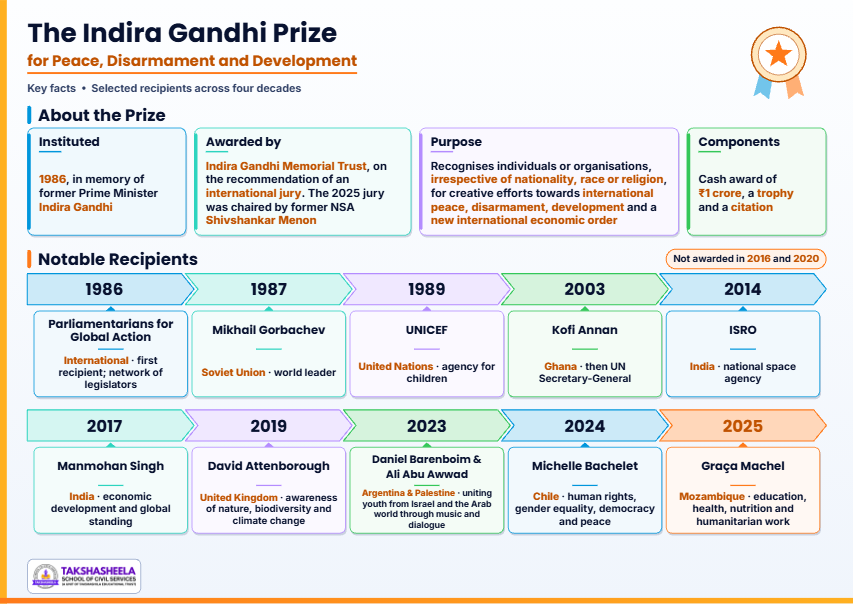
Mozambican stateswoman and women’s and children’s rights advocate Graça Machel was presented the Indira Gandhi Prize for Peace, Disarmament and Development for 2025 in New Delhi on 19 November 2026, the 109th birth anniversary of former Prime Minister Indira Gandhi.
The prize recognises her work in education, health and nutrition, economic empowerment and humanitarian action under difficult circumstances, and her role in inspiring hope in millions for a more equitable and just world.
About the Indira Gandhi Prize
Indira Gandhi Prize and Gandhi Peace Prize
Basis | Indira Gandhi Prize for Peace, Disarmament and Development | Gandhi Peace Prize |
|---|---|---|
Instituted | 1986 | 1995, on the 125th birth anniversary of Mahatma Gandhi |
Conferred by | Indira Gandhi Memorial Trust (a private trust) | Government of India (Ministry of Culture) |
Selection | International jury constituted by the Trust | Jury chaired by the Prime Minister, with the Chief Justice of India, the Leader of the single largest opposition party in the Lok Sabha and two eminent persons |
Award | ₹1 crore, a trophy and a citation | ₹1 crore, a citation, a plaque and a traditional handicraft or handloom item |
Focus | International peace, disarmament and development | Social, economic and political transformation through non-violence and other Gandhian methods |
First recipient | Parliamentarians for Global Action (1986) | Julius Nyerere, former President of Tanzania (1995) |
Previous Years’ Questions
Q1. [UPSC CSE Prelims 2015] Indira Gandhi Prize for Peace, Disarmament and Development for 2014 was given to which one of the following?
(a) Bhabha Atomic Research Centre
(b) Indian Institute of Science
(c) Indian Space Research Organisation
(d) Tata Institute of Fundamental Research
Answer: (c)
Explanation: ISRO received the 2014 prize for four decades of pioneering work in space science and its applications, including the successful Mars Orbiter Mission. ISRO also received the Gandhi Peace Prize for 2014.
Q2. [UPSC CSE Prelims 2025] Who amongst the following are members of the Jury to select the recipient of ‘Gandhi Peace Prize’?
I. The President of India
II. The Prime Minister of India
III. The Chief Justice of India
IV. The Leader of Opposition in the Lok Sabha
Select the correct answer using the code given below:
(a) II and IV only
(b) I, II and III
(c) II, III and IV
(d) I and III only
Answer: (c)
Explanation: The jury for the Gandhi Peace Prize is chaired by the Prime Minister. Its other members are the Chief Justice of India, the Leader of the single largest opposition party in the Lok Sabha, and two eminent persons. The President of India is not a member of the jury.
ICJ Holds Myanmar Responsible for Genocide against the Rohingya
Syllabus: GS Paper II – Important international institutions; effect of policies of other countries on India’s interests | GS Paper IV – Ethics in international relations: human rights
Why in News?
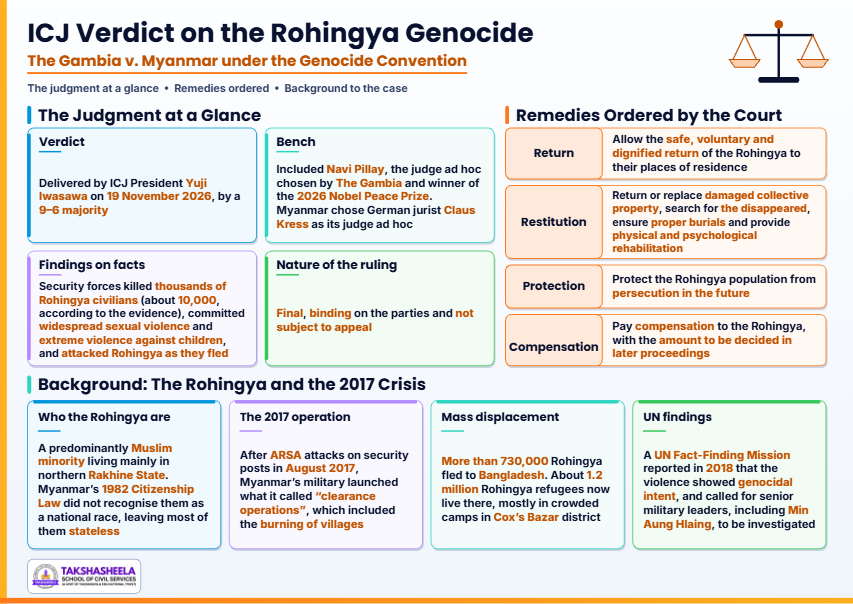
On 19 November 2026, the International Court of Justice (ICJ) ruled in The Gambia v. Myanmar that Myanmar “has committed genocide against the Rohingya group in northern Rakhine State, in violation of its obligations under the Genocide Convention”.
The Judgment at a Glance
The ICJ and the ICC: Key Differences
Basis | International Court of Justice (ICJ) | International Criminal Court (ICC) |
|---|---|---|
Established | 1945 under the UN Charter; principal judicial organ of the UN | 2002 under the Rome Statute; independent of the UN |
Seat | Peace Palace, The Hague | The Hague |
Who is tried | Disputes between states; it decides state responsibility | Individuals accused of genocide, crimes against humanity, war crimes and aggression |
Composition | 15 judges elected for nine years by the UN General Assembly and Security Council, plus judges ad hoc where a party has no judge of its nationality | 18 judges elected by the Assembly of States Parties |
Enforcement | Judgments are binding (Article 94, UN Charter). If a party does not comply, the other party may approach the Security Council | Depends on cooperation of states to arrest and surrender suspects |
India’s position | Member of the UN and party to the ICJ Statute | Not a party to the Rome Statute |
Challenges in Implementation
No direct enforcement: The ICJ has no means of enforcing its rulings. Under Article 94 of the UN Charter, non-compliance can be referred to the Security Council, which has never used this power and where permanent members may differ.
Myanmar’s denial: Myanmar has rejected the genocide allegations throughout, and The Gambia has questioned its compliance reports on the provisional measures ordered in 2020.
Conditions on the ground: With the civil war continuing and the Arakan Army controlling most of Rakhine, conditions for a safe and voluntary return do not yet exist.
Prolonged refugee crisis: Bangladesh hosts about 1.2 million refugees amid declining international funding, and earlier repatriation efforts have not succeeded.
A divided court: The 9–6 split shows that the judges differed on the high threshold of proof for genocidal intent, which Myanmar and its supporters may cite to question the ruling.
Implications for India
Balancing interests and principles: India engages closely with Myanmar for border security, connectivity and the Act East Policy.
Connectivity in Rakhine: Stability in Rakhine is important for the Kaladan Multi-Modal Transit Transport Project and Sittwe Port. The return of the Rohingya and peace in the region are therefore linked to India’s own interests.
Rohingya in India: India regards the Rohingya living in the country without valid documents as illegal migrants, citing security concerns. It is not a party to the 1951 Refugee Convention. The judgment may draw renewed attention to the treatment of Rohingya in India and to the need for a clear national framework on refugees.
Relations with Bangladesh: Bangladesh bears the burden of hosting the refugees, and India has supported it through humanitarian aid such as Operation Insaniyat (2017). It has also built houses in Rakhine to help create conditions for return.
Previous Years’ Questions
Q1. [UPSC CSE Prelims 2016] Consider the following pairs:
Community sometimes mentioned in the news | In the affairs of |
|---|---|
1. Kurd | Bangladesh |
2. Madhesi | Nepal |
3. Rohingya | Myanmar |
Which of the pairs given above is/are correctly matched?
(a) 1 and 2
(b) 2 only
(c) 2 and 3
(d) 3 only
Answer: (c)
Explanation: The Madhesis are people of the Terai plains of Nepal, and the Rohingya are a Muslim minority of Myanmar’s Rakhine State. The Kurds are spread across Turkey, Iraq, Iran and Syria, not Bangladesh, so pair 1 is incorrectly matched.
New Municipal Boards in Assam
Syllabus: GS Paper II – Devolution of powers and finances to local levels; panchayats and municipalities
Why in News?
The Assam Cabinet approved six new municipal boards in Lakhimpur, Majuli, Cachar and Kamrup districts to strengthen urban governance. The Cabinet has also increased the monthly remuneration of elected representatives of Zila Parishads, Anchalik Panchayats and Gaon Panchayats.
Six New Municipal Boards
Municipal Board | District |
|---|---|
Laluk | Lakhimpur |
Harmutti-Bamunbari | Lakhimpur |
Ghilamara | Lakhimpur |
Majuli | Majuli |
Udarbond | Cachar |
Mirza-Bijoynagar | Kamrup |
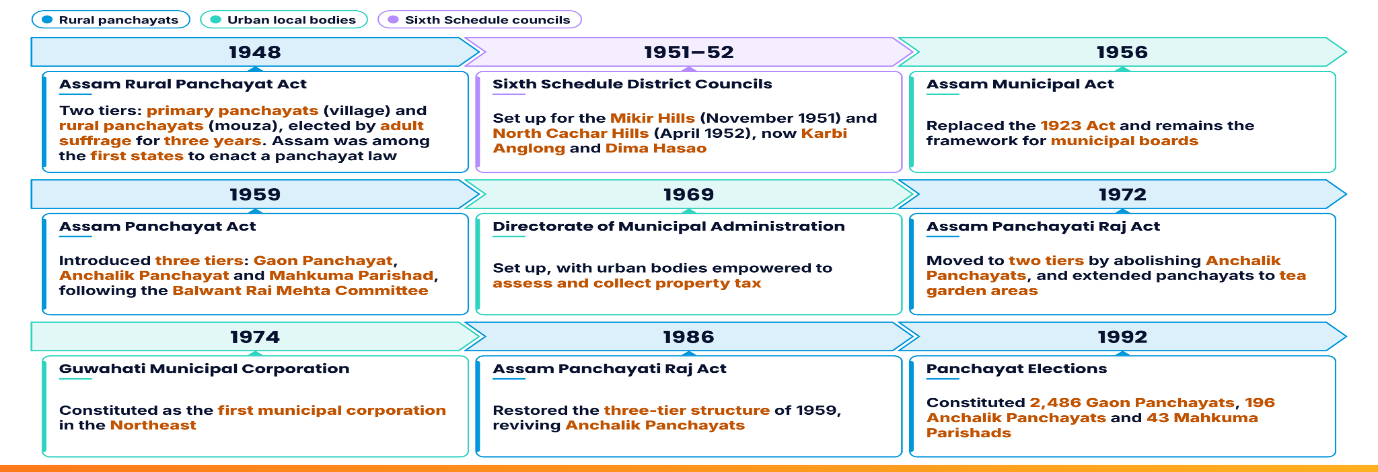
Evolution of Local Governance in Assam
After Independence (1948–1992)
Local Governance in India
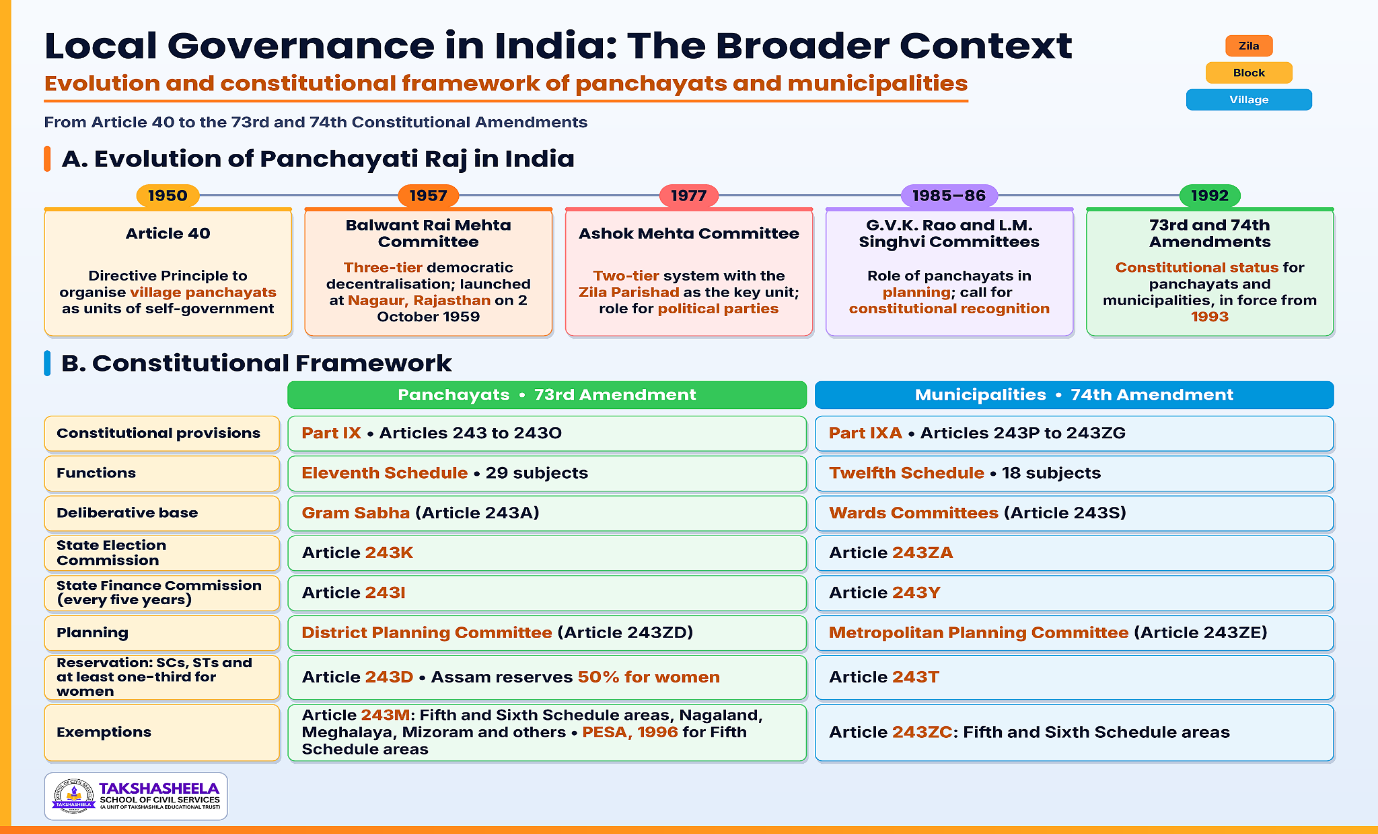
Funding support: The Sixteenth Finance Commission has recommended ₹3.56 lakh crore for urban local bodies for 2026–31, 45% of all local body grants.
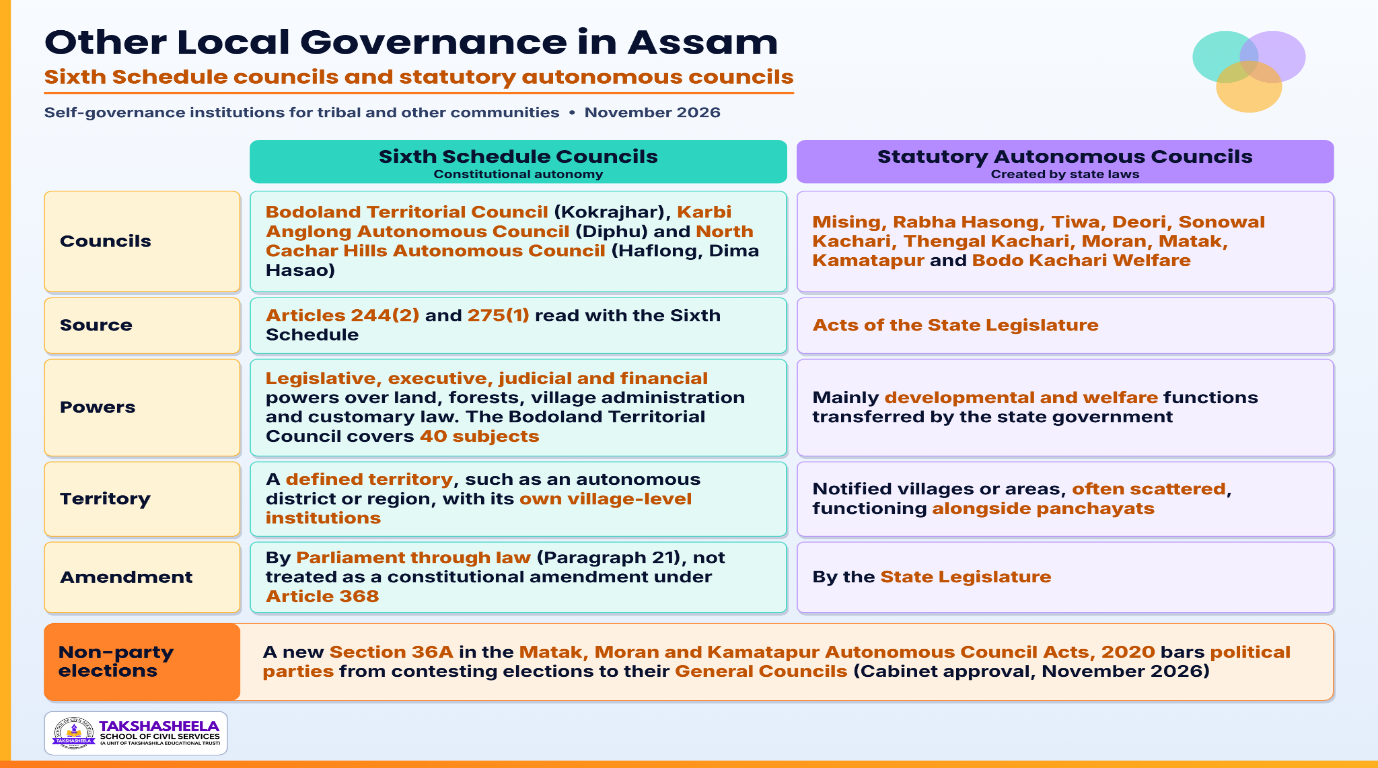
Other Local Governance Structures in Assam
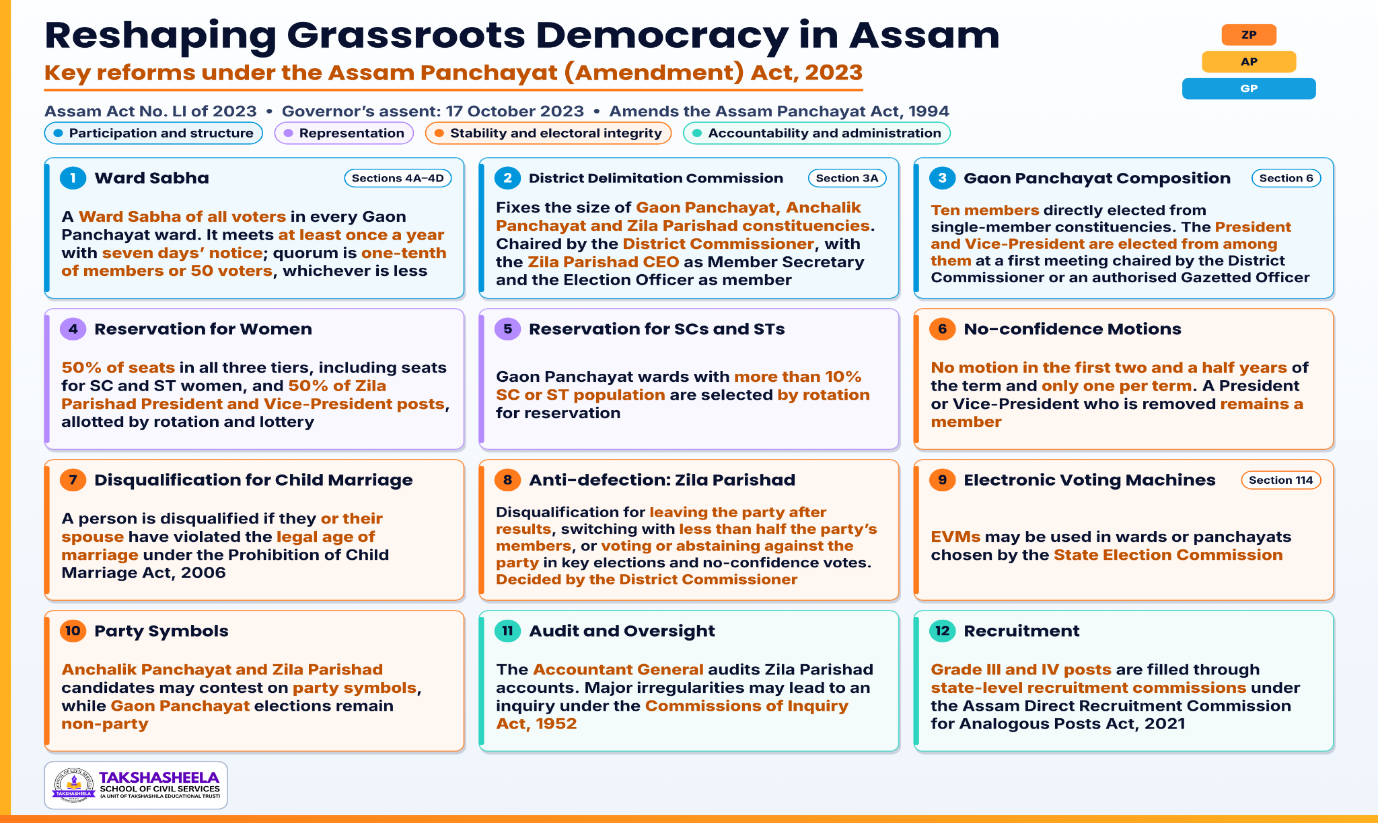
Assam Panchayat (Amendment) Act, 2023
Significance of Local Governance
Deepening democracy: Local bodies bring government closer to citizens and give them a direct voice in decisions on village and town development, reflecting the idea of democratic decentralisation.
Bottom-up planning: Gaon Sabhas, Ward Sabhas and development plans prepared at the local level help match public spending with local priorities.
Inclusion and empowerment: With 50% of seats reserved for women and reservation for SCs and STs, local bodies create a large pool of new leaders from groups that were earlier under-represented.
Accommodating diversity: In Assam, autonomous councils give tribal and other communities a role in their own development while remaining within the framework of the state.
Managing urbanisation: New municipal boards bring growing settlements under planned urban governance and make them eligible for urban schemes and finance commission grants.
Challenges
Incomplete devolution: Functions, funds and functionaries linked to the Eleventh and Twelfth Schedules have not been fully transferred, and line departments continue to perform many local functions.
Weak finances: Local bodies raise little revenue of their own, property tax collection is low, and State Finance Commission recommendations are often delayed or partly implemented.
Overlapping institutions: Panchayats, autonomous councils and government departments work in the same areas, which can blur responsibility and accountability.
Proxy representation: In some places, male relatives act on behalf of elected women representatives, which limits the purpose of reservation.
Way Forward
Activity mapping: As recommended by the Second Administrative Reforms Commission, functions can be clearly assigned among the three panchayat tiers, autonomous councils and urban bodies.
Stronger own revenues: Digital property tax systems, reasonable user charges and better management of local assets can improve the finances of local bodies.
Timely finance commissions and elections: Regular State Finance Commissions, timely release of grants and elections on schedule by the State Election Commission will strengthen local democracy.
Capacity building: Training of elected representatives and staff, a dedicated municipal cadre and the use of digital governance tools can improve performance.
US–China–Russia Shenzhen Summit
Syllabus: GS Paper II – Bilateral, regional and global groupings; effect of policies of developed countries on India’s interests | GS Paper III – Energy security; nuclear security
Why in News?
The Presidents of the United States, China and Russia, Donald Trump, Xi Jinping and Vladimir Putin, held their first-ever trilateral summit in Shenzhen, China, on 19 November 2026, on the sidelines of the 33rd APEC Economic Leaders’ Meeting.
The Four-Point Declaration Towards Peace
Area | What the Declaration Says |
|---|---|
1. Strategic stability and nuclear risks | The three countries held an in-depth exchange on the international situation, committed to maintaining strategic stability and international security, and agreed to launch a dialogue on reducing nuclear risks. They reaffirmed that “a nuclear war cannot be won and must never be fought” |
2. Reform of the United Nations | As permanent members of the UN Security Council, the three committed to reforming the UN so that it can respond more effectively to global challenges and fulfil its mandate of maintaining international peace and security |
3. Energy security | Amid the global energy crisis linked to the war involving Iran, the three plan to increase the production and supply of refined petroleum products for the benefit of all nations, and reaffirmed the importance of stable energy flows |
4. International Criminal Court | They recognised that the principle of state consent and respect for the immunities of state officials are of paramount importance, and agreed that the ICC and similar bodies must not abuse their jurisdiction |
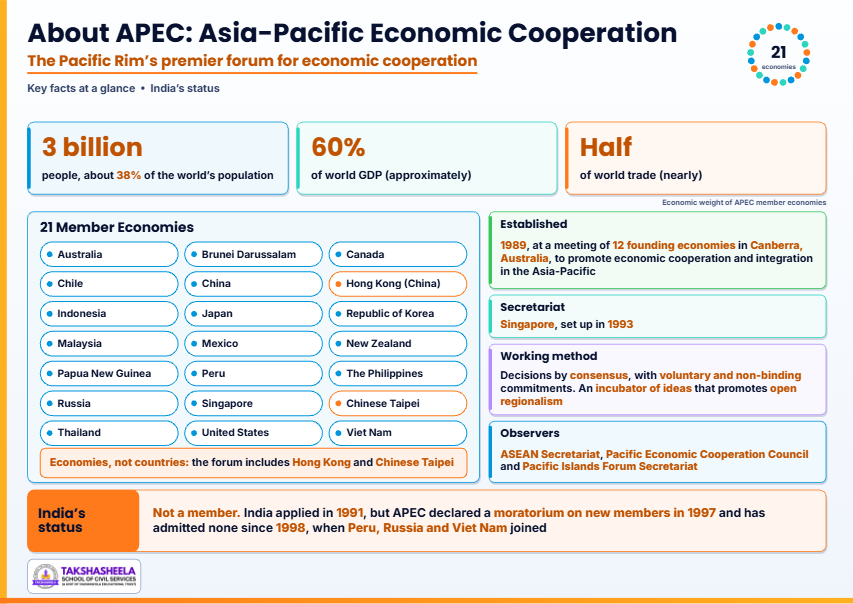
About APEC
Significance of the Summit
(a) Strategic and Nuclear Significance
A meeting of the major nuclear powers: The summit brought together the three countries that hold more than 90% of the world’s nuclear warheads. It reflects a growing recognition that strategic stability can no longer be managed only through US–Russia arrangements.
A response to the arms control gap: With New START having lapsed in February 2026, the agreement to start a dialogue on nuclear risks offers a possible path towards new risk-reduction measures. This is notable given China’s earlier reluctance to join trilateral talks.
Reaffirming nuclear restraint: Restating the principle that a nuclear war cannot be won and must never be fought strengthens the norm against the use of nuclear weapons at a time of heightened tension.
(b) Significance for the Multilateral Order
Momentum for UN reform: A joint commitment by three permanent members of the Security Council to reform the UN could help revive negotiations that have long remained stalled.
Approach to international courts: The shared position on state consent and the ICC reflects a common view of sovereignty among the major powers, and may shape the future of international criminal justice.
Great-power coordination: The summit suggests a form of coordination among the major powers on global questions. Such coordination can bring stability, though it also raises concerns among smaller states about decisions being taken without them.
(c) Economic Significance
Stability in energy markets: The commitment to increase the supply of refined petroleum products, amid the energy crisis linked to the war involving Iran, may ease pressure on importing countries in Asia and beyond.
A signal of reduced confrontation: Holding the summit at APEC sent a message of steadier relations among the world’s largest economies, alongside the continuing US–China economic truce.
(d) Geopolitical Significance
China’s diplomatic stature: Hosting the summit in Shenzhen, a symbol of its economic rise, highlighted China’s ability to convene both Washington and Moscow and its approach of major-country diplomacy.
Russia’s global profile: For Russia, the summit reinforced its place in top-level diplomacy after years of relative isolation following the war in Ukraine.
Managing rivalry: Calls to respect each other’s sovereignty and red lines and to avoid the Thucydides Trap point towards a framework of peaceful coexistence between established and rising powers.
Implications for India
UN reform: India has long called for reform of the UN. The joint commitment of three permanent members is welcome, but India will need sustained diplomacy to ensure that reform includes an expansion of permanent membership.
Energy security: As a major importer of crude oil, including from Russia, India stands to benefit from higher petroleum supplies and stable energy flows.
Strategic autonomy: India has important partnerships with all three powers. Closer coordination among them may narrow the space India has had to balance between them, calling for agile multi-alignment, including through the Quad, BRICS and the SCO.
Nuclear order: India is outside the NPT, so frameworks built around the major nuclear powers may not reflect its interests. The steady growth of China’s arsenal is also directly relevant to India’s credible minimum deterrence.
Conclusion
The Shenzhen summit is a notable moment in major-power diplomacy. For the first time, the leaders of the three largest nuclear powers jointly committed to talks on nuclear risks and to reforming the United Nations. Its outcomes, however, remain largely declaratory, and the deeper differences among the three are still unresolved. Its real value will depend on whether the declaration leads to sustained dialogue and practical steps.
Previous Years’ Questions
Q1. [UPSC CSE Prelims 2011] The “New START” treaty was in the news. What is this treaty?
(a) It is a bilateral strategic nuclear arms reduction treaty between the USA and the Russian Federation.
(b) It is a multilateral energy security cooperation treaty among the members of the East Asia Summit.
(c) It is a treaty between the Russian Federation and the European Union for energy security cooperation.
(d) It is a multilateral cooperation treaty among the BRICS countries for the promotion of trade.
Answer: (a)
Explanation: New START was a bilateral treaty between the US and Russia, signed in 2010 and in force from 2011. It limited each side to 1,550 deployed strategic warheads and expired on 5 February 2026 without a replacement.
Q2. [UPSC CSE Prelims 2015] India is a member of which among the following?
1. Asia-Pacific Economic Cooperation
2. Association of South-East Asian Nations
3. East Asia Summit
Select the correct answer using the code given below:
(a) 1 and 2 only
(b) 3 only
(c) 1, 2 and 3
(d) India is a member of none of them
Answer: (b)
Explanation: India is a member of the East Asia Summit. It is not a member of APEC, which has not admitted new members since 1998, and it is a dialogue partner of ASEAN rather than a member.