First SCO Civilisational Dialogue Forum
Syllabus: GS Paper I – Indian culture and heritage | GS Paper II – Regional groupings and agreements involving India
Why in News?
Prime Minister Narendra Modi inaugurated the first Shanghai Cooperation Organisation (SCO) Civilisational Dialogue Forum at Purana Qila, New Delhi, on 20 November 2026.
About the SCO Civilisational Dialogue Forum
Aspect | Details |
|---|---|
Origin | Proposed by India at the 25th SCO Summit in Tianjin, China (2025), as a platform to share ancient civilisations, art, literature and traditions |
Objectives | Promote dialogue and cooperation through the shared civilisational heritage of SCO countries; encourage dialogue among cultures, knowledge systems and traditions; strengthen people-to-people ties; showcase member states’ art, literature and traditions on a common platform; and use digital platforms to preserve shared heritage |
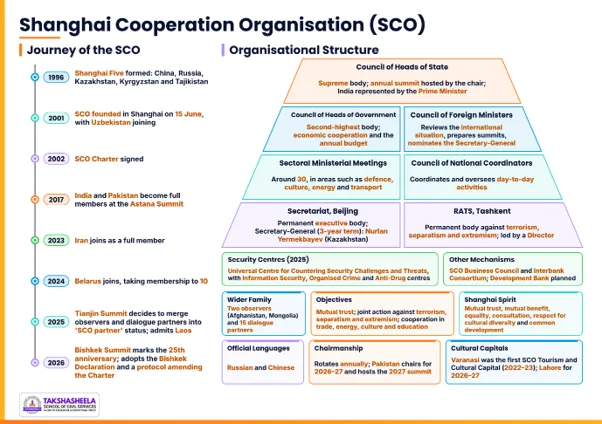
About the SCO
Significance of the SCO for India
Gateway to Central Asia: The SCO is the main multilateral platform where India engages Central Asian countries and Russia together, supporting its Connect Central Asia policy.
Counter-terrorism: RATS offers intelligence sharing and joint exercises, and a forum to raise cross-border terrorism. The 2025 Tianjin Declaration condemned the Pahalgam terror attack.
Energy security: Central Asia and Russia are rich in oil, gas and uranium, which matter for India’s energy needs.
Connectivity: India uses the forum to promote Chabahar Port and the International North–South Transport Corridor, and to stress respect for sovereignty in connectivity projects.
Strategic autonomy: Membership alongside the Quad and BRICS reflects India’s multi-alignment and its ability to work with diverse partners.
Soft power and agenda-setting: Initiatives such as the Civilisational Dialogue Forum and India’s focus on start-ups, traditional medicine and shared Buddhist heritage expand its cultural influence.
Key Concerns for India
China’s dominance: China’s economic weight shapes the agenda. India has consistently stayed out of SCO endorsements of the Belt and Road Initiative, citing sovereignty concerns over the China–Pakistan Economic Corridor.
Terrorism and double standards: Differences persist on cross-border terrorism; in June 2025, India declined to sign the SCO defence ministers’ joint statement over its treatment of terrorism.
Bilateral tensions: Strained India–Pakistan and India–China ties limit cooperation, and Pakistan’s chairmanship for 2026–27 adds complexity. India–Pakistan relations have been tense since the Pahalgam attack and Operation Sindoor in 2025.
Way Forward
Connectivity with sovereignty: Speed up Chabahar and the INSTC, and promote connectivity that respects sovereignty and territorial integrity.
Deeper Central Asia engagement: Build on bilateral ties and the India–Central Asia Summit to complement SCO cooperation.
Economic cooperation: Expand cooperation in energy, critical minerals, digital public infrastructure, start-ups and traditional medicine.
Previous Years’ Questions
Q1. [UPSC CSE Prelims 2022] Consider the following:
1. Asian Infrastructure Investment Bank
2. Missile Technology Control Regime
3. Shanghai Cooperation Organisation
India is a member of which of the above?
(a) 1 and 2 only
(b) 3 only
(c) 2 and 3 only
(d) 1, 2 and 3
Answer: (d)
Explanation: India is a founding member of the Asian Infrastructure Investment Bank, joined the Missile Technology Control Regime in 2016, and became a full member of the Shanghai Cooperation Organisation in 2017.
WHO’s SPECS 2030 Initiative
Syllabus: GS Paper II – Health; important international institutions (WHO)
Why in News?
The National Health Mission (NHM) Assam, the Government of Assam and Sri Sankaradeva Nethralaya (SSDN), Guwahati, have signed a Memorandum of Understanding to implement the World Health Organization’s (WHO) SPECS 2030 initiative in the state.
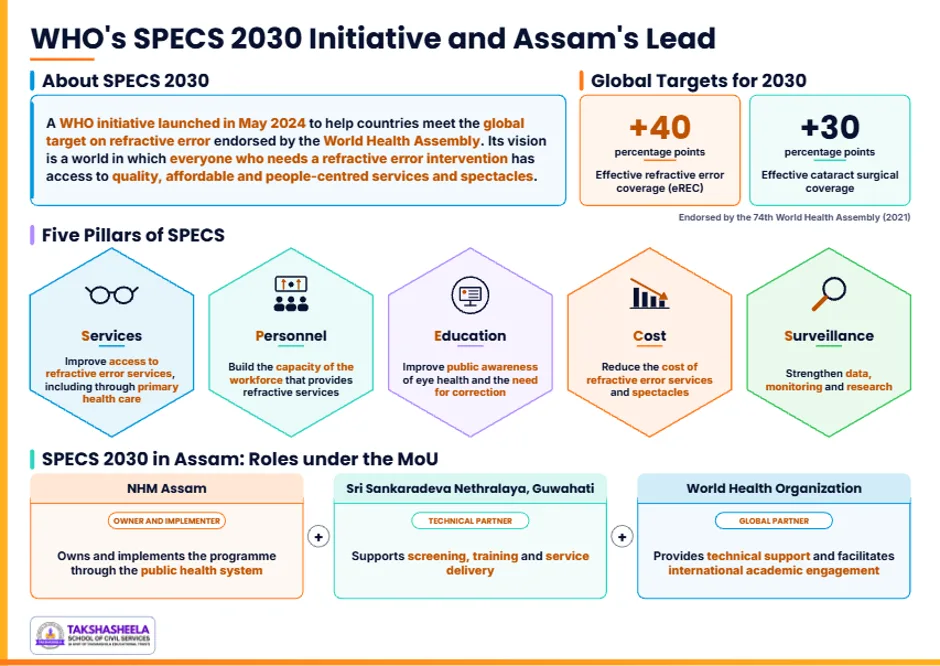
About WHO’s SPECS Initiative
Scrub Typhus: A Silent Killer Spreading across the Northeast
Syllabus: GS Paper II – Health | GS Paper III – Science and technology: communicable diseases
Why in News?
Health experts have flagged scrub typhus as a growing but under-recognised public health threat in the Northeast, with cases reported from Assam, Arunachal Pradesh, Nagaland, Mizoram and other states.
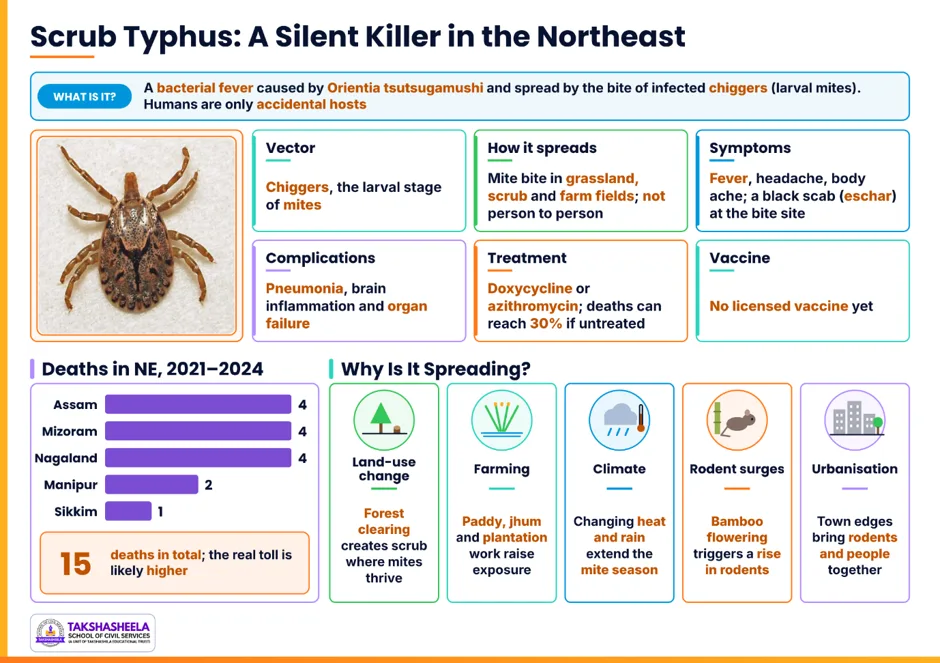
About Scrub Typhus
Previous Years’ Questions
Q1. [APSC CCE Prelims 2024] In early 2025, a rare marbled cat was spotted in which National Park of Assam?
(A) Dehing Patkai National Park
(B) Kaziranga National Park
(C) Manas National Park
(D) Nameri National Park
Answer: (A)
Q2. [UPSC CSE Prelims 2022] Which of the following is not a bird?
(a) Golden Mahseer
(b) Indian Nightjar
(c) Spoonbill
(d) White Ibis
Answer: (a)
Explanation: The Golden Mahseer (Tor putitora) is a large freshwater fish of Himalayan rivers, listed as Endangered by the IUCN, while the Indian Nightjar, Spoonbill and White Ibis are birds.
Index of Core Industries
Syllabus: GS Paper III – Indian economy: growth, development and industrial performance
Why in News?
The Index of Core Industries (ICI) grew by 10.9% in October 2026, the highest in the new series and up from 8.2% in September, according to provisional data released by the Ministry of Commerce and Industry.
Factors Behind the Surge
Base effect: Weak output in October 2025 makes the year-on-year comparison look stronger.
Festive calendar: Diwali fell in October in 2025 but in November in 2026, so October 2026 had more working days than a year earlier.
Power demand: A sharp rise in electricity generation pushed up coal production for thermal plants.
Infrastructure spending: Economists have linked recent strength in cement and steel to government spending on roads and railways.
Steel and iron ore: Higher steel output raised demand for iron ore, a key raw material.
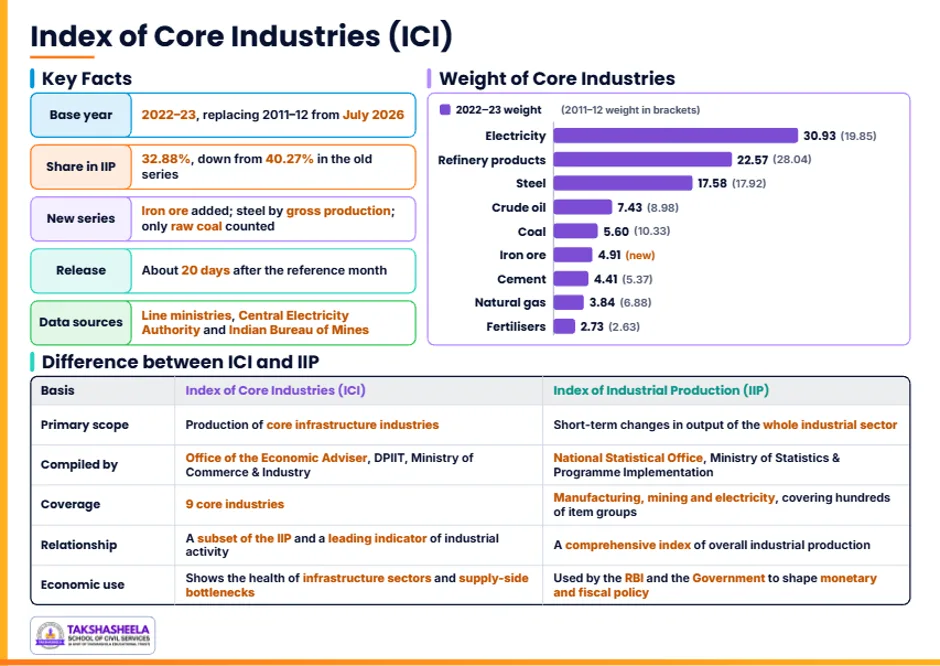
About the Index of Core Industries
Significance
Lead indicator: Since core industries make up about a third of the IIP, the ICI gives an early signal of industrial performance.
Input to GDP estimates: Core sector and IIP trends feed into estimates of industrial and overall growth.
Infrastructure health: Output of cement, steel and electricity reflects the pace of construction and infrastructure activity.
Energy demand: Electricity and coal data indicate demand from households, industry and services.
Policy guidance: The data help the government and the Reserve Bank of India assess the strength of demand and the investment cycle.
Supply-chain signals: These industries supply inputs to almost every other sector, so their performance affects the wider economy.
Previous Years’ Questions
Q1. [UPSC CSE Prelims 2015] In the ‘Index of Eight Core Industries’, which one of the following is given the highest weight?
(a) Coal production
(b) Electricity generation
(c) Fertilizer production
(d) Steel production
Answer: (b)
Explanation: Among the options, electricity generation had the highest weight when this question was asked. In the new series with base year 2022–23, electricity has the highest weight of all nine industries at 30.93%, followed by refinery products (22.57%) and steel (17.58%).