New Flower Species Discovered in Assam
Environment and Ecology (GS Paper 3)
Key Highlights
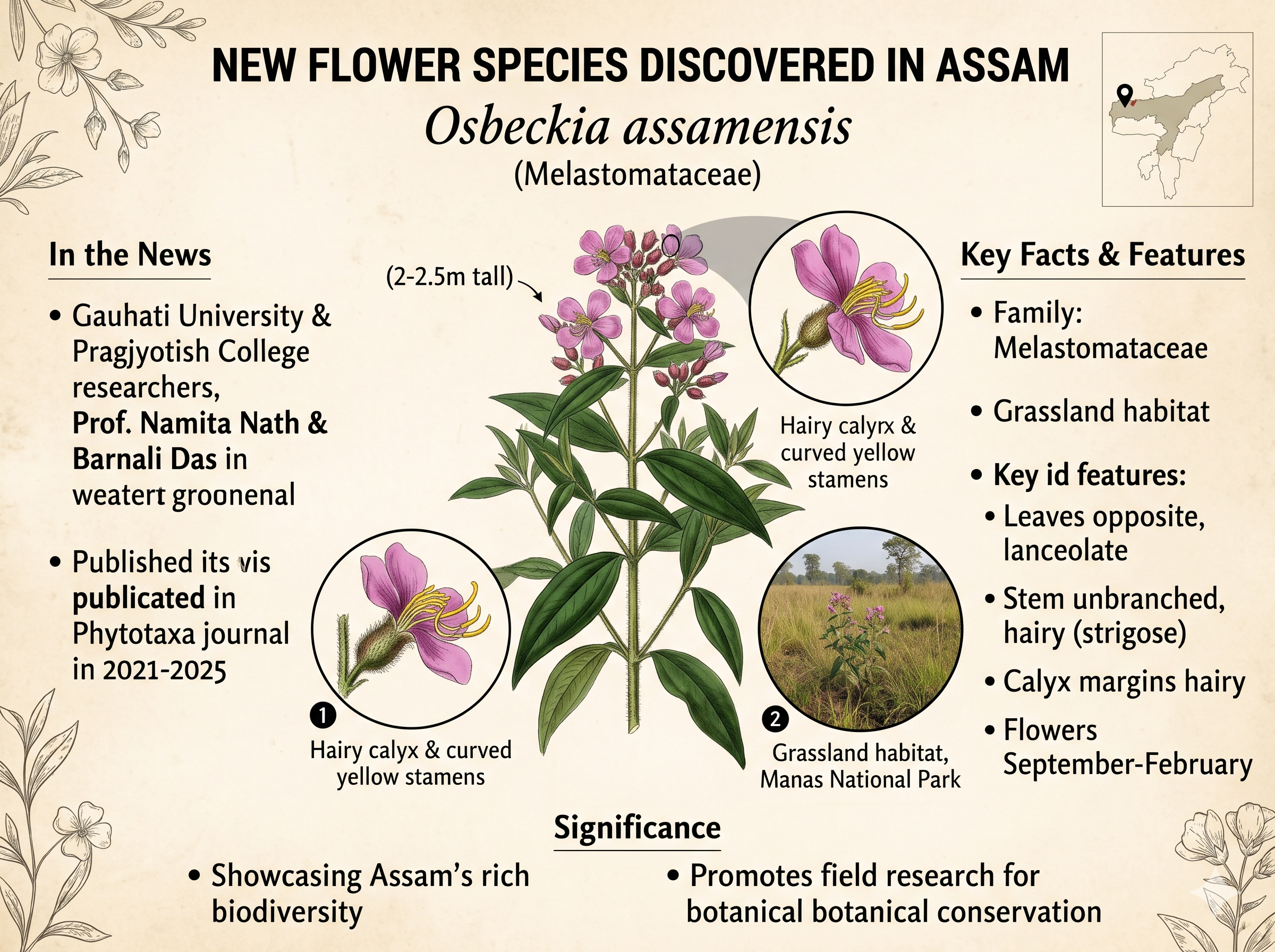
A new flowering plant species, Osbeckia assamensis, has been discovered in Manas National Park, Assam.
Researchers: Prof. Namita Nath (Gauhati University) and Barnali Das (Pragjyotish College).
Published in the international, peer-reviewed journal Phytotaxa.
Key Facts
Family: Melastomataceae.
Genus: Osbeckia.
Habitat: Grasslands of Manas National Park, Assam.
Distribution: Found in large, scattered populations in the park.
Identification: Distinguished from related species by its stem, leaf features, hairy calyx margins and flower-bearing structures.
Related species: Osbeckia nayarii.
Research period: 2021–2025.
Significance
Highlights Assam’s rich floral biodiversity.
Emphasises the importance of botanical research and field surveys.
Supports the conservation of lesser-known plant species and their habitats.
Practice Questions
Prelims Questions
Q1. Osbeckia assamensis, recently reported in the news, belongs to which plant family?
A. Orchidaceae
B. Melastomataceae
C. Fabaceae
D. Poaceae
Answer: B. Melastomataceae
Ladakh Declared India’s First 100% Organic Union Territory
Agriculture (GS Paper 3)
In News
Lieutenant Governor V.K. Saxena declared Ladakh India’s first 100% organic Union Territory.
The administration prohibited the use, sale and distribution of chemical and synthetic fertilisers for agricultural purposes.
Key Facts
Location: Ladakh, a Union Territory of India.
Major crops and produce: Apricots, sea buckthorn, buckwheat, barley and vegetables.
Policy measure: Ban on chemical and synthetic fertilisers across Ladakh.
Organic farming: Agriculture that avoids synthetic fertilisers and follows approved organic farming practices.
Significance
Environmental protection: Conserves the fragile Himalayan ecosystem.
Sustainable agriculture: Promotes environmentally friendly farming.
Farmers’ income: Can improve market access and prices for organic produce.
Traditional knowledge: Encourages traditional farming practices supported by scientific methods.
Biodiversity: Helps protect soil health and the natural environment.
Challenges
Maintaining organic certification and quality standards.
Ensuring access to organic markets.
Managing pests and maintaining soil fertility.
Providing training and scientific support to farmers.
Practice Questions
Prelims Questions
Q1. Ladakh was recently declared India’s first 100% organic Union Territory. Who made the declaration, according to the news report?
A. The President of India
B. The Lieutenant Governor of Ladakh
C. The Union Agriculture Minister
D. The Prime Minister of India
Answer: B. The Lieutenant Governor of Ladakh
Mains Question
Q. Discuss the role of organic farming in promoting sustainable agriculture, improving farmers’ income and conserving fragile Himalayan ecosystems.
Cybersecurity: A Critical Concern for India
Internal Security (GS Paper 3)
In News
Prime Minister Narendra Modi inaugurated the Reserve Bank of India’s (RBI) new Data Centre and Cybersecurity Training Institute in Bhubaneswar, Odisha.
He highlighted the growing threat of cybercrime and cyberterrorism to India’s financial system.
Cost mentioned in the report: ₹169 crore.
Why Is Cybersecurity Important?
Financial security: Protects banks and financial institutions from cyberattacks.
Economic stability: Cyberattacks can disrupt banking services and damage public confidence.
Digital India: Protects digital payments and online banking.
National security: Cyberattacks can be used as tools of economic warfare.
Data protection: Helps safeguard customers’ personal and financial information.
Major Cybersecurity Threats
Phishing and online financial fraud.
Ransomware and malware attacks.
Identity theft and data breaches.
Attacks on banking systems and digital payment platforms.
Cyberterrorism and attacks on critical infrastructure.
Measures to Strengthen Cybersecurity
Develop modern cybersecurity infrastructure.
Train skilled cybersecurity professionals.
Improve cybercrime detection and response.
Promote public awareness of online fraud.
Strengthen coordination between banks, regulators and law enforcement agencies.
Practice Questions
Prelims Questions
Q1. The RBI’s new Data Centre and Cybersecurity Training Institute, mentioned in the news, was inaugurated in:
A. Guwahati
B. Bhubaneswar
C. Hyderabad
D. Mumbai
Answer: B. Bhubaneswar
Mains Practice Question
Q. “Cybersecurity is essential for India’s financial stability in the era of digital banking.” Discuss the major challenges and suggest suitable measures. (150 words)