Cyclone Arnab
GS Paper III (Disaster Management)
Key Highlights
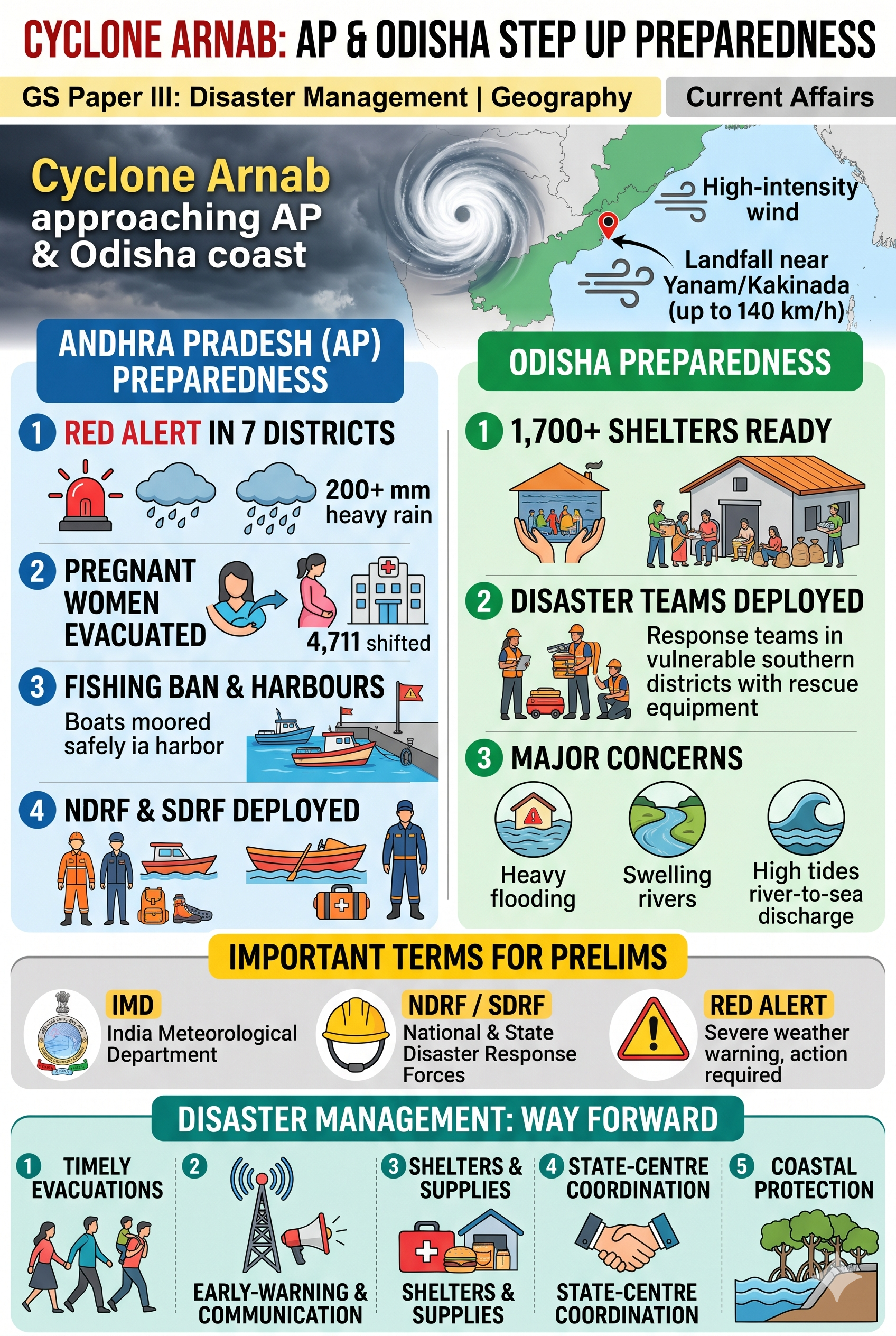
Event: Andhra Pradesh and Odisha intensified evacuation and disaster-preparedness measures as Cyclone Arnab approached the coast, according to the provided report.
Andhra Pradesh: The IMD issued red alerts for seven districts, forecasting isolated extremely heavy rainfall of 200 mm or more.
Expected impact: The storm was forecast to make landfall near Yanam or Kakinada, with wind gusts reaching 140 km/h.
Evacuation: Andhra Pradesh planned to shift 4,711 pregnant women to safer healthcare facilities. Fishing boats returned to harbours.
Disaster response: NDRF and State Disaster Response Force (SDRF) teams were deployed in vulnerable areas.
Odisha: More than 1,700 shelters were prepared, with disaster-response teams deployed in vulnerable southern districts.
Major concern: Heavy rainfall, flooding, river swelling, storm-related damage and difficulties in discharging river water into the sea during high tides.
Important Terms for Prelims
IMD: India Meteorological Department.
NDRF: National Disaster Response Force.
SDRF: State Disaster Response Force.
Red Alert: Indicates the need for authorities to take action and prepare for potentially severe weather impacts.
Disaster Management: Way Forward
Ensure timely evacuation of vulnerable populations.
Strengthen early-warning systems and last-mile communication.
Prepare cyclone shelters, hospitals and emergency supplies.
Coordinate disaster response between States and the Centre.
Improve coastal protection and flood-resilient infrastructure.
Practice Questions
Prelims Question
Q. Consider the following statements about tropical cyclones:
They generally develop over warm tropical ocean waters.
The India Meteorological Department issues cyclone warnings in India.
Storm surges can cause coastal flooding during cyclones.
Tropical cyclones form only during the summer monsoon.
Which of the statements given above are correct?
A. 1 and 2 only
B. 1, 2 and 3 only
C. 2, 3 and 4 only
D. 1, 2, 3 and 4
Answer: B. 1, 2 and 3 only.
Menga Dam Project Protest in Arunachal Pradesh
GS Paper III (Environment)
Key Highlights
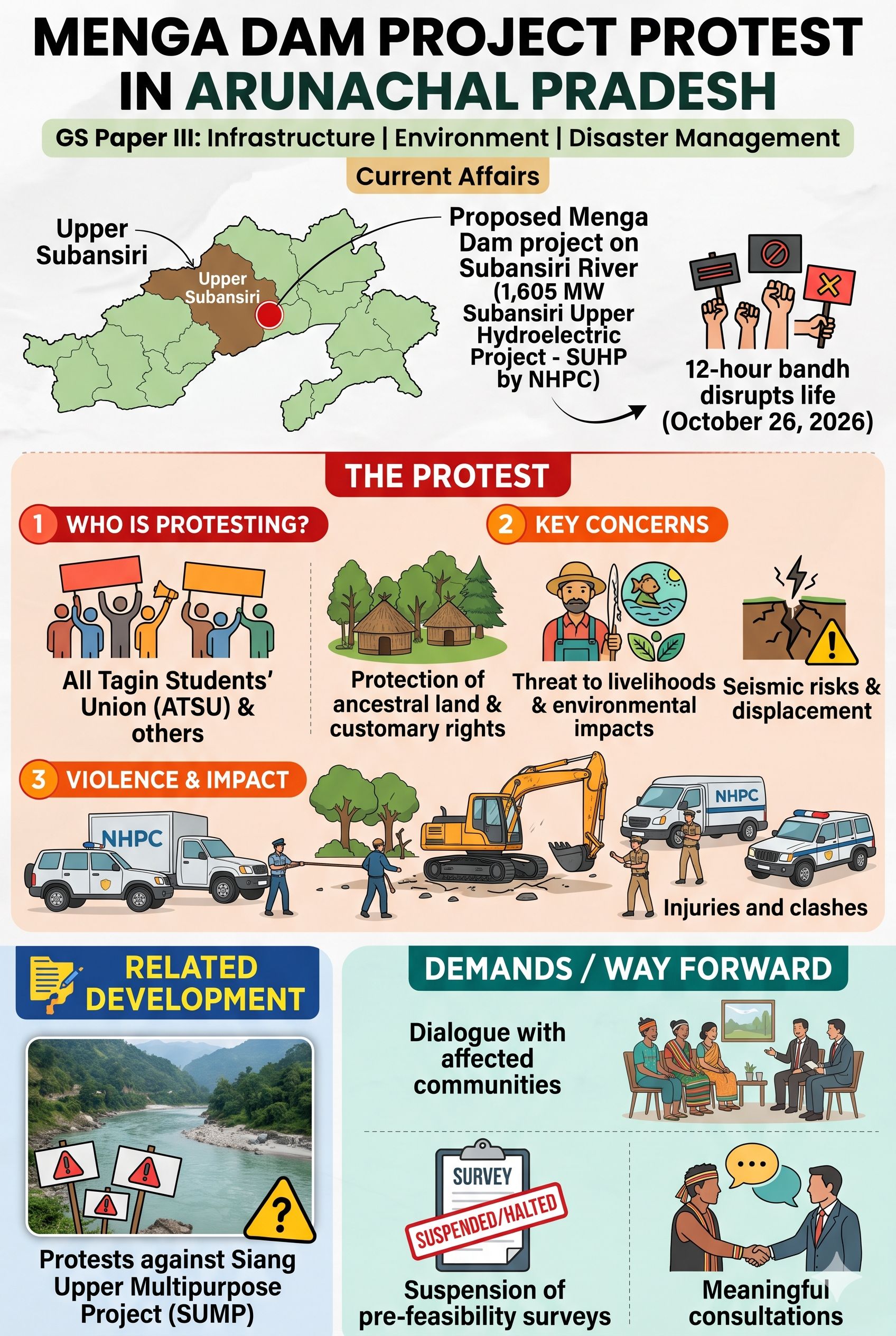
All Tagin Students’ Union (ATSU) and other organisations protested against the proposed Menga Dam project.
Project: The Menga Dam is part of the 1,605 MW Subansiri Upper Hydroelectric Project (SUHP) being developed by NHPC Ltd on the Subansiri River.
Key concerns: Protection of ancestral land, customary rights, livelihoods, environmental impacts, seismic risks and displacement of affected communities.
Violence: Protesters damaged NHPC equipment and vehicles, while two police vehicles were also damaged. Personnel were injured.
Related development: Protests have also taken place against the proposed Siang Upper Multipurpose Project (SUMP).
Way Forward
Conduct comprehensive environmental and seismic impact assessments.
Ensure free, prior and informed consultation with affected communities.
Protect customary land rights and provide fair rehabilitation and compensation.
Maintain law and order while respecting democratic protest.
Adopt transparent and participatory decision-making.
Practice Questions
Prelims Question
Q. Consider the following statements regarding the Menga Dam project:
It is part of the Subansiri Upper Hydroelectric Project.
The project is being developed by NHPC Ltd.
The project is located in Arunachal Pradesh.
Which of the statements given above are correct?
A. 1 and 2 only
B. 2 and 3 only
C. 1 and 3 only
D. 1, 2 and 3
Correct Answer: D. 1, 2 and 3
Explanation: All three statements are correct according to the provided news report.
Mera Hou Chongba Festival, Manipur
GS Paper I (Indian Culture)
Key Highlights
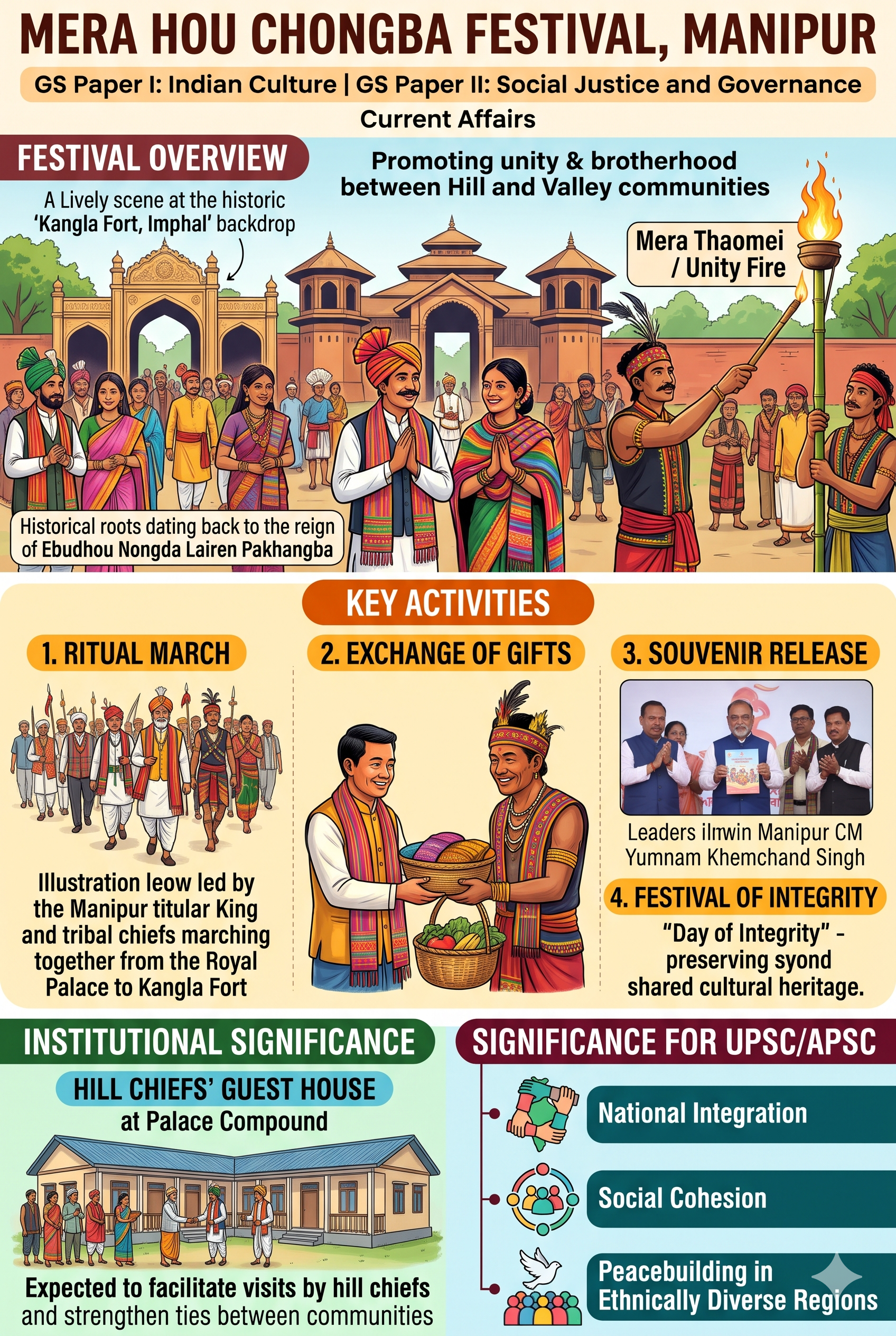
Occasion: Mera Hou Chongba is a traditional festival celebrated in Manipur to promote unity and brotherhood between hill and valley communities.
Venue: Historic Kangla Fort, Imphal, Manipur.
Historical significance: The tradition dates back to the reign of Ebudhou Nongda Lairen Pakhangba.
Key activities: Exchange of gifts between hill and valley representatives and the release of a festival souvenir.
Significance: The festival symbolises communal harmony, cultural unity, mutual respect and peaceful coexistence among Manipur’s diverse ethnic communities.
Practice Questions
Prelims Practice Question
Q. Mera Hou Chongba, recently seen in the news, is associated with which of the following?
A. A harvest festival of Assam
B. Promoting unity between hill and valley communities in Manipur
C. A Buddhist festival celebrated in Arunachal Pradesh
D. A traditional boat festival of Tripura
Answer: B. Promoting unity between hill and valley communities in Manipur.
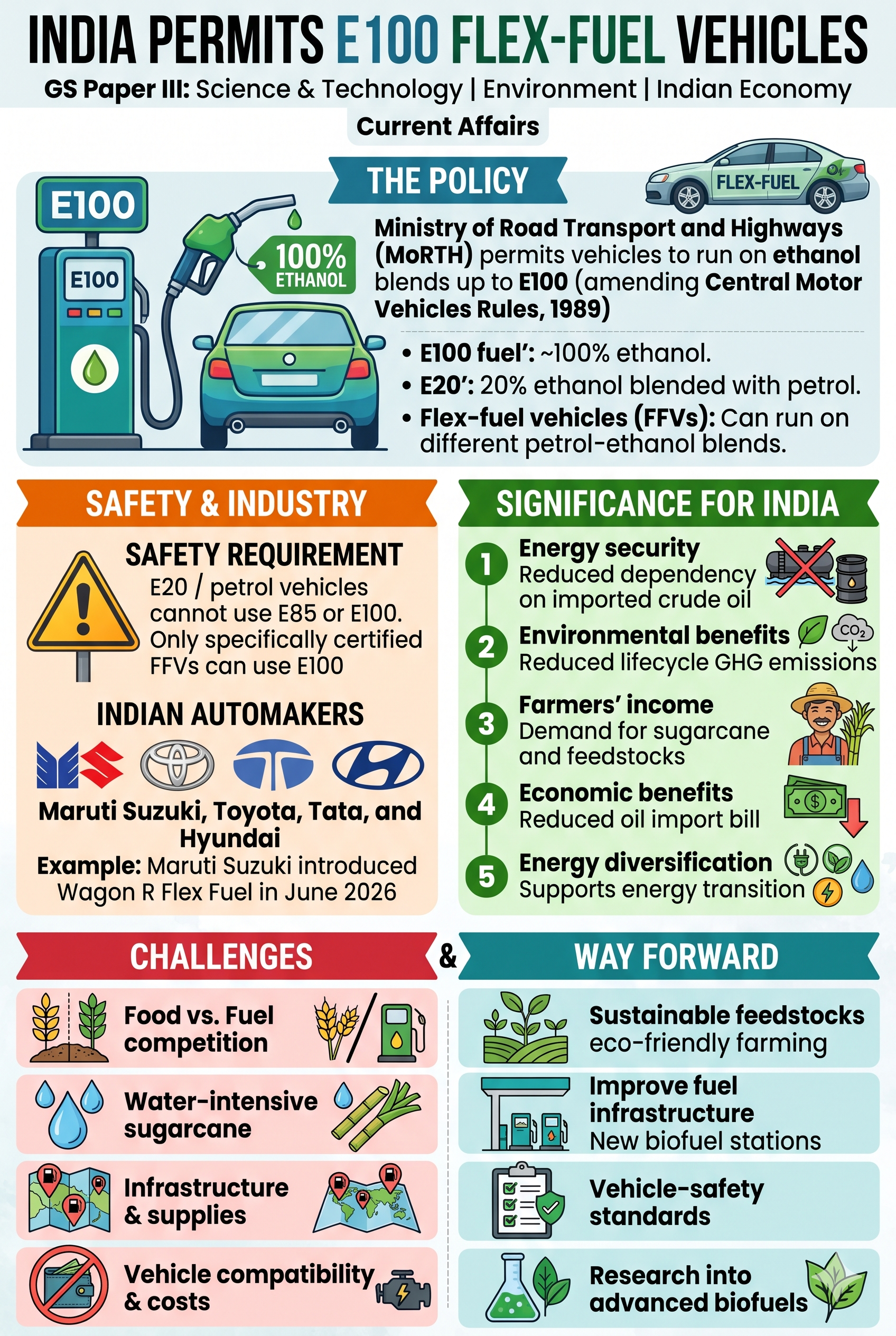
India Permits E100 Flex-Fuel Vehicles
GS Paper III (Science & Technology)
Key Highlights
Ministry: Ministry of Road Transport and Highways (MoRTH).
Recent development: The government amended the Central Motor Vehicles Rules, 1989, permitting vehicles certified to run on ethanol blends up to E100.
E100 fuel: Fuel consisting predominantly of ethanol, with nearly 100% ethanol.
E20: Petrol blended with 20% ethanol.
Flex-fuel vehicles (FFVs): Vehicles designed to operate on different petrol–ethanol blends, depending on their certification.
Safety requirement: Vehicles designed for E20 or normal petrol cannot automatically use E85 or E100. Only vehicles specifically designed and certified for these fuels can use them.
Indian automakers: Companies such as Maruti Suzuki, Toyota, Tata and Hyundai are exploring flex-fuel technology.
Example: Maruti Suzuki introduced the Wagon R Flex Fuel vehicle in June 2026, according to the provided report.
Significance for India
Energy security: Reduces dependence on imported crude oil.
Environmental benefits: Can reduce lifecycle greenhouse gas emissions, depending on ethanol production methods and fuel efficiency.
Farmers’ income: Creates additional demand for sugarcane and other suitable ethanol feedstocks.
Economic benefits: May help reduce the crude oil import bill and pressure on the current account.
Energy diversification: Promotes alternative fuels and supports India’s energy-transition goals.
Challenges
Competition between food crops and fuel production.
Water-intensive sugarcane cultivation in some regions.
Availability of adequate ethanol supplies and refuelling infrastructure.
Vehicle compatibility, fuel efficiency and consumer costs.
Need to assess lifecycle emissions and sustainability.
Way Forward
Promote sustainable ethanol feedstocks, improve fuel infrastructure, enforce vehicle-safety standards and encourage research into advanced biofuels.
Practice Questions
Prelims Practice Question
Q. Consider the following statements about flex-fuel vehicles (FFVs):
They can operate on different petrol–ethanol blends within their certified fuel range.
Every petrol vehicle can use E100 fuel without modification.
Ethanol blending can help reduce dependence on imported crude oil.
E100 fuel consists predominantly of ethanol.
Which of the statements given above are correct?
A. 1 and 2 only
B. 1, 3 and 4 only
C. 2 and 3 only
D. 1, 2, 3 and 4
Answer: B. 1, 3 and 4 only
Explanation: Flex-fuel vehicles must be specifically designed and certified for the fuel blends they use. Ordinary petrol vehicles cannot automatically use E100.