SC Collegium Recommends Four Judges as High Court Chief Justices
GS Paper II: Polity & Governance
Key Highlights
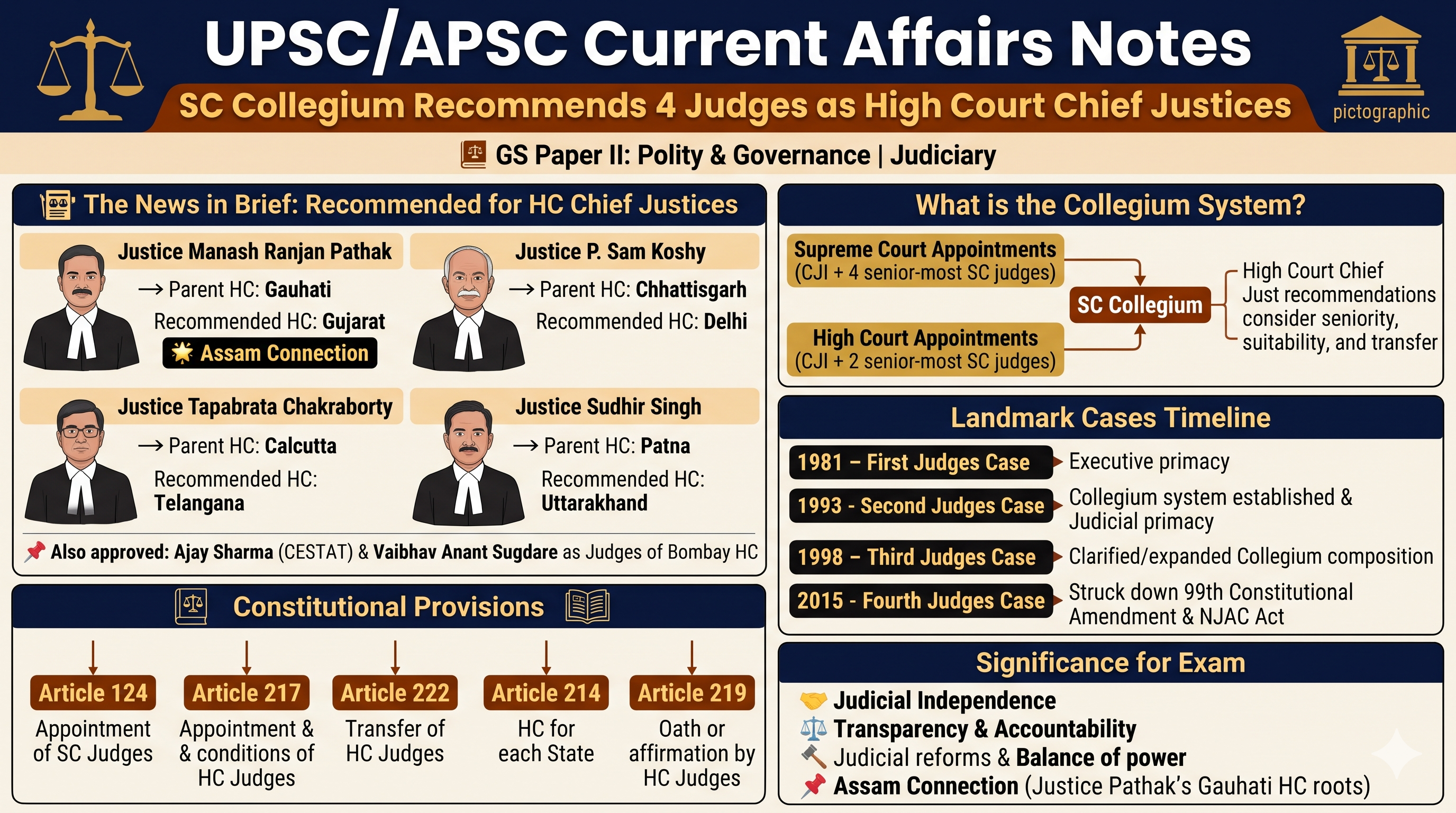
The Supreme Court Collegium, in its resolution dated October 26, recommended four judges for appointment as Chief Justices of the High Courts of Gujarat, Delhi, Telangana and Uttarakhand.
Judge | Recommended High Court | Parent High Court |
|---|---|---|
Justice Manash Ranjan Pathak | Gujarat | Gauhati |
Justice P. Sam Koshy | Delhi | Chhattisgarh |
Justice Tapabrata Chakraborty | Telangana | Calcutta |
Justice Sudhir Singh | Uttarakhand | Patna |
Other development: The Collegium also approved the proposal to appoint Ajay Sharma, Judicial Member of CESTAT, Mumbai, and advocate Vaibhav Anant Sugdare as judges of the Bombay High Court.
What Is the Collegium System?
The Collegium System is the mechanism through which judges of the Supreme Court and High Courts are recommended for appointment and elevation.
Supreme Court appointments: Chief Justice of India (CJI) and four senior-most Supreme Court judges.
High Court appointments: CJI and two senior-most Supreme Court judges, in consultation with relevant constitutional authorities and judges.
High Court Chief Justice appointments: Recommendations are made by the Supreme Court Collegium, considering factors such as seniority, suitability and inter-High Court transfers.
Constitutional Provisions
Article | Provision |
|---|---|
Article 124 | Appointment of Supreme Court judges |
Article 217 | Appointment and conditions of office of High Court judges |
Article 222 | Transfer of High Court judges |
Article 214 | High Court for each State |
Article 219 | Oath or affirmation by High Court judges |
Important Supreme Court Judgments
First Judges Case (1981): Established executive primacy in judicial appointments.
Second Judges Case (1993): Established the Collegium System and gave primacy to the judiciary.
Third Judges Case (1998): Clarified and expanded the Collegium’s composition.
Fourth Judges Case (2015): The Supreme Court struck down the 99th Constitutional Amendment and the National Judicial Appointments Commission (NJAC) Act.
Significance
Strengthens judicial administration through the appointment of High Court Chief Justices.
Highlights the importance of judicial independence.
Raises questions about transparency and accountability in judicial appointments.
Relevant to the debate on judicial reforms and the balance of power between the executive and judiciary.
Assam connection: Justice Manash Ranjan Pathak’s parent High Court is the Gauhati High Court.
Practice Questions
Prelims Question
Q1. The appointment of High Court judges is governed by which Article of the Indian Constitution?
A. Article 124
B. Article 217
C. Article 222
D. Article 226
Answer: B. Article 217
Explanation: Article 217 deals with the appointment and conditions of office of High Court judges.
India’s Next Investment Cycle Will Shape Its Carbon Future
GS Paper III: Environment, Climate Change
Key Highlights
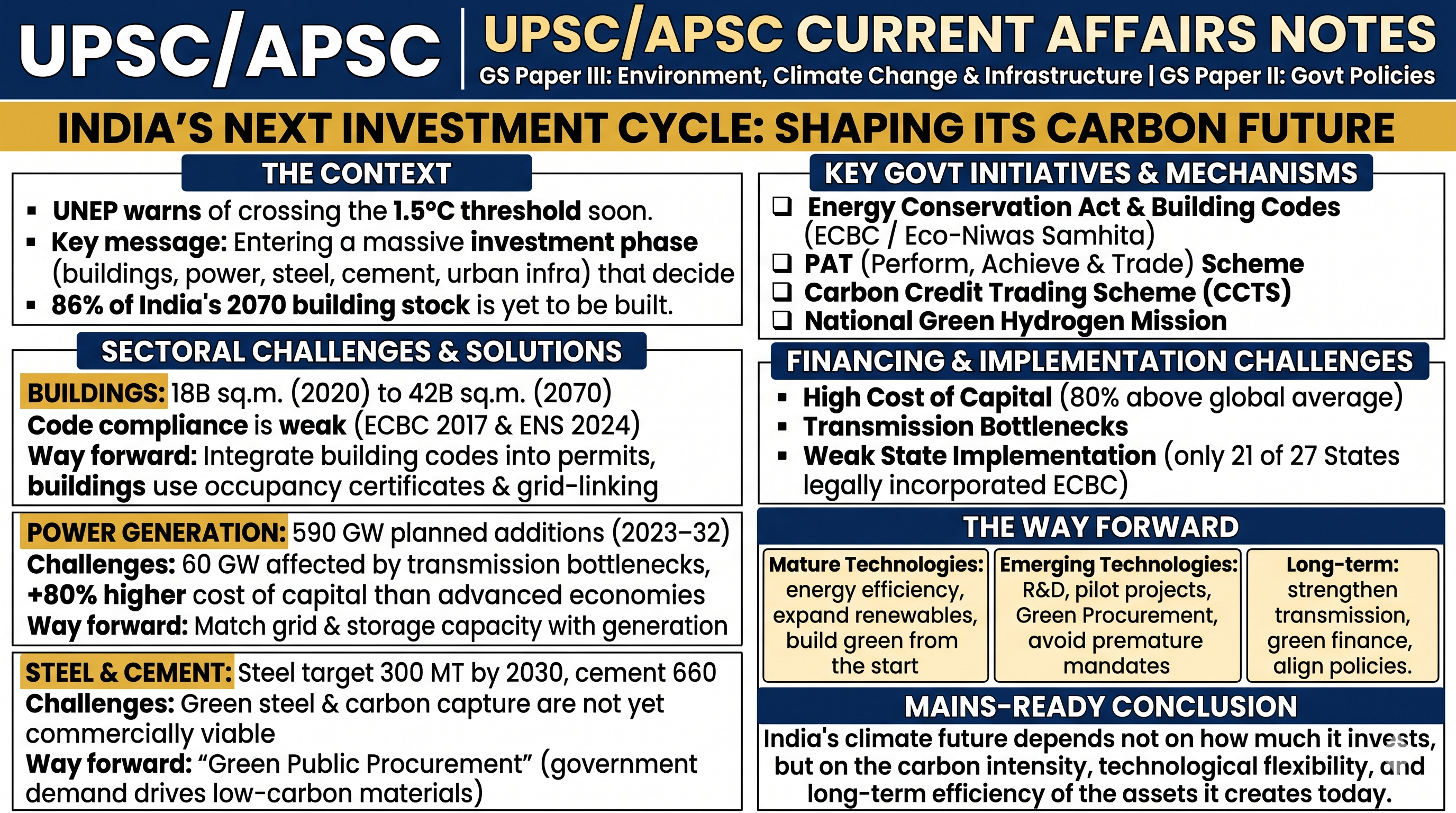
The United Nations Environment Programme (UNEP) has warned that the world could cross the 1.5°C global warming threshold within the next few years.
India is entering a major investment phase in buildings, electricity, steel, cement and urban infrastructure. The technologies and standards adopted during this phase will significantly influence the country’s future carbon emissions.
India should pursue economic growth while investing in low-carbon infrastructure, energy efficiency and sustainable industrial development.
Important Facts and Figures
Indicator | Data |
|---|---|
India’s building stock yet to be built by 2070 | 86% |
Projected building floor space | 18 billion sq. m. (2020) to 42 billion sq. m. (2070) |
India’s crude steel capacity | Approximately 200 million tonnes in 2024–25 |
Targeted steel capacity | 300 million tonnes by 2030–31 |
India’s cement production | Approximately 427 million tonnes in 2024 |
Projected cement production | 660 million tonnes by 2030 |
Renewable capacity affected by transmission bottlenecks | Approximately 60 GW |
Planned power generation additions | Approximately 590 GW during 2023–2032 |
Major Issues Discussed
A. The Advantage of India’s Development Stage
India’s infrastructure deficit is often viewed as a barrier to decarbonisation. However, it also offers an opportunity to build infrastructure with cleaner technologies from the start.
Advantages:
Avoids locking in high-emission technologies.
Reduces future retrofitting and renovation costs.
Improves energy efficiency.
Minimises the risk of stranded assets.
Supports sustainable economic growth.
Energy Efficiency in Buildings
Buildings consume significant energy for lighting, cooling, and other activities.
India has introduced several regulatory frameworks to improve building efficiency.
Framework | Purpose |
|---|---|
Energy Conservation Building Code (ECBC), 2017 | Promotes energy efficiency in commercial buildings |
Energy Conservation and Sustainable Building Code (ECSBC), 2024 | Establishes sustainability and energy-efficiency standards for commercial and office buildings |
Eco-Niwas Samhita (ENS), 2024 | Promotes energy efficiency in residential buildings |
Way forward:
Integrate building-efficiency standards into building permits.
Link compliance to occupancy certificates and grid connections.
Strengthen monitoring and enforcement.
Promote energy-efficient cooling and sustainable construction materials.
Challenges in the Power Sector
India has rapidly expanded renewable energy generation, but transmission infrastructure has not kept pace.
Major challenges:
Transmission bottlenecks delay renewable energy integration.
Renewable electricity may not reach areas with high demand.
Electrification of transport, cooling and industry will increase electricity demand.
Insufficient storage can make it difficult to balance variable renewable generation.
Way forward:
Develop transmission infrastructure alongside renewable energy projects.
Expand battery and other energy-storage systems.
Strengthen interstate electricity transmission.
Improve grid planning and management.
Coordinate generation, transmission and demand forecasting.
Practice Questions
Prelims Questions
Q1. Consider the following statements regarding India’s future building stock:
A significant proportion of India’s building stock projected for 2070 is yet to be constructed.
Energy-efficient building standards can help reduce long-term electricity consumption.
Retrofitting existing buildings is always cheaper than incorporating energy efficiency during construction.
Which of the statements given above are correct?
A. 1 only
B. 1 and 2 only
C. 2 and 3 only
D. 1, 2 and 3
Answer: B. 1 and 2 only
Explanation: Incorporating energy efficiency during construction can avoid expensive retrofits. Therefore, statement 3 is incorrect.
Mains Question
Q. India’s next phase of infrastructure development presents an opportunity to align economic growth with decarbonisation. Discuss the major challenges and suggest measures to promote low-carbon infrastructure in India. (15 marks, 250 words)
India Discusses Maritime Partnerships with South Korea and Cyprus
GS Paper II: International Relations
Key Highlights
Union Minister: Sarbananda Sonowal, Ministry of Ports, Shipping and Waterways.
South Korea: Cooperation in shipbuilding, marine equipment, green propulsion and maritime technology.
Cyprus: Collaboration in shipping, maritime investment, ship recycling and seafarer welfare.
Target: Make India a globally competitive shipbuilding and maritime services hub by 2047.
KOMERI: Korea Marine Equipment Research Institute; potential cooperation in research, testing and certification.
HMM: Discussions covered Indian seafarer recruitment, vessel registration and expansion of shipping services.
Ship recycling: India seeks EU recognition for eligible Indian ship-recycling facilities.
Significance for India
Attracts foreign investment and technology.
Generates employment in shipbuilding and shipping.
Strengthens port infrastructure and maritime supply chains.
Promotes green shipping and sustainable ship recycling.
Supports India’s maritime ambitions under Maritime India Vision 2030 and Maritime Amrit Kaal Vision 2047.
Practice Questions
Prelims Questions
Q. KOMERI, mentioned in the context of India’s maritime cooperation, is associated with which country?
A. Cyprus
B. South Korea
C. Japan
D. Singapore
Answer: B. South Korea
GST Reforms: First Phase from November 1, 2026
GS Paper III: Indian Economy
Key Highlights
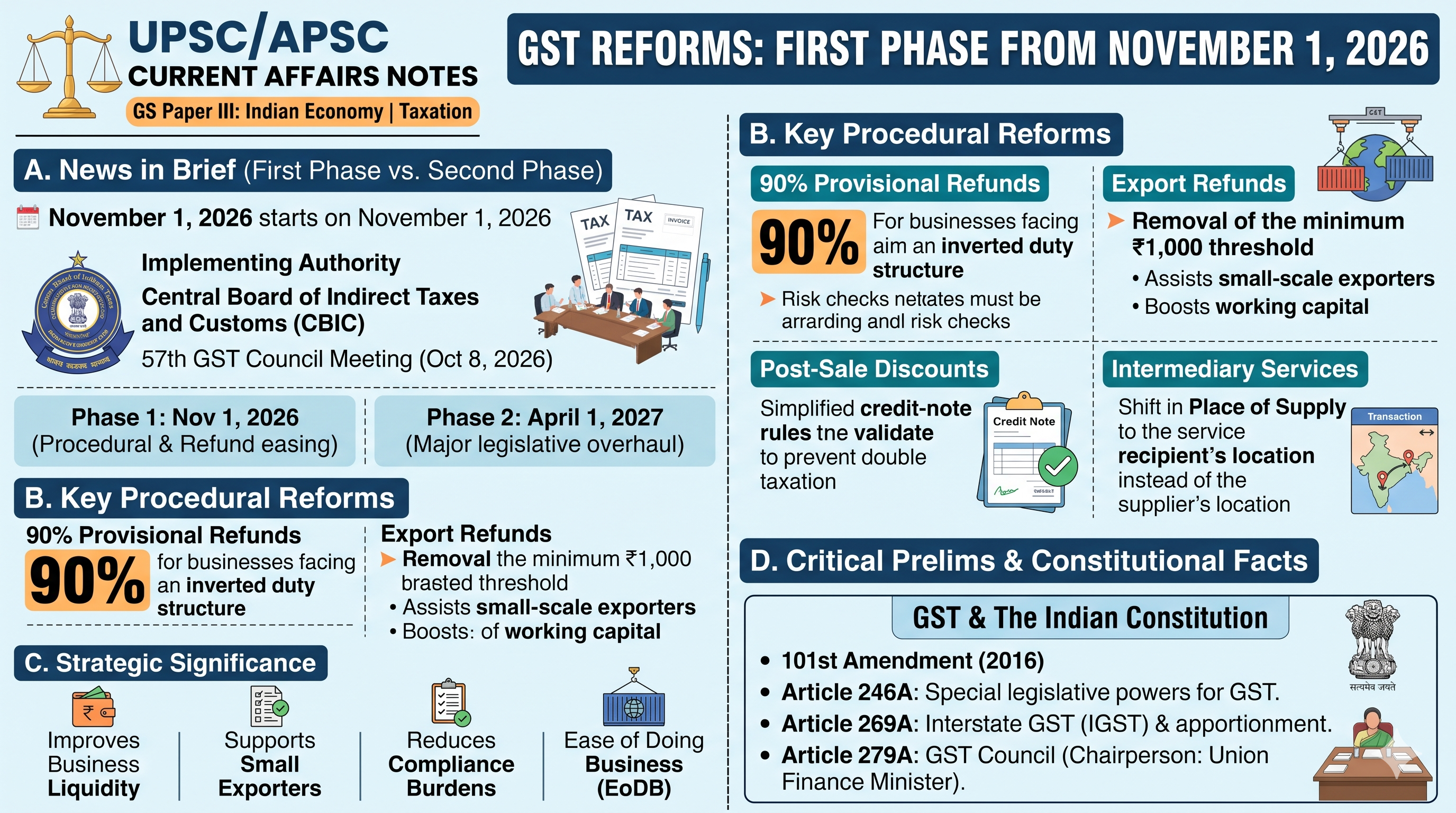
Implementing authority: Central Board of Indirect Taxes and Customs (CBIC).
GST Council meeting: 57th meeting, October 8, 2026.
90% provisional refunds: For eligible businesses facing an inverted duty structure, subject to risk checks.
Export refunds: Removal of the minimum ₹1,000 threshold.
Post-sale discounts: Simplified credit-note provisions.
Intermediary services: Place of supply shifts to the service recipient’s location.
Second phase: Major legislative changes targeted for April 1, 2027.
Significance
Improves business liquidity.
Supports small exporters.
Reduces compliance burdens.
Promotes ease of doing business.
Important Prelims Facts
101st Constitutional Amendment Act, 2016: Introduced GST.
Article 246A: Legislative powers regarding GST.
Article 269A: GST on inter-State supplies.
Article 279A: GST Council.
GST Council Chairperson: Union Finance Minister.
Practice Questions
Q. The GST Council is constituted under which Article?
A. Article 246A
B. Article 269A
C. Article 279A
D. Article 280
Answer: C. Article 279A