Industrial Production Growth Slows to 6.7%
ECONOMY (GS Paper 3)
Key Highlights
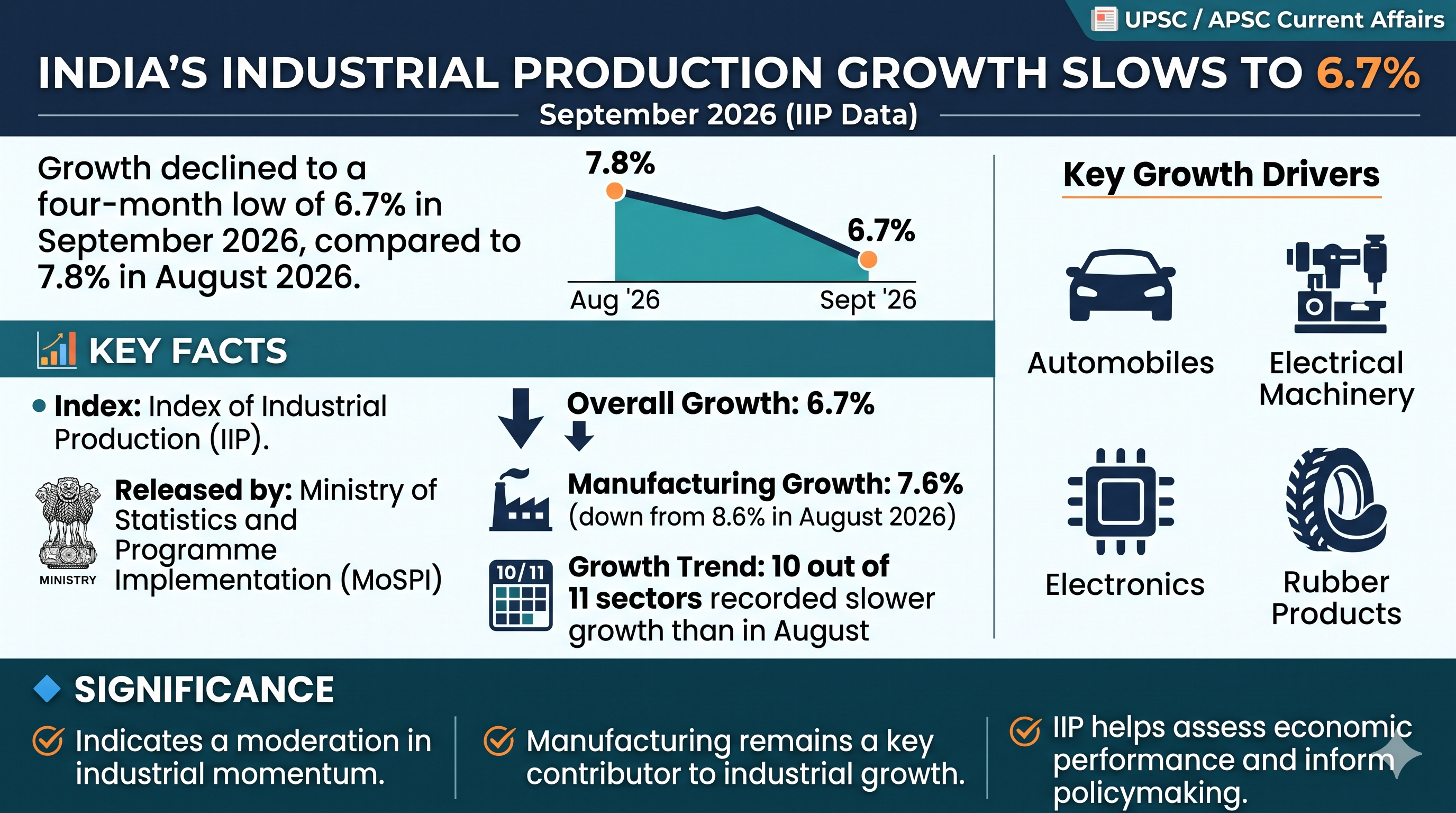
India’s industrial production growth declined to a four-month low of 6.7% in September 2026, compared with 7.8% in August 2026.
Key Facts
Index: Index of Industrial Production (IIP).
Released by: Ministry of Statistics and Programme Implementation (MoSPI).
Overall growth: 6.7% in September 2026.
Manufacturing growth: 7.6%, down from 8.6% in August 2026.
Growth trend: 10 out of 11 sectors recorded slower growth than in August.
Key growth drivers: Automobiles, electrical machinery, electronics and rubber products.
Indicator | September 2026 | August 2026 |
|---|---|---|
Overall IIP growth | 6.7% | 7.8% |
Manufacturing growth | 7.6% | 8.6% |
Significance
Indicates a moderation in industrial momentum.
Manufacturing remains a key contributor to industrial growth.
IIP helps assess economic performance and inform policymaking.
Practice Questions
Prelims Questions
Q1. The Index of Industrial Production (IIP) is released by which organisation?
A. RBI
B. NITI Aayog
C. MoSPI
D. Ministry of Commerce and Industry
Answer: C. MoSPI
Mains Question
Q. Discuss the significance of the Index of Industrial Production in assessing India’s economic growth. (150 words)
Assam Skill University–Japan Cultural Exchange Initiative
International Relations (GS Paper 2)
Key Highlights
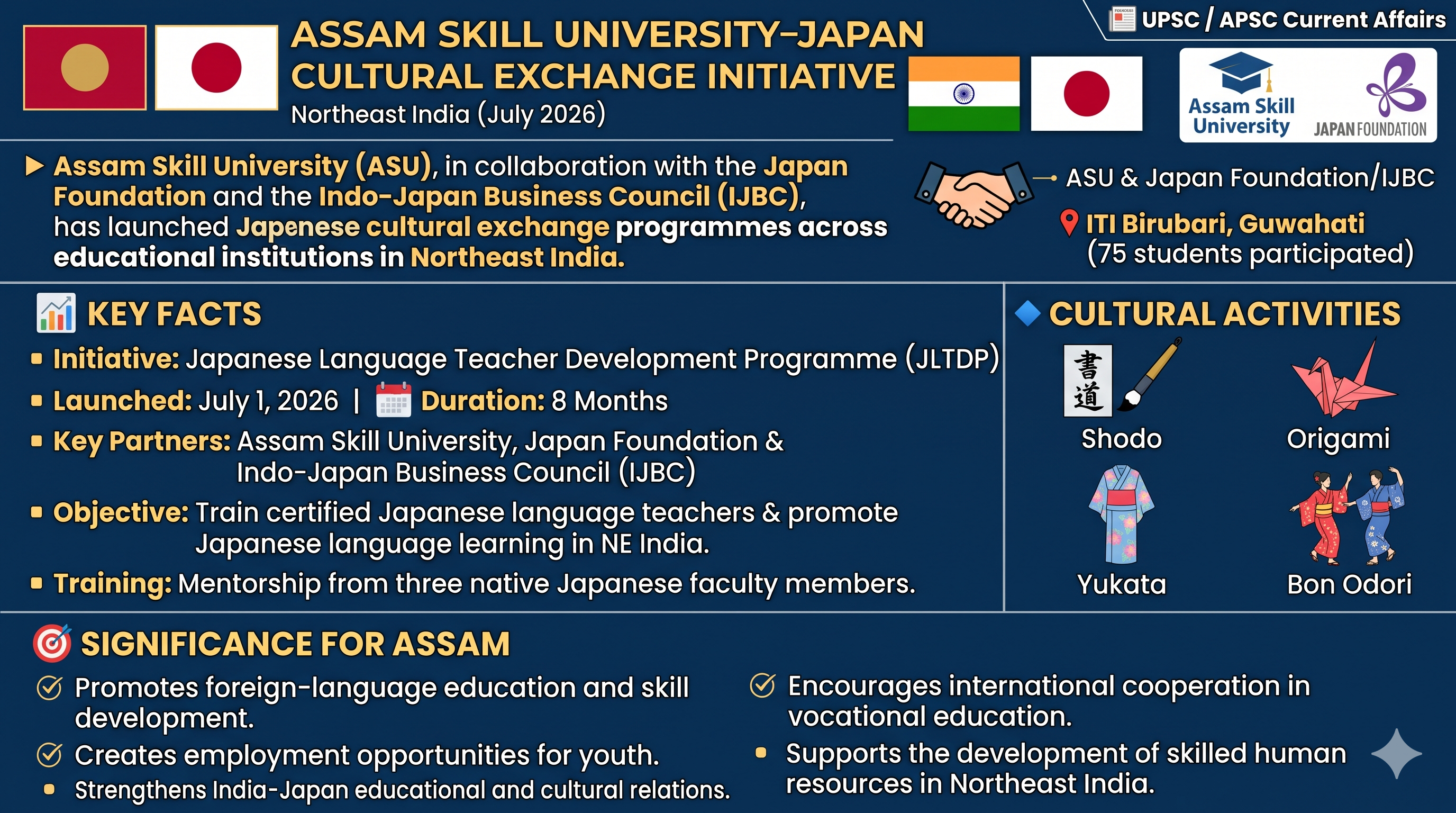
Assam Skill University (ASU), in collaboration with the Japan Foundation and the Indo-Japan Business Council (IJBC), has launched Japanese cultural exchange programmes across educational institutions in Northeast India.
Key Facts
Initiative: Japanese Language Teacher Development Programme (JLTDP).
Launched: July 1, 2026.
Duration: Eight months.
Key partners: Assam Skill University, Japan Foundation and Indo-Japan Business Council.
Objective: Train certified Japanese language teachers and promote Japanese language learning in Northeast India.
Training: Mentorship from three native Japanese faculty members.
Recent event: 75 students participated in a cultural exchange programme at ITI Birubari, Guwahati.
Cultural Activities
Shodo: Japanese calligraphy.
Origami: Traditional paper folding.
Yukata: Traditional Japanese summer garment.
Bon Odori: Traditional Japanese folk dance.
Significance for Assam
Promotes foreign-language education and skill development.
Creates employment opportunities for youth.
Strengthens India–Japan educational and cultural relations.
Encourages international cooperation in vocational education.
Supports the development of skilled human resources in Northeast India.
Practice Questions
Prelims Questions
Q1. The Japanese Language Teacher Development Programme (JLTDP) is associated with which state?
A. Meghalaya
B. Assam
C. Manipur
D. Nagaland
Answer: B. Assam
Mains Practice Question
Q. Discuss the role of international educational and cultural collaborations in promoting skill development and employment opportunities for youth in Northeast India. (150 words)
India Needs 220 Billion for Renewable Energy Transition
Environment (GS Paper 3)
Key Highlights
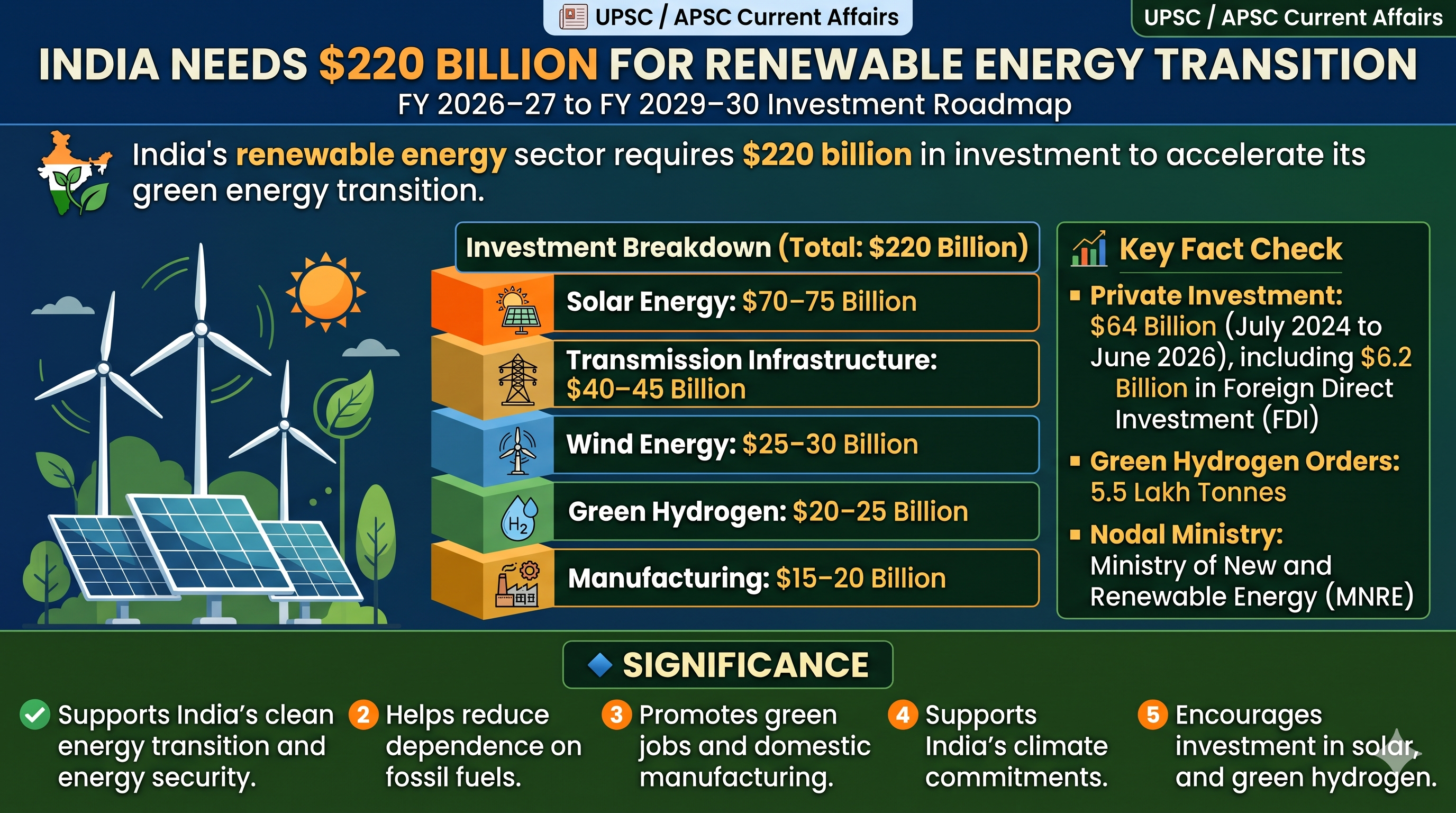
India’s renewable energy sector requires 220 billion in investment during FY 2026–27 to FY 2029–30 to accelerate its green energy transition.
Key Facts
Total investment required: 220 billion.
Solar energy: 70–75 billion.
Transmission infrastructure: 40–45 billion.
Wind energy: 25–30 billion.
Green hydrogen: 20–25 billion.
Manufacturing: 15–20 billion.
Private investment: 64 billion between July 2024 and June 2026, including 6.2 billion in FDI.
Green hydrogen orders: 5.5 lakh tonnes.
Segment | Investment Required |
|---|---|
Solar energy | 70–75 billion |
Transmission infrastructure | 40–45 billion |
Wind energy | 25–30 billion |
Green hydrogen | 20–25 billion |
Manufacturing | 15–20 billion |
Total | 220 billion |
Nodal Ministry: Ministry of New and Renewable Energy (MNRE).
Significance
Supports India’s clean energy transition and energy security.
Helps reduce dependence on fossil fuels.
Promotes green jobs and domestic manufacturing.
Supports India’s climate commitments.
Encourages investment in solar, wind and green hydrogen.
Practice Questions
Prelims Questions
Q1. Which ministry is responsible for renewable energy development in India?
A. Ministry of Power
B. Ministry of New and Renewable Energy
C. Ministry of Environment, Forest and Climate Change
D. Ministry of Heavy Industries
Answer: B. Ministry of New and Renewable Energy
Mains Question
Q. Discuss the major challenges and opportunities in India’s transition towards renewable energy. (150 words)
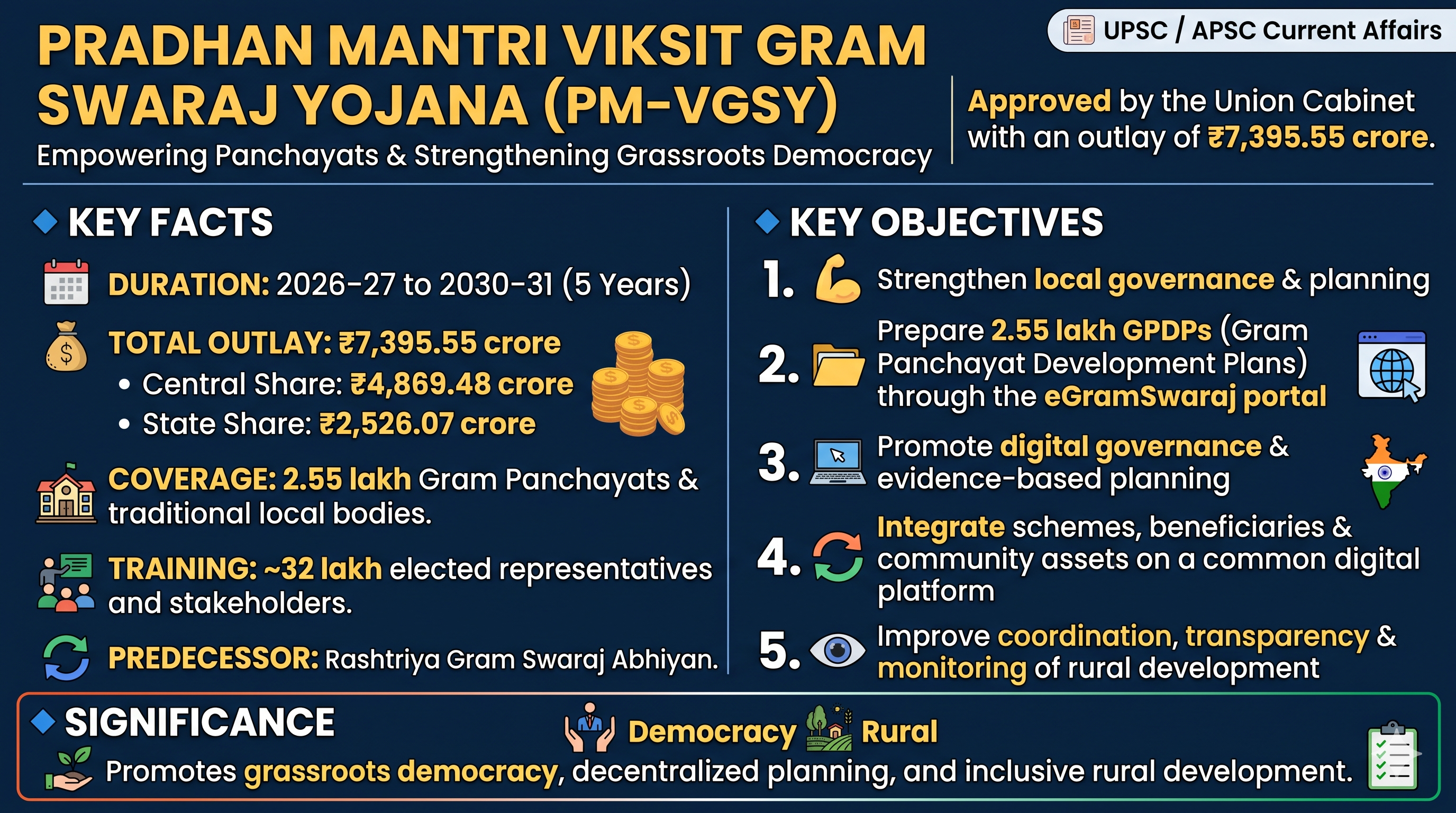
Pradhan Mantri Viksit Gram Swaraj Yojana (PM-VGSY)
Governance (GS Paper 2)
Key Highlights
The Union Cabinet approved PM-VGSY with an outlay of 7,395.55 crore to strengthen Gram Panchayats.
Key Facts
Duration: 2026–27 to 2030–31 (5 years).
Total outlay: 7,395.55 crore.
Central share: 4,869.48 crore.
State share: 2,526.07 crore.
Coverage: 2.55 lakh Gram Panchayats and traditional local bodies.
Training: Approximately 32 lakh elected representatives and stakeholders.
Predecessor: Rashtriya Gram Swaraj Abhiyan.
Component | Amount |
|---|---|
Total outlay | 7,395.55 crore |
Central share | 4,869.48 crore |
State share | 2,526.07 crore |
Key Objectives
Strengthen local governance and planning.
Prepare 2.55 lakh Gram Panchayat Development Plans (GPDPs) through the eGramSwaraj portal.
Promote digital governance and evidence-based planning.
Integrate government schemes, beneficiaries and community assets on a common digital platform.
Improve coordination, transparency and monitoring of rural development.
Significance
Promotes grassroots democracy, decentralised planning and inclusive rural development.
Practice Questions
Prelims Questions
Q1. Consider the following statements about PM-VGSY:
The scheme aims to strengthen Gram Panchayats.
It will be implemented from 2026–27 to 2030–31.
It focuses on providing individual stipends to elected representatives.
Which of the statements given above is/are correct?
A. 1 only
B. 1 and 2 only
C. 2 and 3 only
D. 1, 2 and 3
Answer: B. 1 and 2 only
Mains Question
Q. How can strengthening Gram Panchayats contribute to grassroots democracy and rural development in India? (150 words)