Cyclone Murasu: Andhra Pradesh on Red Alert
GS Paper III: Disaster Management
Key Highlights
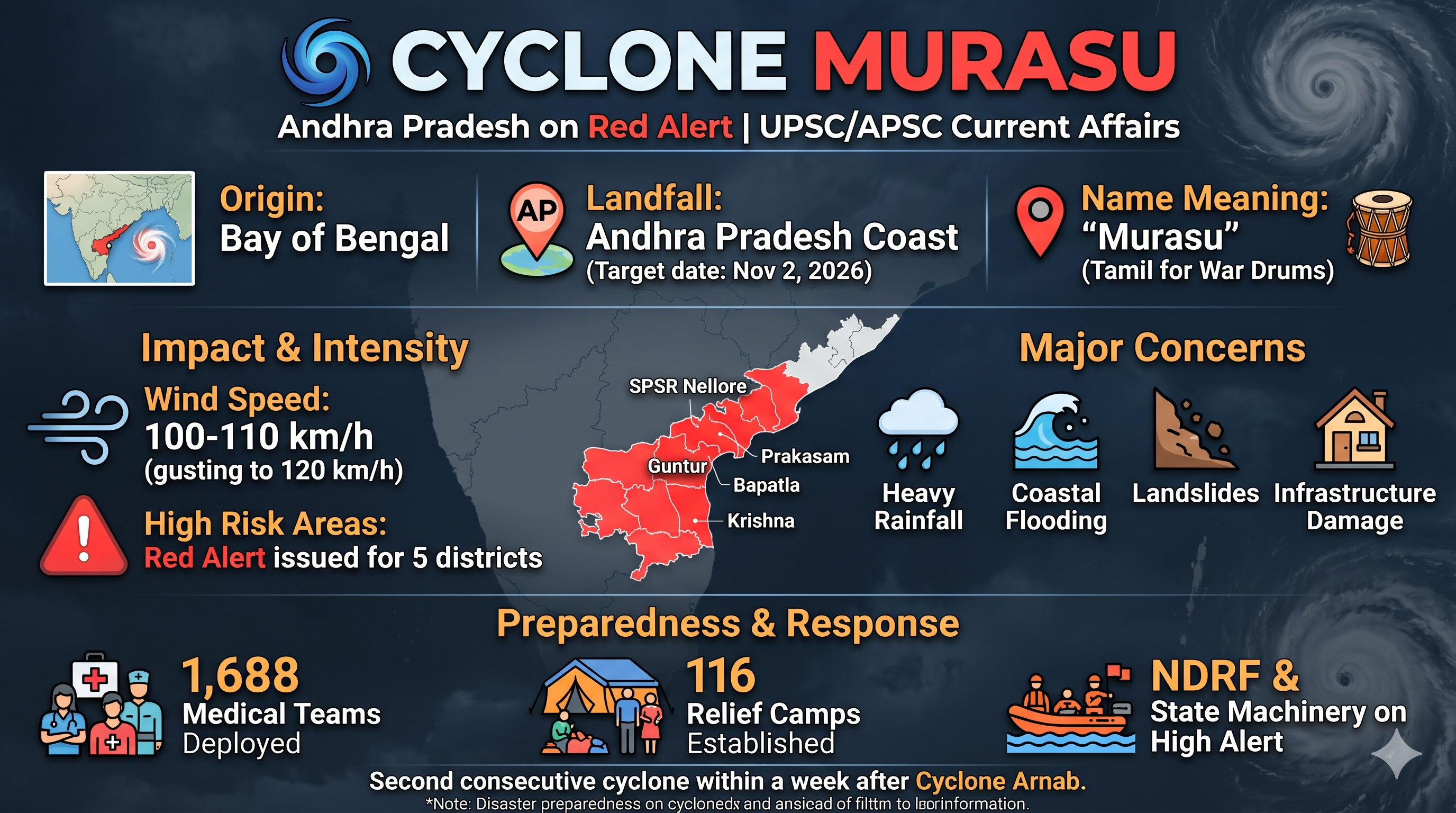
Andhra Pradesh is preparing for Cyclone Murasu, the second cyclone within a week after Cyclone Arnab. The IMD issued a red alert for five districts ahead of the expected landfall on November 2, 2026.
Key Facts
Origin: Bay of Bengal.
Expected landfall: Andhra Pradesh coast.
Wind speed: 100–110 km/h, gusting up to 120 km/h.
Red-alert districts: SPSR Nellore, Prakasam, Guntur, Bapatla and Krishna.
Preparedness: 1,688 medical teams and 116 relief camps established.
Major concerns: Heavy rainfall, flooding, landslides and damage to infrastructure.
Cyclone naming: “Murasu” is a Tamil word meaning war drums.
Practice Questions
Prelims Question
Q1. Consider the following statements about tropical cyclones:
Tropical cyclones derive energy primarily from warm ocean waters.
The Bay of Bengal is a region prone to tropical cyclones.
The India Meteorological Department (IMD) issues cyclone warnings in India.
Which of the statements given above are correct?
A) 1 only
B) 1 and 2 only
C) 2 and 3 only
D) 1, 2 and 3
Answer: D) 1, 2 and 3
Mains Question
Q. Discuss the major challenges posed by tropical cyclones in India. Suggest measures to strengthen disaster preparedness and coastal resilience. (150 words | 10 marks)
Indian Navy’s 80,000-Crore Project 18A
GS Paper III: Defence and Security
Key Highlights
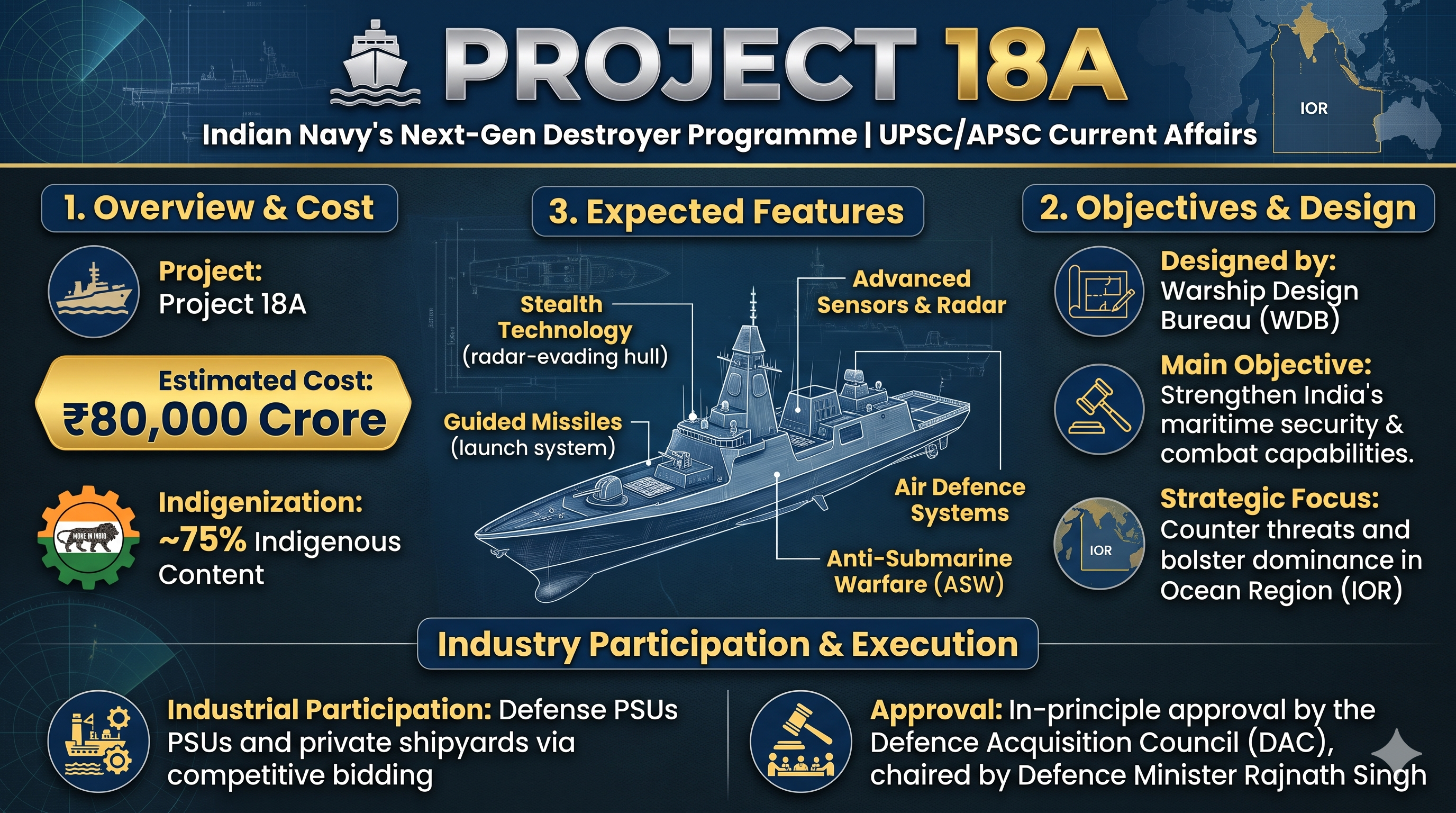
The Defence Acquisition Council (DAC), chaired by Defence Minister Rajnath Singh, has given in-principle approval to the Indian Navy’s next-generation destroyer programme under Project 18A, estimated to cost 80,000 crore.
Key Facts
Project: Project 18A.
Estimated cost: ₹80,000 crore.
Indigenous content: Approximately 75%.
Main objective: Strengthen India’s maritime security and combat capabilities.
Expected features: Stealth technology, guided missiles, advanced sensors, air defence and anti-submarine warfare systems.
Design agency: Indian Navy’s Warship Design Bureau.
Strategic significance: Counter emerging maritime threats and strengthen India’s presence in the Indian Ocean Region (IOR).
Industrial participation: Defence PSUs and private companies may participate in competitive bidding.
Practice Questions
Prelims Question
Q1. Consider the following statements about the Defence Acquisition Council (DAC):
It is chaired by the Defence Minister of India.
It deals with major defence acquisition decisions.
It functions under the Ministry of Defence.
Which of the statements given above are correct?
A) 1 only
B) 1 and 2 only
C) 2 and 3 only
D) 1, 2 and 3
Answer: D) 1, 2 and 3
Mains Question
Q. Examine the significance of modernising the Indian Navy in safeguarding India’s maritime interests in the Indo-Pacific region. (150 words | 10 marks)
India–Myanmar Military Cooperation
GS Paper II: International Relations
Key Highlights
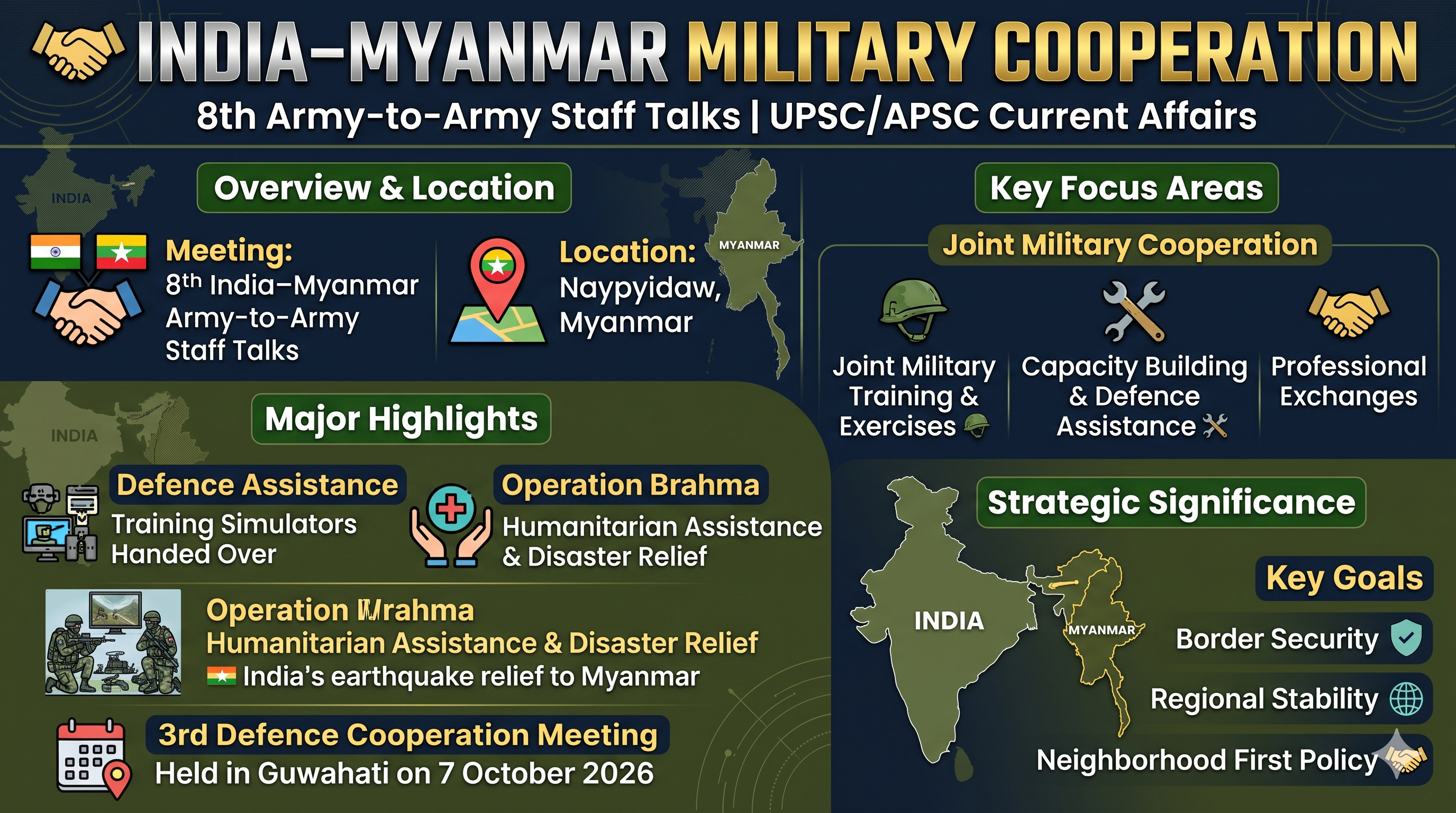
India and Myanmar held the 8th Army-to-Army Staff Talks in Naypyidaw to strengthen bilateral military cooperation through joint training, exercises and capacity building.
Key Facts
Meeting: 8th India–Myanmar Army-to-Army Staff Talks.
Location: Naypyidaw, Myanmar.
Key areas: Joint military training, exercises, capacity building and professional exchanges.
Defence assistance: India handed over training simulators to the Myanmar Army.
Defence Cooperation Meeting: The 3rd meeting was held in Guwahati on 7 October 2026.
Operation Brahma: India provided humanitarian assistance to Myanmar following the devastating earthquake.
Strategic significance: Strengthens border security, regional stability and cooperation in India’s neighbourhood.
Practice Questions
Prelims Question
Q1. Consider the following statements about India–Myanmar relations:
Myanmar shares a land border with India.
Myanmar is a member of ASEAN.
Operation Brahma was launched by India to provide humanitarian assistance to Myanmar following an earthquake.
Which of the statements given above are correct?
A) 1 only
B) 1 and 2 only
C) 2 and 3 only
D) 1, 2 and 3
Answer: D) 1, 2 and 3
Mains Question
Q. Discuss the strategic significance of India–Myanmar relations for India’s Act East Policy and security in Northeast India. (150 words | 10 marks)
Adverse Impact of Rat-Hole Mining: Kopili River Pollution
Environment (GS Paper 3)
Key Highlights
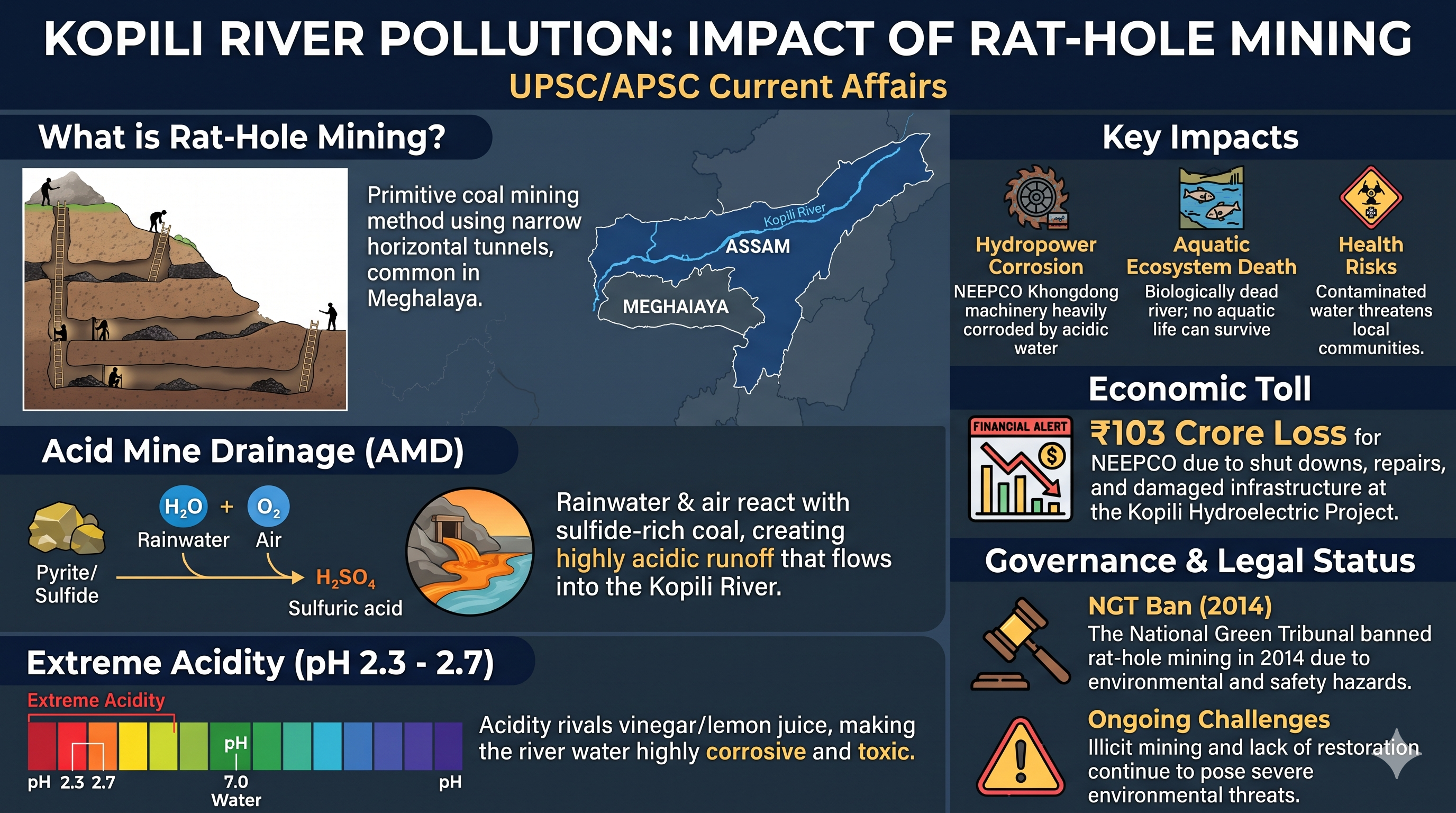
The Kopili River, flowing through Assam and Meghalaya, remains acidic due to sulphuric acid pollution associated with rat-hole coal mining in Meghalaya. Its acidic water has damaged machinery at NEEPCO’s Khongdong hydropower project.
Key Facts
Cause: Acid mine drainage from coal mining.
pH level: Approximately 2.3–2.7, indicating highly acidic water.
Impact: Corrosion of hydropower machinery, damage to aquatic ecosystems and risks to human health.
Economic loss: NEEPCO reported losses of ₹103 crore due to repeated power plant breakdowns.
Legal development: The National Green Tribunal (NGT) banned rat-hole mining in Meghalaya in 2014.
Current concern: Illegal mining continues despite the ban, and the river has not returned to a neutral pH.
What Is Rat-Hole Mining?
Rat-hole mining is a form of coal extraction through narrow, horizontal tunnels that are often just large enough for workers to enter.
Acid mine drainage: When sulphide minerals in exposed coal-bearing rocks react with air and water, they can produce sulphuric acid, contaminating nearby rivers and streams.
Practice Questions
Prelims Question
Q1. Consider the following statements about rat-hole mining:
It involves extracting coal through narrow tunnels.
It can cause acid mine drainage and water pollution.
The NGT banned rat-hole mining in Meghalaya in 2014.
Which of the statements given above are correct?
A) 1 only
B) 1 and 2 only
C) 2 and 3 only
D) 1, 2 and 3
Answer: D) 1, 2 and 3
Mains Question
Q. Discuss the environmental and economic consequences of rat-hole coal mining in Northeast India. Suggest measures for sustainable mining and river conservation. (150 words | 10 marks)