Supreme Court Seeks ECI Report on Form 7 Misuse
GS Paper II: Polity and Governance
Key Highlights
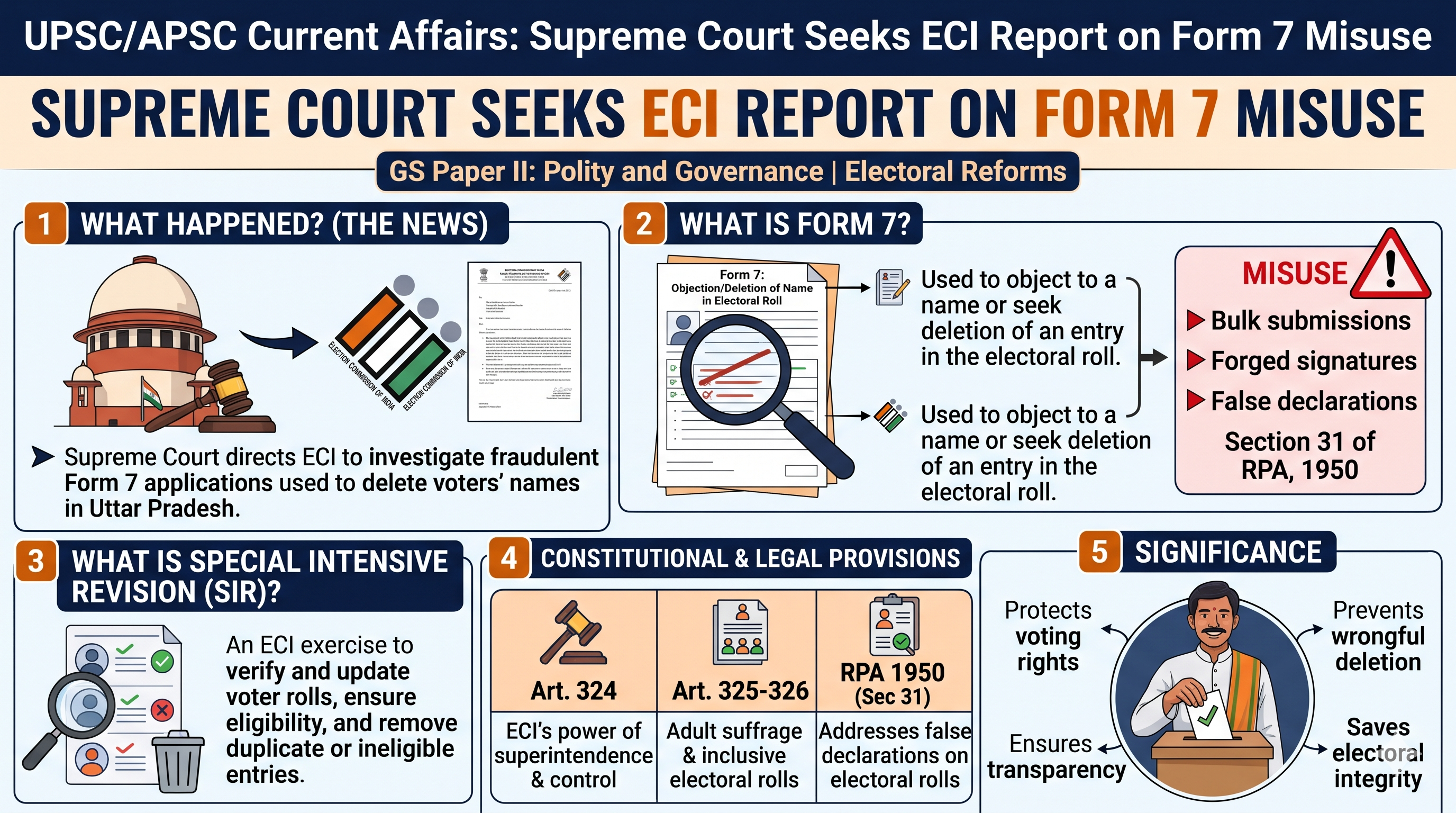
The Supreme Court directed the Election Commission of India (ECI) to investigate allegations of fraudulent use of Form 7 during the Special Intensive Revision (SIR) of electoral rolls in Uttar Pradesh and submit a compliance report.
The ECI stated that although false Form 7 applications were detected, none of the identified fraudulent applications was accepted.
Key Facts
Institution: Election Commission of India (ECI).
Court: Supreme Court of India.
Issue: Alleged fraudulent applications for deleting voters’ names.
State: Uttar Pradesh.
Form 7: Used to object to the inclusion of a name or seek deletion of an entry in the electoral roll, subject to applicable rules.
Legal provision: Section 31 of the Representation of the People Act, 1950, concerning false declarations.
Concern: Electoral integrity and the risk of wrongful voter deletion.
What Is Form 7?
Form 7 is an electoral form used for:
Objecting to the inclusion of a person’s name in the electoral roll.
Requesting deletion of an entry on permissible grounds under election rules.
Alleged misuse included:
Forged signatures and false declarations.
Incomplete or invalid details of applicants.
Bulk submission of pre-filled forms.
Filing objections in the names of people who denied submitting them.
What Is Special Intensive Revision (SIR)?
SIR is a detailed exercise conducted by the ECI to verify and update electoral rolls.
Objectives:
Ensure eligible citizens are included.
Identify duplicate or ineligible entries.
Correct errors in electoral rolls.
Improve the accuracy of voter lists.
Constitutional and Legal Provisions
Provision | Significance |
|---|---|
Article 324 | Vests the ECI with powers of superintendence, direction and control over elections. |
Article 325 | Provides for one general electoral roll and prohibits exclusion on grounds of religion, race, caste or sex. |
Article 326 | Provides for elections to the Lok Sabha and State Legislative Assemblies on the basis of adult suffrage, subject to constitutional provisions. |
Representation of the People Act, 1950 | Deals with electoral rolls and related matters. |
Section 31, RPA 1950 | Addresses false declarations in connection with electoral rolls. |
Significance
Protects citizens’ voting rights.
Prevents wrongful deletion of eligible voters.
Strengthens transparency and accountability in electoral-roll revision.
Reinforces public confidence in the electoral process.
Highlights the need for verification of objections and safeguards against impersonation.
Practice Questions
Prelims MCQs
A Form 7 application is subject to verification and the prescribed legal procedure; deletion is not automatic. Consider the following statements about Form 7:
It can be used to object to the inclusion of a name in the electoral roll.
It can be used to seek deletion of an entry in the electoral roll.
Every Form 7 application automatically results in deletion of a voter.
Which of the statements is/are correct?
A. 1 only
B. 1 and 2 only
C. 2 and 3 only
D. 1, 2 and 3
Answer: B. 1 and 2 only
Mains Question
Q. Examine the significance of electoral-roll revision in strengthening Indian democracy. What safeguards are necessary to prevent the wrongful deletion of eligible voters? (150 words)
Poverty Reduction in India
GS Paper II: Social Justice
Key Facts (World Bank Report, October 2026)
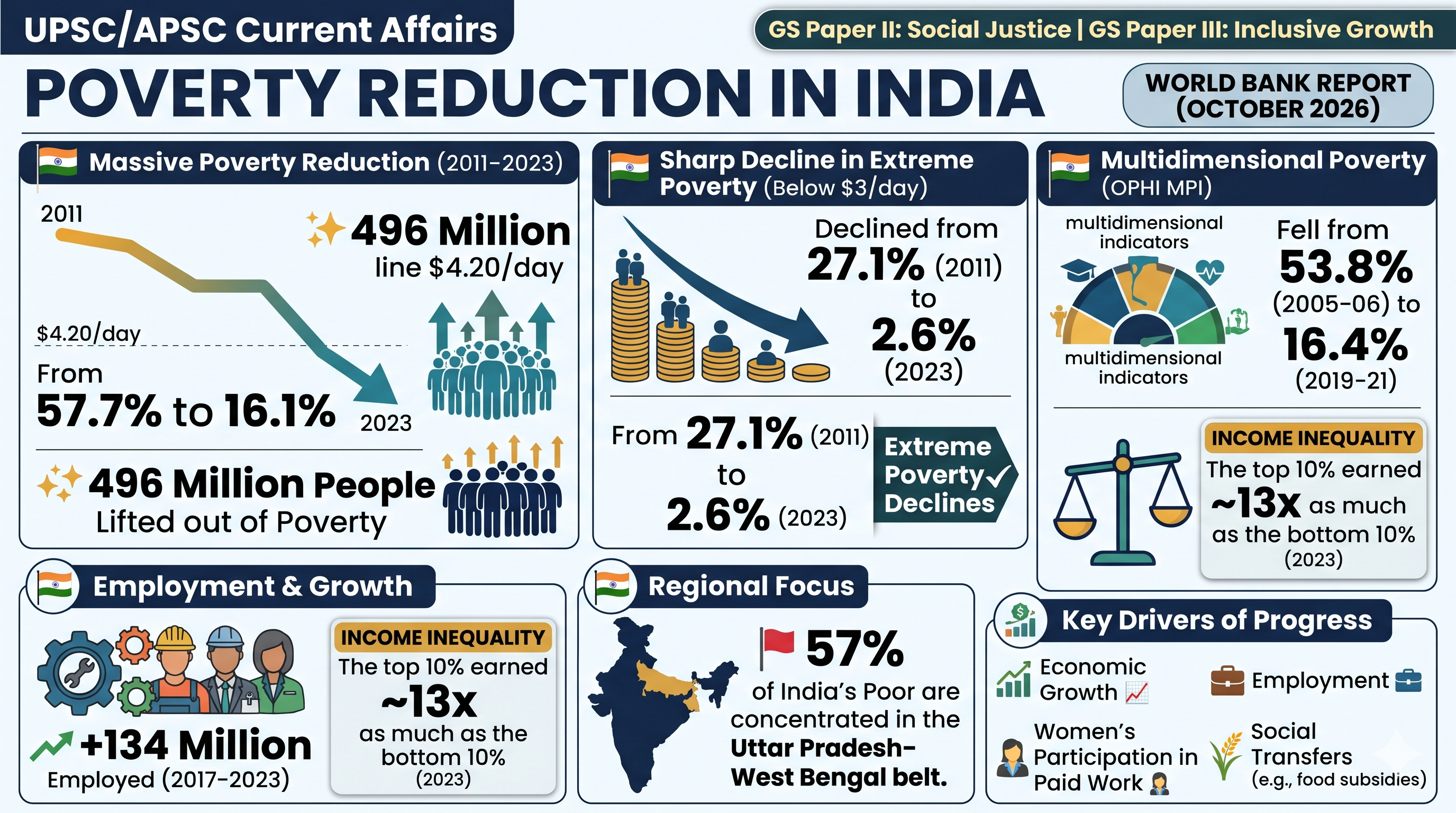
Poverty reduction (2011–2023): Poverty below the 4.20/day line fell from 57.7% to 16.1%, lifting an estimated 496 million people out of poverty.
Extreme poverty: Declined from 27.1% to 2.6% (below 3/day).
Multidimensional poverty: OPHI MPI poverty fell from 53.8% (2005–06) to 16.4% (2019–21).
Employment: Increased by approximately 134 million people (2017–2023).
Income inequality: The top 10% of workers earned about 13 times as much as the bottom 10% in 2023.
Regional concentration: Uttar Pradesh–West Bengal belt accounted for 57% of India’s poor.
Key drivers: Economic growth, employment, women’s participation in paid work and social transfers, including food subsidies.
Indicator | Earlier | Latest |
|---|---|---|
Poverty below the 4.20/day line (2011–2023) | 57.7% | 16.1% |
Extreme poverty (below 3/day) | 27.1% | 2.6% |
OPHI MPI poverty (2005–06 to 2019–21) | 53.8% | 16.4% |
Practice Questions
Prelims Questions
1. The World Bank’s lower-middle-income poverty line mentioned in the report is:
A. 2.15/day
B. 3.00/day
C. 4.20/day
D. 5.50/day
Answer: C. 4.20/day
Mains Question
Q. Despite India’s progress in poverty reduction, what challenges remain in achieving inclusive growth?
Glacial Lake Outburst Flood (GLOF) in Bhutan
GS Paper III: Disaster Management
Key Highlights
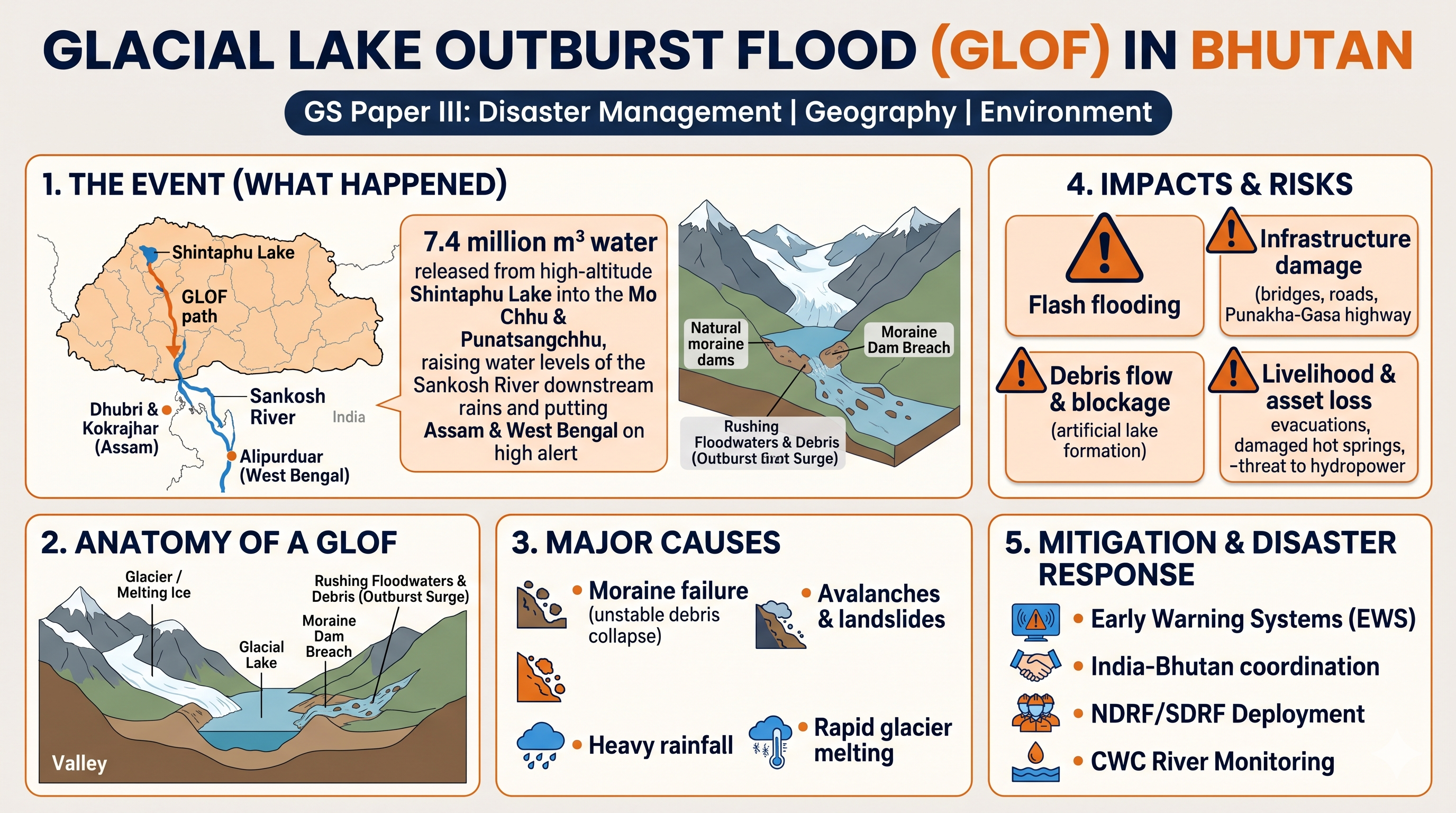
A Glacial Lake Outburst Flood (GLOF) occurred at Shintaphu Lake in Bhutan, triggering flood alerts in Dhubri and Kokrajhar districts of Assam and parts of West Bengal due to the possible sudden rise in the Sankosh River.
Key Facts
Location: Shintaphu Lake, Gasa district, northwestern Bhutan.
River system: Punatsangchhu–Sankosh River system.
Water released: Approximately 7.4 million cubic metres.
Affected areas in Assam: Dhubri and Kokrajhar.
Response: Authorities alerted residents; SDRF and NDRF teams were kept on standby.
Major concerns: Flash floods, erosion, damage to infrastructure and loss of life.
What Is GLOF?
A Glacial Lake Outburst Flood (GLOF) is the sudden release of water stored in a glacial lake when its natural barrier fails or is overtopped.
Causes:
Landslides and rockfalls.
Ice avalanches and earthquakes.
Failure of moraine dams.
Heavy rainfall and excessive meltwater inflow.
Rising temperatures and glacier melting.
Impacts of GLOF
Sudden flooding of downstream areas.
Loss of human and animal lives.
Destruction of bridges, roads and settlements.
Soil erosion and deposition of rocks and debris.
Damage to agriculture and livelihoods.
Disruption of communication and transport networks.
Disaster Management Measures
Early-warning systems and river-level monitoring.
Hazard mapping and regular risk assessment.
Evacuation of vulnerable communities.
Coordination among India, Bhutan, CWC, ASDMA, SDRF and NDRF.
Community awareness and disaster-preparedness drills.
Long-term monitoring of high-risk glacial lakes.
Practice Questions
Prelims Questions
GLOFs can cause destructive floods far downstream, affecting areas distant from glaciers. Consider the following statements about GLOFs:
GLOFs involve the sudden release of water from glacial lakes.
Landslides and ice avalanches can trigger GLOFs.
GLOFs affect only areas located near glaciers.
Which of the statements is/are correct?
A. 1 only
B. 1 and 2 only
C. 2 and 3 only
D. 1, 2 and 3
Answer: B. 1 and 2 only
Mains Question
Q. What are Glacial Lake Outburst Floods (GLOFs)? Discuss their causes, impacts and mitigation measures, with special reference to Northeast India. (150 words)
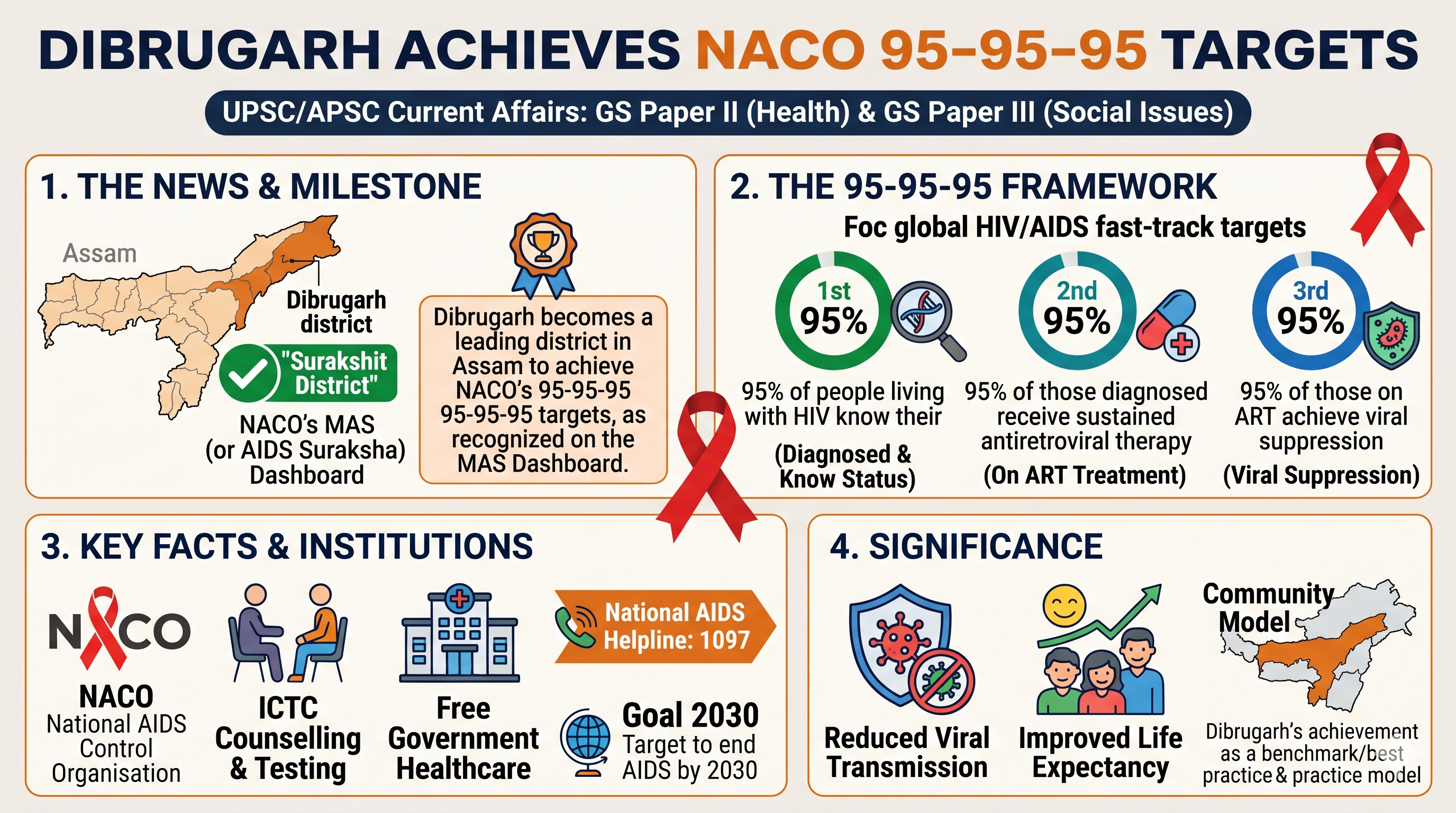
Dibrugarh Achieves NACO’s 95-95-95 Targets
GS Paper II: Health
Key Highlights
Dibrugarh has become the first among Assam’s six identified high-priority districts to achieve all three targets under the 95-95-95 framework, earning ‘Surakshit District’ status on the NACO’s Mobilization for AIDS Suraksha (MAS) Dashboard.
Key Facts
NACO: National AIDS Control Organisation.
Programme: National AIDS Control Programme (NACP).
MAS: Mobilization for AIDS Suraksha.
Goal: End AIDS as a public health threat by 2030.
Key achievement: Meeting all three 95-95-95 targets.
Free services: HIV testing and treatment at government health facilities.
National AIDS Helpline: 1097.
What Is the 95-95-95 Framework?
Target | Objective |
|---|---|
First 95% | People living with HIV know their HIV status. |
Second 95% | People diagnosed with HIV receive antiretroviral therapy (ART). |
Third 95% | People receiving ART achieve viral suppression. |
Important Terms
HIV: Human Immunodeficiency Virus, which attacks the immune system.
AIDS: Acquired Immunodeficiency Syndrome, the advanced stage of HIV infection.
ART: Antiretroviral Therapy, which suppresses HIV and helps people live longer, healthier lives.
ICTC: Integrated Counselling and Testing Centre.
DAPCU: District AIDS Prevention and Control Unit.
Significance
Strengthens HIV prevention, testing and treatment.
Improves access to healthcare services.
Encourages community participation.
Supports India’s commitment to ending AIDS as a public health threat by 2030.
Provides a model for other high-priority districts in Assam.
Practice Questions
Prelims Questions
Q1. Consider the following statements about the 95-95-95 framework:
It aims to increase awareness of HIV status.
It promotes access to antiretroviral therapy.
It aims to achieve viral suppression among people receiving treatment.
Which of the statements is/are correct?
A. 1 only
B. 1 and 2 only
C. 2 and 3 only
D. 1, 2 and 3
Answer: D. 1, 2 and 3
Mains Question
Q. Explain the significance of the 95-95-95 framework in controlling HIV/AIDS in India. (150 words)