SC Permits Green Crackers for Two Days in Delhi-NCR
GS Paper 2 (Polity)
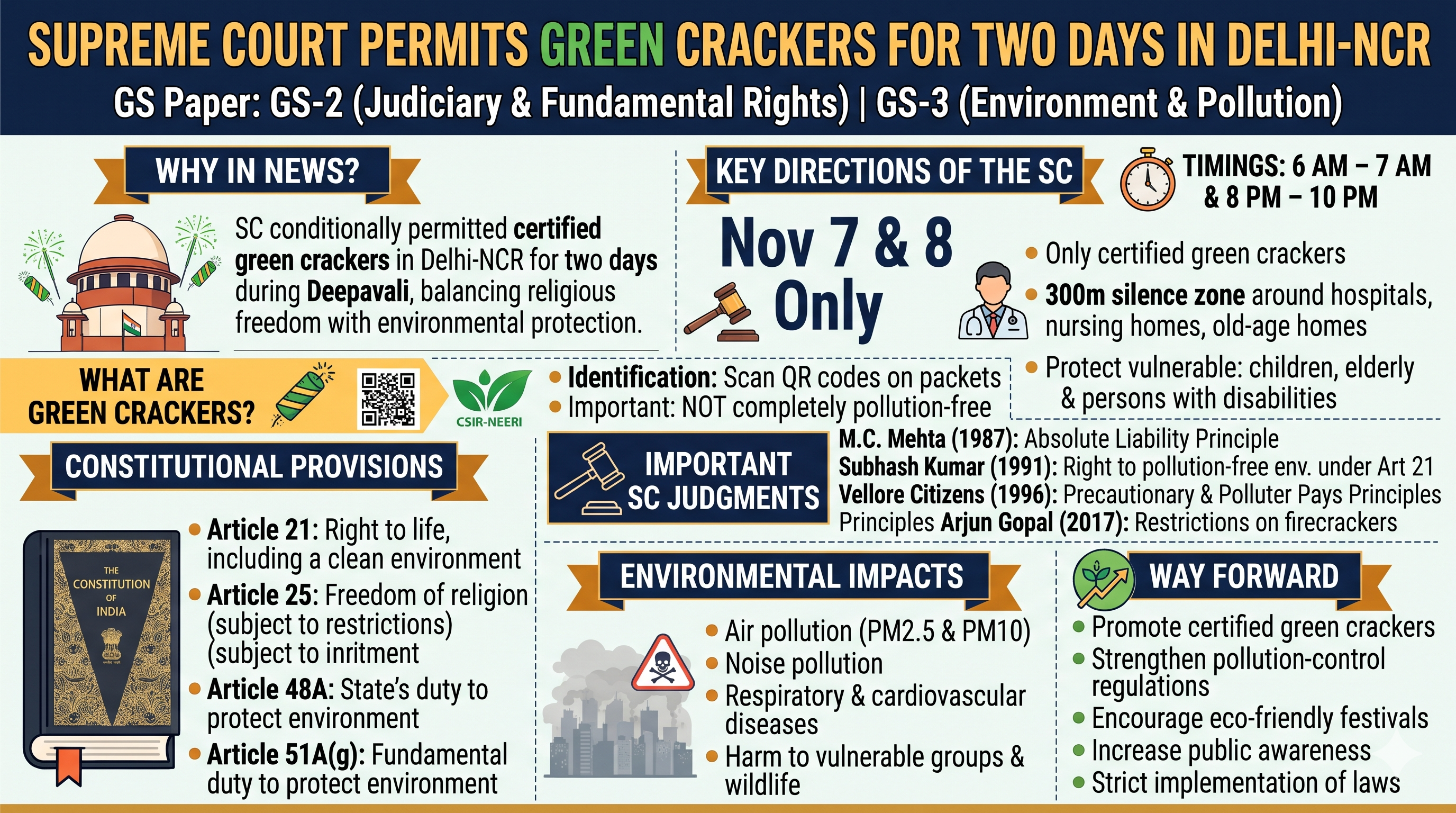
The Supreme Court conditionally permitted certified green crackers in Delhi-NCR for two days during Deepavali, balancing religious freedom with environmental protection and public health.
Key Directions of the Supreme Court
Permitted dates: November 7 and 8.
Morning: 6 AM – 7 AM.
Evening: 8 PM – 10 PM.
Only certified green crackers are permitted.
No crackers within a 300-metre radius of hospitals, nursing homes, health centres, old-age homes and notified silence zones.
Children, elderly people and persons with disabilities are particularly vulnerable to pollution.
What Are Green Crackers?
Developed through research by CSIR-NEERI.
Designed to reduce particulate emissions.
Use reduced quantities of certain polluting chemicals.
QR codes help identify certified products.
Important: Green crackers are not completely pollution-free.
Constitutional Provisions
Article | Provision |
|---|---|
Article 21 | Right to life, including a clean environment |
Article 25 | Freedom of religion, subject to restrictions |
Article 48A | State’s duty to protect the environment |
Article 51A(g) | Fundamental duty to protect the environment |
Important Supreme Court Judgments
M.C. Mehta Case (1987): Absolute Liability Principle.
Subhash Kumar Case (1991): Right to pollution-free environment under Article 21.
Vellore Citizens’ Welfare Forum (1996): Precautionary Principle and Polluter Pays Principle.
Arjun Gopal Case (2017): Restrictions on firecrackers to control air pollution.
Environmental Impacts
Air pollution (PM2.5 and PM10).
Noise pollution.
Respiratory and cardiovascular diseases.
Harm to children and elderly people.
Disturbance to wildlife.
Way Forward
Promote certified green crackers.
Strengthen pollution-control regulations.
Encourage eco-friendly festivals.
Increase public awareness.
Ensure strict implementation of environmental laws.
Practice Questions
Prelims Questions
Q1. Green crackers are associated with which organisation?
A. ISRO
B. DRDO
C. CSIR-NEERI
D. NITI Aayog
Answer: C
Mains Questions
Discuss the role of the judiciary in balancing religious freedom and environmental protection. (150 words)
Examine the importance of green crackers in controlling urban air pollution. (150 words)
Supreme Court Directs Time-Bound Financial Assistance and Rehabilitation for Rescued Bonded Labourers
GS Paper 2 (Social Justice & Human Rights)
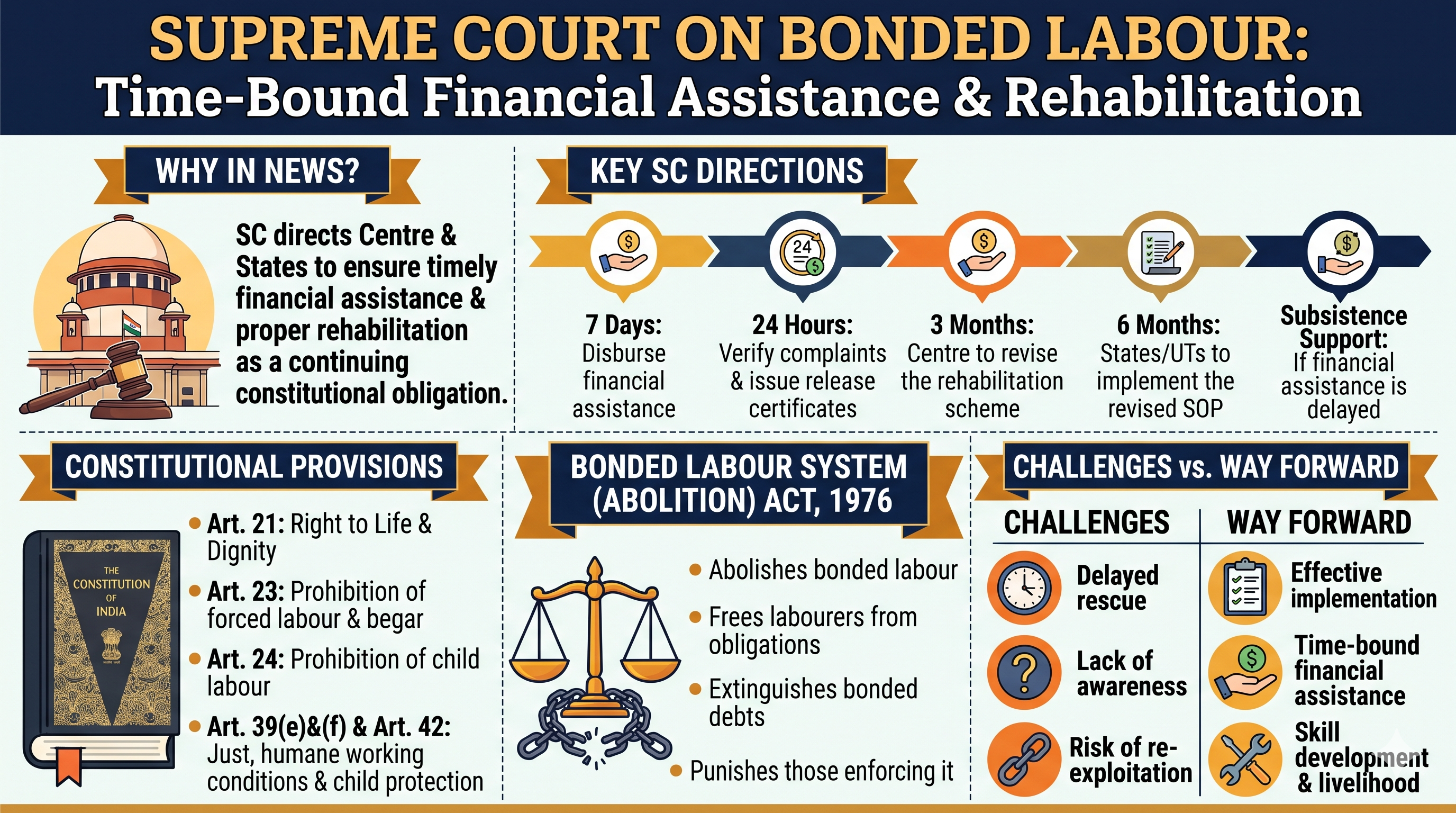
The Supreme Court directed the Centre and States to ensure timely financial assistance and proper rehabilitation of rescued bonded labourers, emphasising that their rehabilitation is a continuing constitutional obligation.
Key Directions of the Supreme Court
Financial assistance must be disbursed within 7 days of release.
Centre to consider revising the rehabilitation scheme within 3 months.
Provide subsistence support if financial assistance is delayed.
States and UTs must implement the revised SOP within 6 months.
Centre to issue supplementary guidelines in consultation with NHRC within 3 months.
Complaints should ordinarily be verified within 24 hours.
Release certificates should ordinarily be issued within 24 hours after identification and necessary inquiry.
Constitutional Provisions
Article | Provision |
|---|---|
Article 21 | Right to life and dignity |
Article 23 | Prohibition of human trafficking, begar and forced labour |
Article 24 | Prohibition of child labour in factories, mines and hazardous employment |
Article 39(e) | Protection of workers’ health and strength |
Article 39(f) | Protection of children’s development and dignity |
Article 42 | Just and humane conditions of work |
Important Legislation
Bonded Labour System (Abolition) Act, 1976
Key provisions:
Abolishes the bonded labour system.
Frees bonded labourers from their obligations.
Extinguishes bonded debts.
Prohibits the creation of new bonded labour arrangements.
Provides for punishment of those enforcing bonded labour.
Important Institutions
NHRC: Monitors human rights violations and safeguards.
Ministry of Labour and Employment: Implements labour welfare policies.
District Magistrate: Plays an important role in identifying, releasing and rehabilitating bonded labourers.
Significance
Protects human dignity and fundamental rights.
Prevents re-trafficking and exploitation.
Promotes social justice and inclusive development.
Ensures timely rehabilitation and financial security.
Strengthens implementation of Article 23.
Challenges
Delayed identification and rescue.
Lack of awareness among vulnerable communities.
Poverty, unemployment and indebtedness.
Weak implementation of rehabilitation schemes.
Risk of re-exploitation after release.
Way Forward
Effective implementation of the Bonded Labour System (Abolition) Act, 1976.
Time-bound financial assistance.
Skill development and livelihood opportunities.
Strengthening district-level monitoring.
Awareness campaigns and legal assistance.
Coordination among Centre, States and NHRC.
Practice Questions
Prelims Questions
Q1. Article 23 of the Indian Constitution prohibits:
A. Child marriage
B. Human trafficking and forced labour
C. Religious discrimination
D. Untouchability
Answer: B
Mains Questions
Discuss the constitutional and legal safeguards available for the protection of bonded labourers in India. (150 words)
Government Can Intervene in Airfares During Extraordinary Situations
GS Paper 3 (Economy)
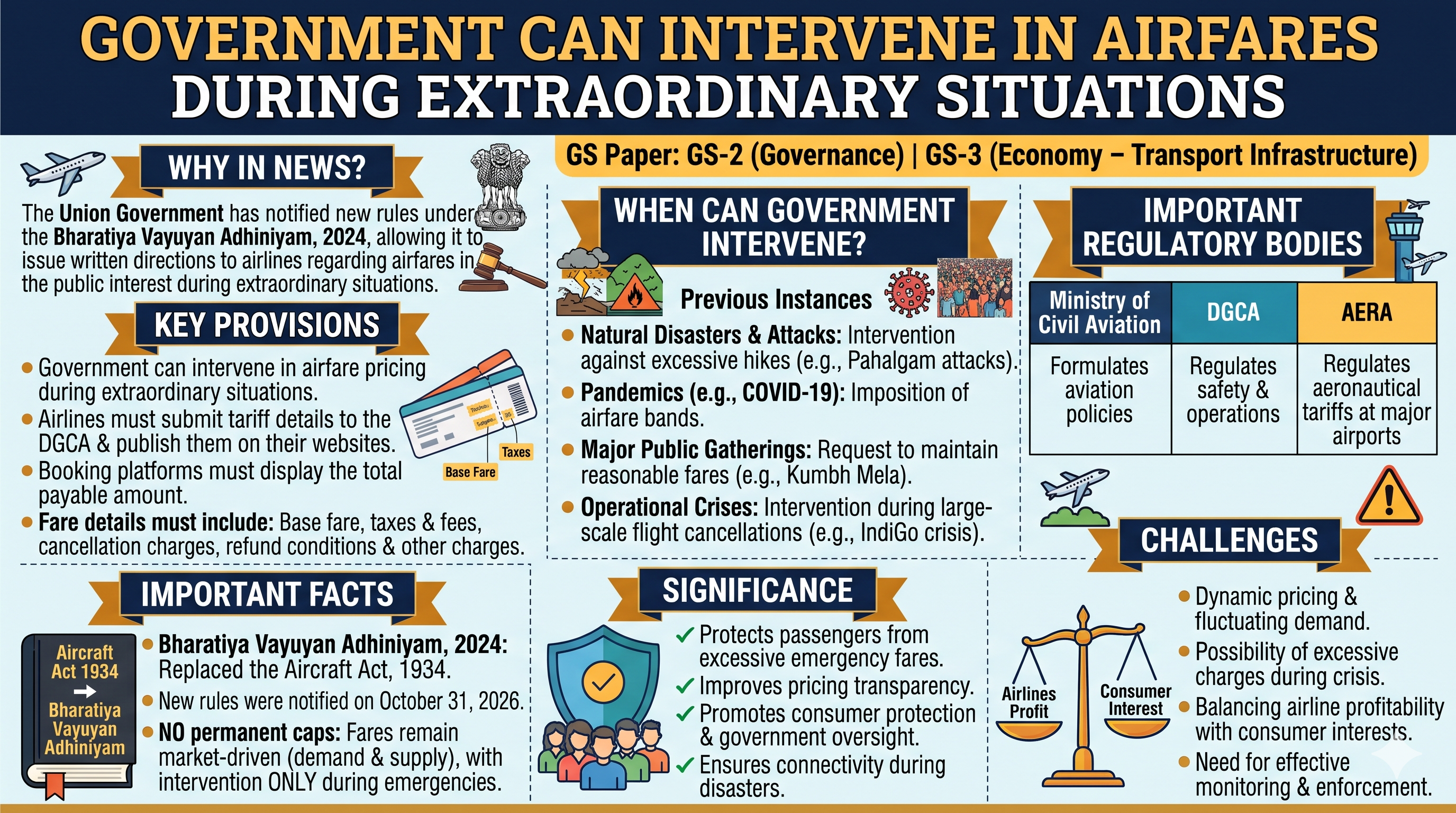
The Union Government has notified new rules under the Bharatiya Vayuyan Adhiniyam, 2024, allowing it to issue written directions to airlines regarding airfares in the public interest during extraordinary situations.
Key Provisions
Government can intervene in airfare pricing during extraordinary situations.
Airlines must submit their tariff details to the Directorate General of Civil Aviation (DGCA).
Airlines must publish fares on their websites or specified digital platforms.
Booking platforms and tickets must display the total payable amount.
When Can Government Intervene?
Previous instances of government intervention include:
COVID-19 pandemic: Imposition of airfare bands.
IndiGo operational crisis: Intervention following large-scale flight cancellations.
Kumbh Mela: Request to airlines to maintain reasonable fares.
Pahalgam attacks and natural disasters: Intervention against excessive airfare increases.
Important Regulatory Bodies
Institution | Role |
|---|---|
Ministry of Civil Aviation | Formulates aviation policies |
DGCA | Regulates civil aviation safety and operations |
AERA | Regulates aeronautical tariffs at major airports |
Important Facts
Bharatiya Vayuyan Adhiniyam, 2024: Replaced the Aircraft Act, 1934.
New rules were notified on October 31, 2026.
Government intervention is permitted in extraordinary situations.
No permanent airfare caps have been introduced.
Airfares generally remain market-driven, based on demand and supply.
Significance
Protects passengers from excessive airfare during emergencies.
Improves pricing transparency.
Promotes consumer protection.
Strengthens government oversight.
Ensures reasonable air connectivity during disasters.
Challenges
Dynamic pricing and fluctuating demand.
Possibility of excessive charges during emergencies.
Balancing airline profitability with consumer interests.
Need for effective monitoring and enforcement.
Practice Questions
Prelims Question
Q1. Bharatiya Vayuyan Adhiniyam, 2024 replaced which legislation?
A. Air Corporations Act, 1953
B. Aircraft Act, 1934
C. Airports Authority of India Act, 1994
D. Civil Aviation Act, 2000
Answer: B. Aircraft Act, 1934
Mains Questions
Discuss the role of government regulation in ensuring consumer protection in India’s aviation sector. (150 words)