Public Accounts Committee (PAC)
GS Paper II – Polity & Governance
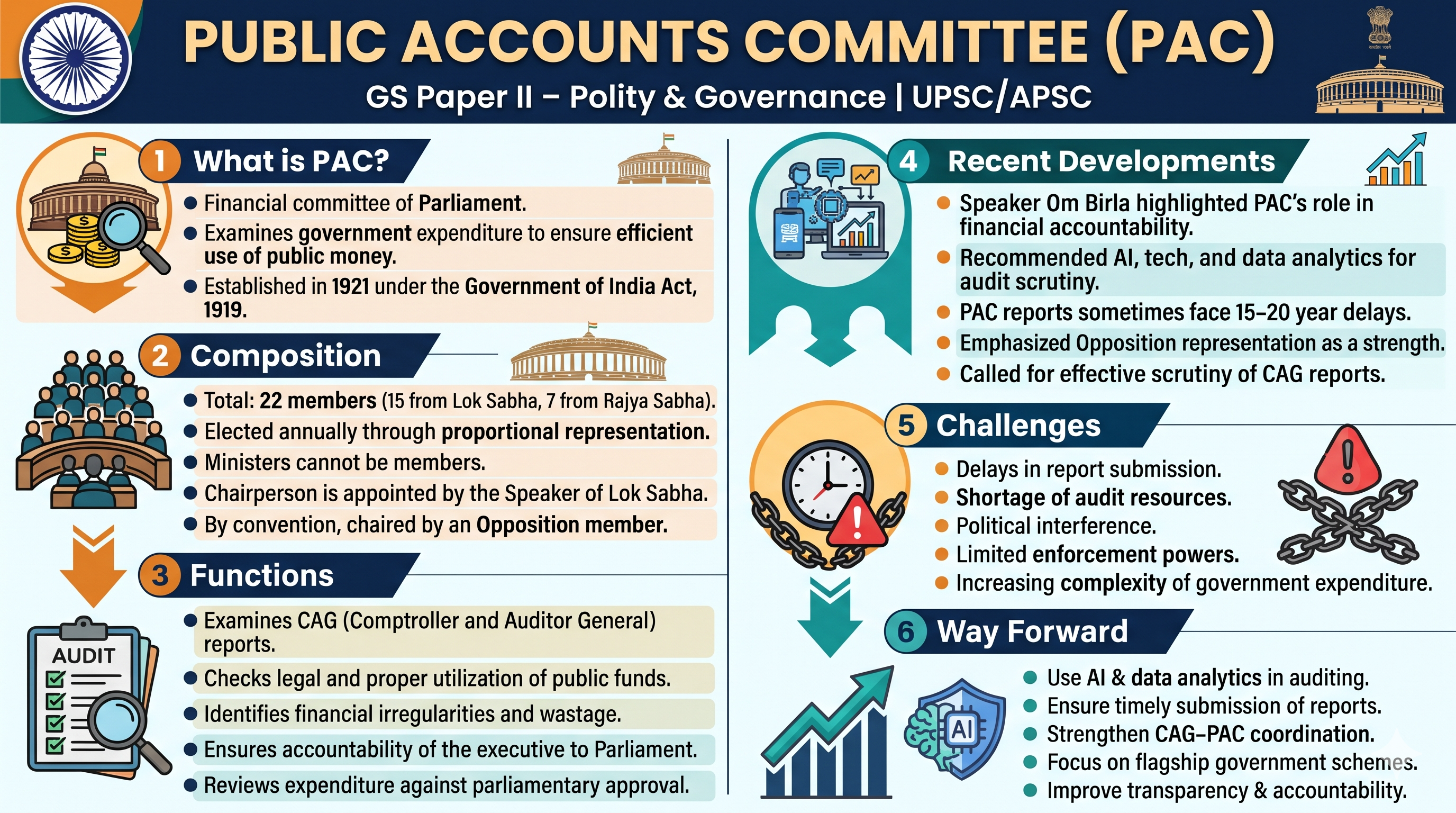
What is PAC?
The Public Accounts Committee (PAC) is a financial committee of Parliament.
It examines government expenditure and ensures public money is used efficiently and for its intended purposes.
Established in 1921 under the Government of India Act, 1919.
Composition
22 members: 15 from Lok Sabha and 7 from Rajya Sabha.
Members are elected annually through proportional representation.
Ministers cannot become PAC members.
The Speaker of Lok Sabha appoints chairperson.
By convention, a member of the Opposition chairs the PAC.
Functions
Examines CAG reports on government expenditure.
Checks whether public funds are legally and properly utilised.
Identifies financial irregularities and wastage.
Ensures accountability of the executive to Parliament.
Reviews expenditure against parliamentary approval.
Recent Developments
Lok Sabha Speaker Om Birla highlighted PAC’s role in financial accountability.
Recommended AI, technology and data analytics to improve audit scrutiny.
PAC reports sometimes face delays of 15–20 years.
Emphasised Opposition representation as a strength of parliamentary democracy.
Called for effective scrutiny of CAG reports.
Challenges
Delays in submission of reports.
Shortage of audit resources.
Political interference.
Limited enforcement powers.
Increasing complexity of government expenditure.
Way Forward
Use AI and data analytics in auditing.
Ensure timely submission of reports.
Strengthen CAG–PAC coordination.
Focus on flagship government schemes.
Improve transparency and accountability.
Practice Questions
Prelims Questions
Q1. Consider the following statements about PAC:
It consists of 22 members.
Ministers can become PAC members.
It examines CAG reports.
Which statements are correct?
A. 1 and 2 only
B. 1 and 3 only
C. 2 and 3 only
D. All three
Answer: B
Mains Questions
(10 Marks, 150 Words) Discuss the role of the Public Accounts Committee in ensuring financial accountability and transparency in India.
India’s Priorities at UN Climate Conference (COP31)
GS Paper III – Environment & Climate Change
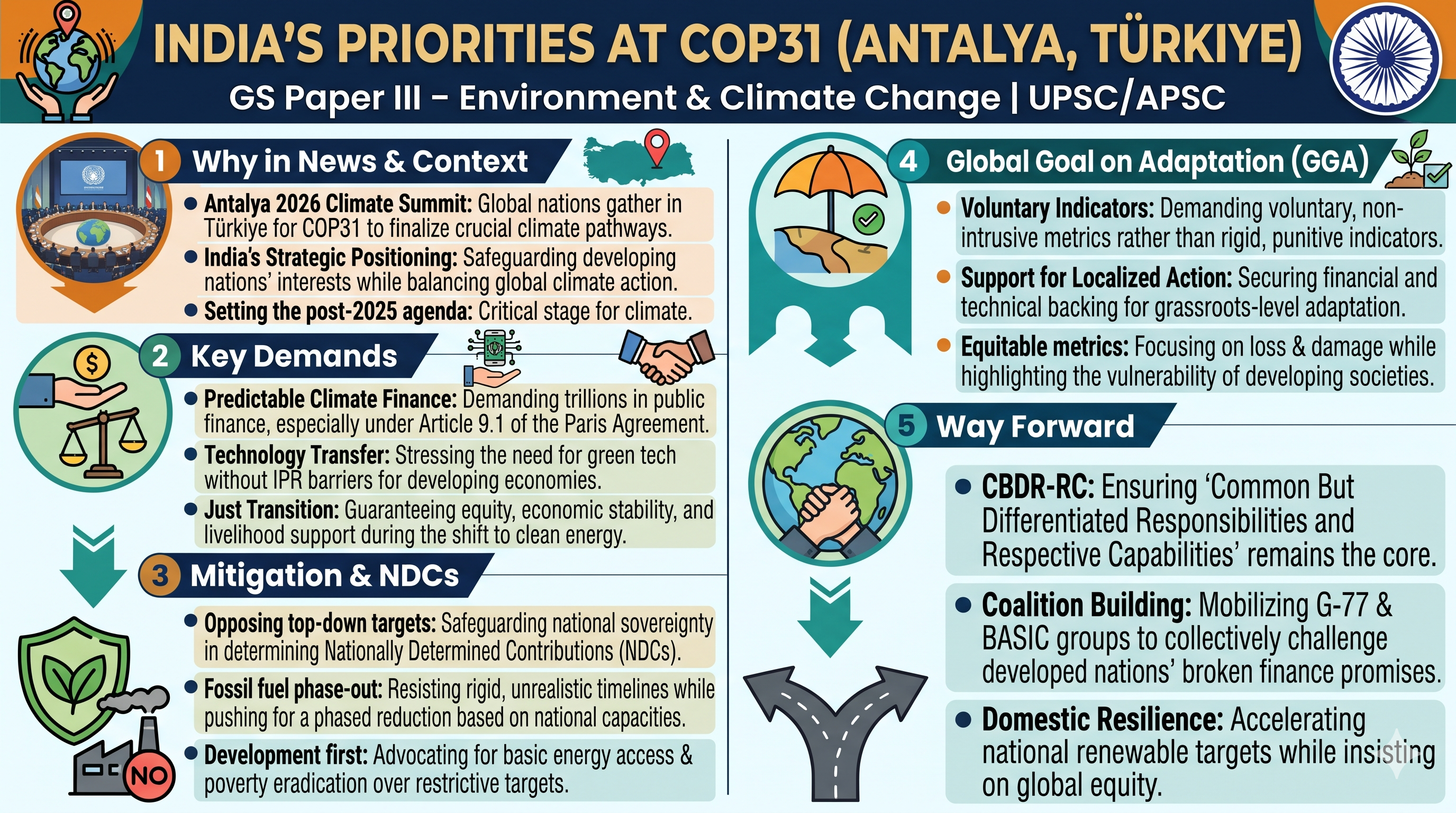
India has outlined its priorities for COP31, scheduled to be held in Antalya, Türkiye, from 9–20 November 2026.
India’s Key Demands
Predictable Climate Finance: Developed countries must fulfil their financial commitments to developing nations.
Climate Finance Work Programme: India seeks its commencement at COP31.
Equitable Transition: Supports a just and fair energy transition without imposing unequal burdens on developing countries.
Technology Transfer: Demands affordable access to clean technologies.
Nationally Determined Contributions (NDCs): Opposes imposing top-down mitigation targets on developing countries.
Just Transition Work Programme (JTWP): Supports its continuation.
Fossil Fuel Phase-out: India opposes restrictive language on fossil fuel cuts or phase-out.
Important Climate Provisions
Provision | Significance |
|---|---|
Article 9.1, Paris Agreement | Developed countries shall provide financial resources to developing countries. |
Article 2 | Limits global temperature rise to well below 2°C and pursues efforts towards 1.5°C. |
Article 4 | Nationally Determined Contributions (NDCs). |
Article 7 | Global Goal on Adaptation (GGA). |
Global Goal on Adaptation (GGA)
Aims to enhance adaptive capacity and climate resilience.
India wants adaptation indicators to remain voluntary.
Such indicators should not become conditions for accessing climate finance.
India highlighted reduction of adaptation parameters from nearly 1,000 to 59.
Key Concepts for Prelims
COP: Conference of the Parties to the UNFCCC.
UNFCCC: United Nations Framework Convention on Climate Change (1992).
Paris Agreement: Adopted in 2015 at COP21.
NDCs: Country-specific climate action commitments.
Climate Finance: Financial support for mitigation and adaptation.
Just Transition: Ensuring fairness for workers and communities during the shift to a low-carbon economy.
GGA: Global Goal on Adaptation.
Challenges
Climate finance gap.
Unequal climate responsibilities.
Technology transfer barriers.
Energy security concerns.
Debt burden on developing countries.
Balancing economic development with emission reduction.
Way Forward
Ensure predictable and concessional climate finance.
Promote technology transfer.
Follow the principle of Common but Differentiated Responsibilities and Respective Capabilities (CBDR-RC).
Strengthen international climate cooperation.
Ensure a just and inclusive energy transition.
Practice Questions
Prelims MCQs
Q1. Article 9.1 of the Paris Agreement deals with:
A. Climate adaptation
B. Climate finance
C. Carbon markets
D. Technology transfer
Answer: B
Mains Questions
(10 Marks | 150 Words) Discuss India’s key priorities at COP31 and examine the challenges faced by developing countries in achieving climate justice.
Rising Education Loan Burden in India
GS Paper III – Indian Economy
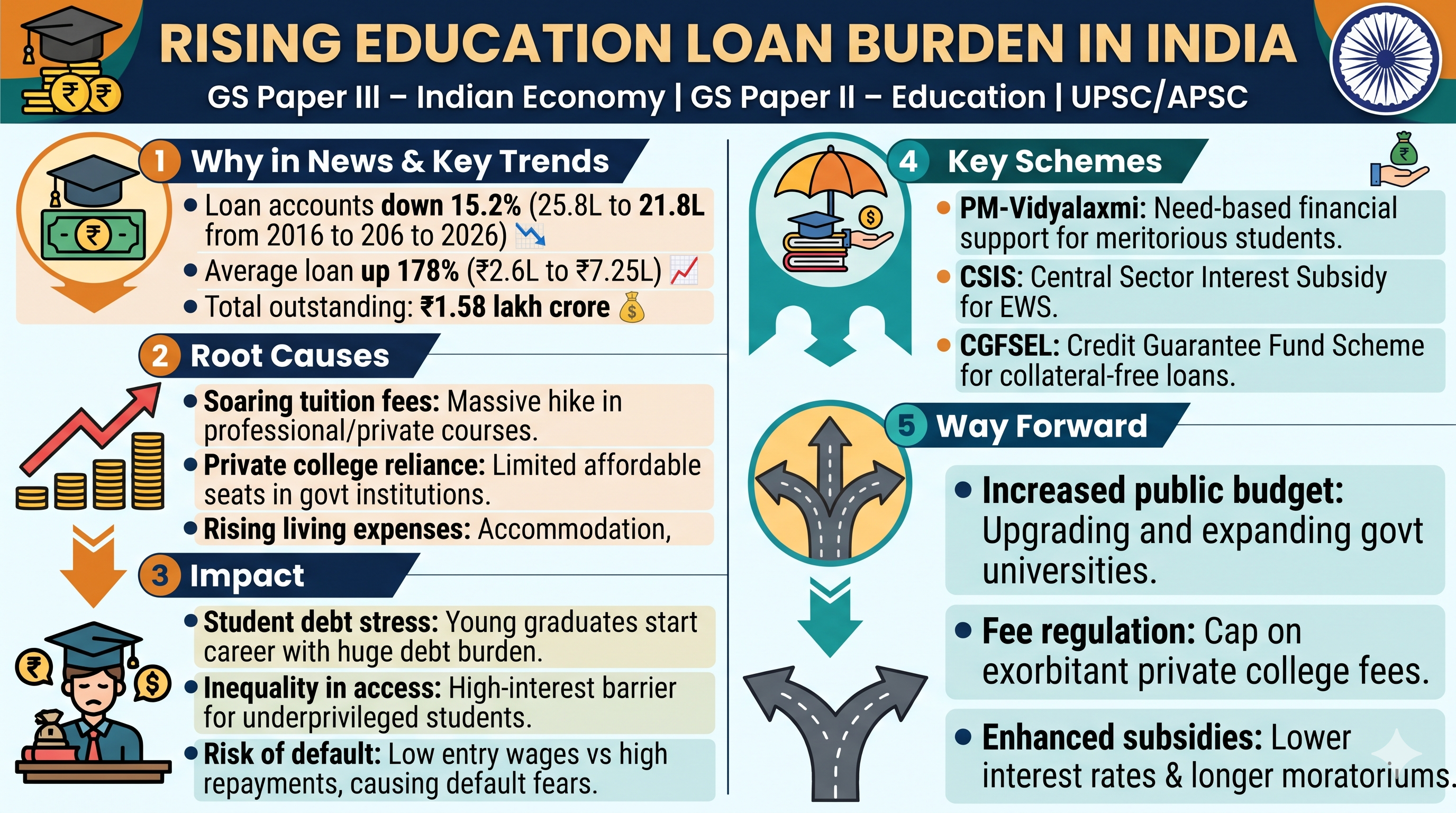
An analysis of RBI data shows that fewer students are taking education loans, but the average loan amount has increased significantly over the last decade (June 2016–June 2026).
Key Findings
Indicator | June 2016 | June 2026 |
|---|---|---|
Education loan accounts | 25.76 lakh | 21.84 lakh |
Average loan outstanding | 2.6 lakh | 7.25 lakh |
Total outstanding loans | 67,175 crore | 1,58,468 crore |
Share in total bank credit | 0.93% | 0.74% |
Important Statistics:
Number of education loan accounts declined by 15.2%.
Average outstanding loan increased by 178.2%.
Loans above 2 lakh increased by 31.6%.
Smaller loan accounts (up to 2 lakh) declined from 11.44 lakh to 3 lakh.
Education Department’s share in the Union Budget declined from 1.46% (2016–17) to 0.99% (2025–26).
Major Reasons
Rising cost of higher education.
Increasing professional and technical education fees.
Higher living and accommodation expenses.
Growing dependence on private educational institutions.
Limited availability of affordable higher education.
Reduced access to smaller education loans.
Implications
Economic Impact
Increasing financial burden on students.
Risk of education loan defaults.
Long-term debt burden on young graduates.
Social Impact
Educational inequality.
Reduced access for economically weaker sections.
Possible decline in social mobility.
Human Capital
May affect skill development.
Limits equal opportunities in higher education.
Government Initiatives
Scheme | Objective |
|---|---|
PM-Vidyalaxmi Scheme | Collateral-free, guarantor-free education loans for eligible students in quality higher education institutions. |
Central Sector Interest Subsidy Scheme (CSIS) | Interest subsidy during the moratorium period for eligible students from economically weaker sections. |
Credit Guarantee Fund Scheme for Education Loans (CGFSEL) | Provides guarantee coverage for eligible education loans. |
Way Forward
Increase public investment in education.
Expand scholarships and interest subsidies.
Strengthen government higher education institutions.
Improve access to affordable professional education.
Ensure transparent regulation of private educational fees.
Strengthen financial literacy among students.
Practice Questions
Prelims Questions
Q1. Which institution publishes data on outstanding education loans by scheduled commercial banks in India?
A. SEBI
B. RBI
C. NITI Aayog
D. NABARD
Answer: B
Mains Questions
(10 Marks | 150 Words) Discuss the major challenges associated with rising education costs and their impact on access to higher education in India.
Dibru-Saikhowa National Park: Oil Exploration Dispute
GS Paper III – Environment
Key Highlights
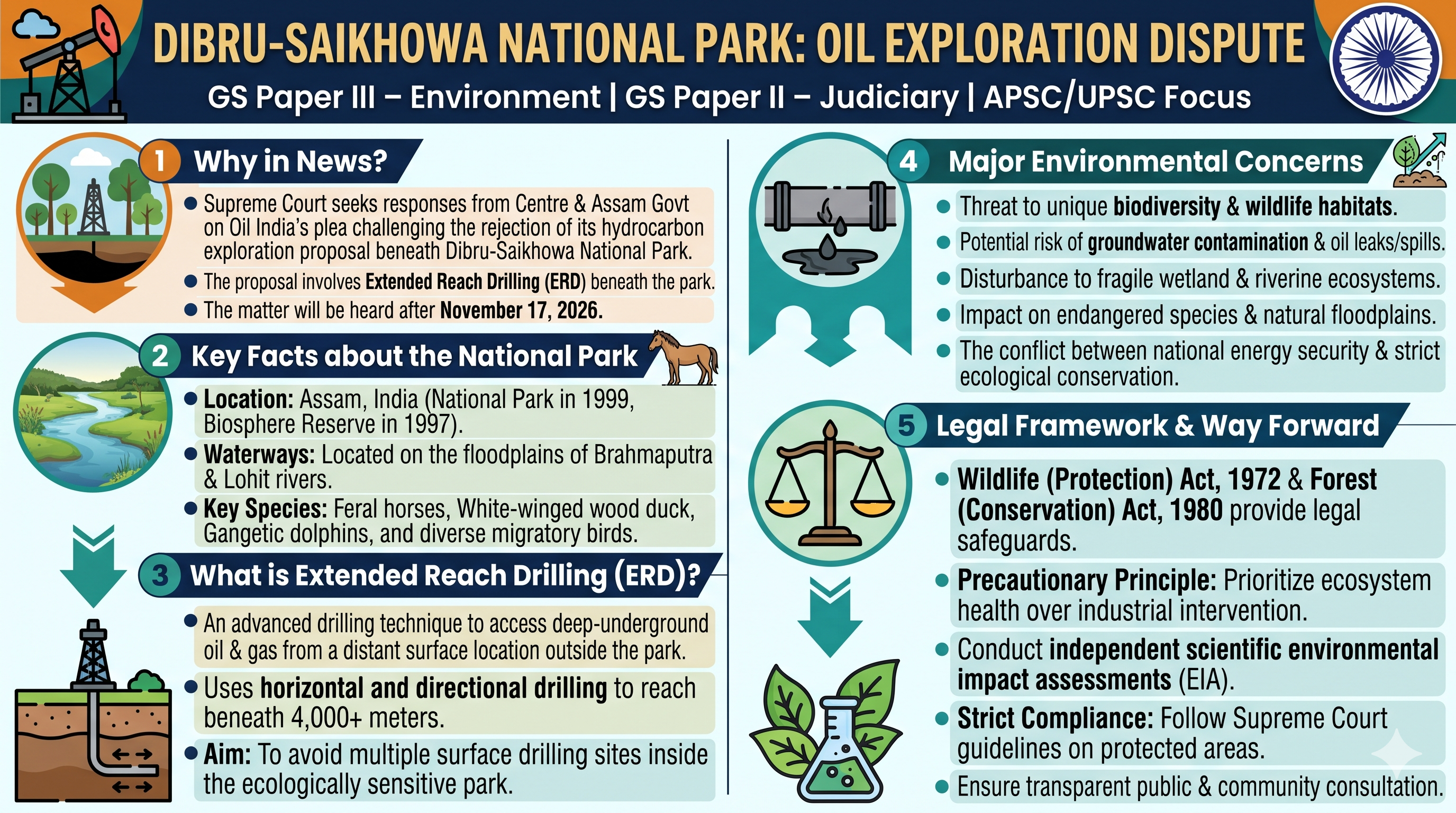
The Supreme Court sought responses from the Centre and Assam Government on Oil India’s plea challenging the rejection of its hydrocarbon exploration proposal beneath Dibru-Saikhowa National Park.
The proposal involves Extended Reach Drilling (ERD).
The matter will be heard after November 17, 2026.
What is Extended Reach Drilling (ERD)?
An advanced drilling technique used to access underground oil and gas reserves from a distant drilling location.
Allows horizontal and directional drilling.
Reduces the need for multiple drilling sites.
Oil India claims drilling below 4,000 metres will minimise ecological disturbance.
Key Facts
Location: Assam, India.
Type: National Park and Biosphere Reserve.
Established as National Park: 1999.
Biosphere Reserve: 1997.
Rivers: Brahmaputra and Lohit river systems.
Famous for: Floodplain ecosystem, wetlands and rich biodiversity.
Important species: Feral horses, Gangetic dolphins, riverine species and migratory birds.
Major Concerns
Threat to biodiversity and wildlife habitats.
Possible groundwater contamination.
Risk of oil spills and leakage.
Disturbance to fragile wetland ecosystems.
Impact on endangered species.
Conflict between energy security and environmental protection.
Legal and Environmental Context
Wildlife (Protection) Act, 1972: Provides legal protection to wildlife and protected areas.
Environment (Protection) Act, 1986: Provides a framework for environmental protection.
Forest (Conservation) Act, 1980: Regulates diversion of forest land.
Supreme Court’s 2023 order: Relevant to restrictions on mining activities in protected areas.
Important Concepts
Concept | Meaning |
|---|---|
ERD | Extended Reach Drilling |
Hydrocarbon | Compounds of hydrogen and carbon, including petroleum and natural gas |
National Park | Protected area for wildlife and biodiversity |
Ecological Impact Assessment | Assessment of potential environmental impacts |
Sustainable Development | Balancing economic development and environmental protection |
Way Forward
Conduct independent scientific environmental assessments.
Follow the precautionary principle.
Ensure strict compliance with environmental laws.
Protect biodiversity and fragile ecosystems.
Balance energy security with ecological sustainability.
Ensure transparent public consultation.
Practice Questions
Prelims Questions
Q1. Dibru-Saikhowa National Park is located in:
A. Arunachal Pradesh
B. Assam
C. Meghalaya
D. Nagaland
Answer: B
Mains Questions
(10 Marks | 150 Words) Discuss the environmental challenges associated with hydrocarbon exploration near protected areas, with special reference to Dibru-Saikhowa National Park.