Agnipath Scheme: Cabinet Approves Two-Year Extension for Agniveers
GS Paper II: Government Policies and Interventions
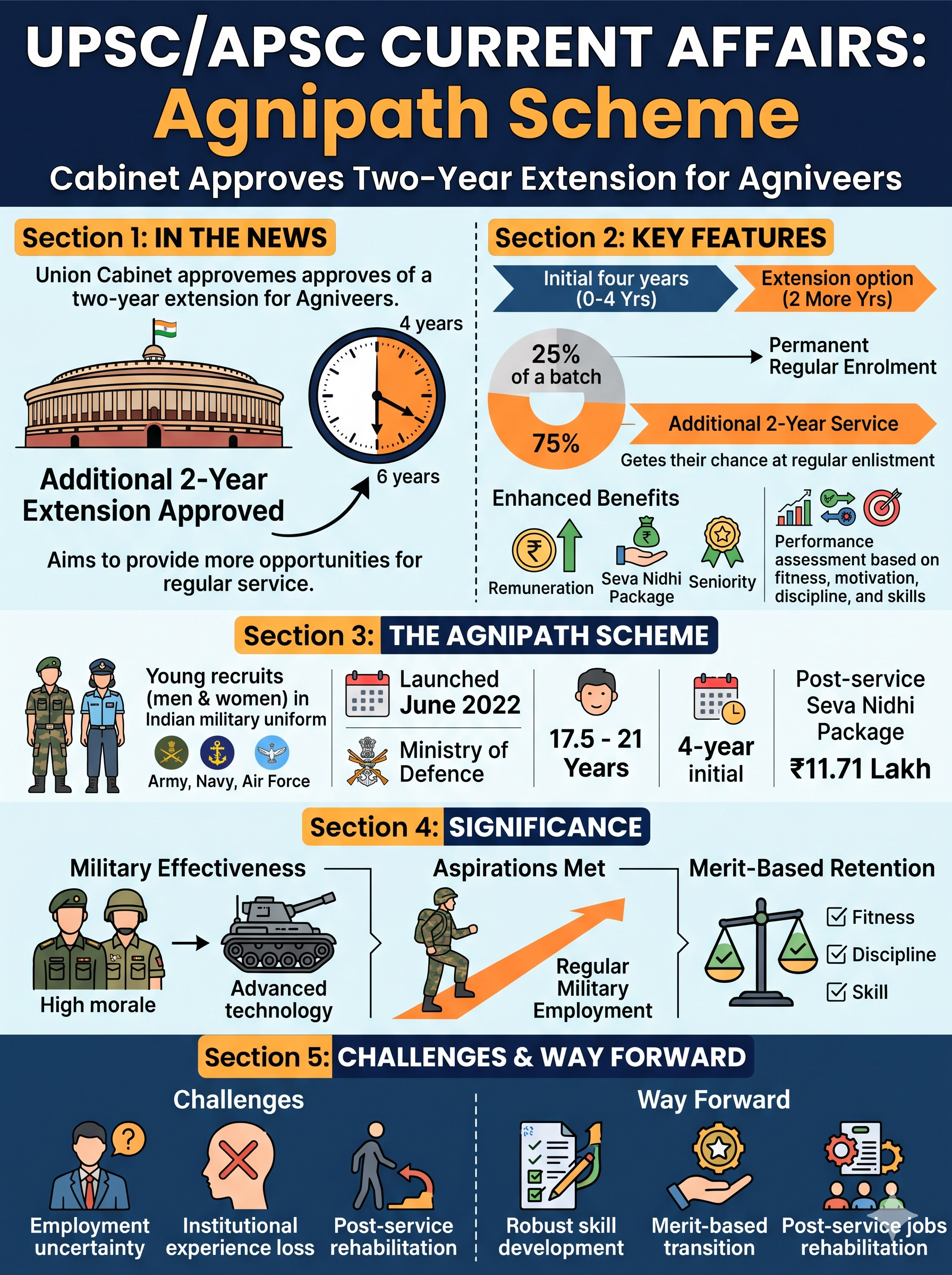
The Union Cabinet has reportedly approved an additional two-year engagement period for a section of Agniveers recruited under the Agnipath Scheme.
The revised arrangement aims to provide Agniveers with an additional opportunity to enter regular military service, subject to their willingness and fulfilment of prescribed selection criteria.
Key Features of the Revised Arrangement
Additional Engagement: A section of Agniveers will be offered an additional two-year service period after completing their initial four-year engagement.
Regular Employment: The existing provision of offering regular employment to 25% of each batch will continue.
Extended Opportunity: The remaining 75% will get an opportunity to serve for another two years and subsequently be considered for enrolment as regular soldiers, subject to selection criteria.
Enhanced Benefits:
Higher remuneration.
Enhanced Seva Nidhi package.
Seniority-related benefits.
Performance Assessment: The decision follows an evaluation of Agniveers’ performance in terms of:
Physical fitness.
Motivation and morale.
Technical skills.
Discipline.
Operational efficiency.
About the Agnipath Scheme
The Agnipath Scheme introduced by the Government of India in June 2022 for recruitment into the Indian Armed Forces.
Particulars | Details |
|---|---|
Launch | June 2022 |
Ministry | Ministry of Defence |
Objective | Short-term recruitment into the Armed Forces |
Recruitment period | 4 years |
Recruits | Agniveers |
Age limit | 17.5–21 years (subject to applicable recruitment notifications) |
Regular retention | Up to 25% of each batch |
Seva Nidhi | Approximately 11.71 lakh (including government contribution and applicable interest) |
Important: Agniveers serve in the Army, Navy and Air Force under this scheme.
Achievements of the Agnipath Scheme
According to the government, the assessment highlighted several achievements:
Wider geographical representation in recruitment across districts.
Standardised and transparent recruitment procedures.
Improved physical fitness.
High levels of morale and motivation.
Competitive spirit and discipline.
Development of technological skills.
Significance of the Decision
A. Strengthening Military Effectiveness
Helps retain trained and experienced personnel.
Improves operational efficiency.
Supports organisational requirements of the Armed Forces.
B. Addressing Aspirations of Agniveers
Provides additional opportunities for continued military service.
Creates a potential pathway towards regular military employment.
C. Human Resource Management
Allows the Armed Forces to evaluate personnel based on performance.
Promotes merit-based retention.
D. Technological Preparedness
Retention of technically skilled personnel can strengthen the Armed Forces’ capacity to operate modern military equipment.
Challenges and Concerns
Employment Uncertainty: A significant proportion of Agniveers may still face uncertainty regarding permanent employment.
Military Experience: Frequent turnover may affect the continuity of institutional experience.
Training Investment: Repeated recruitment and training may involve additional costs.
Social Security: Released Agniveers may require adequate employment and rehabilitation support.
Operational Continuity: Maintaining an appropriate balance between young personnel and experienced soldiers remains important.
Way Forward
Strengthen skill development and post-service employment opportunities.
Ensure transparent and merit-based selection for regular service.
Improve social security and rehabilitation mechanisms.
Conduct periodic assessments of the scheme.
Maintain an appropriate balance between youth, experience and operational readiness.
Conclusion
The proposed revision represents an important development in the Agnipath framework. Its success will depend on balancing the aspirations of young recruits with the long-term requirements of military preparedness, operational efficiency and national security.
Practice Questions
Prelims Questions
Q1. With reference to the Agnipath Scheme, consider the following statements:
It was launched in June 2022.
It provides for an initial engagement period of four years.
All Agniveers are guaranteed permanent employment after completing four years.
Which of the statements given above is/are correct?
A. 1 and 2 only
B. 2 and 3 only
C. 1 and 3 only
D. 1, 2 and 3
Answer: A
Explanation: Only up to 25% of each batch are eligible for regular enrolment under the original framework, subject to selection.
Mains Questions
(150 words | 10 marks) Discuss the Agnipath Scheme as a major defence recruitment reform in India. Examine its potential benefits and challenges.
Supreme Court Examines Legal Immunity Granted to Chief Election Commissioner and Election Commissioners
GS Paper II: Indian Constitution

The Supreme Court of India has sought responses from the Union Government and the Election Commission of India (ECI) on petitions challenging the constitutional validity of Section 16 of the Chief Election Commissioner and Other Election Commissioners (Appointment, Conditions of Service and Term of Office) Act, 2023.
The petitions challenge the provision granting legal immunity to the Chief Election Commissioner (CEC) and Election Commissioners (ECs) for acts performed in the discharge of their official duties.
The petitioners argue that the provision violates the Basic Structure of the Constitution, particularly the principle of judicial review.
Key Developments
The Supreme Court issued notices to the Union Government and the Election Commission of India.
The petitions were filed by RJD MP Manoj Jha and advocate Arun Kumar Agrawal.
The petitions challenge the constitutional validity of Section 16 of the 2023 Act.
The petitioners argue that the provision restricts the jurisdiction of constitutional courts.
The matter has been listed for further hearing on December 18, according to the newspaper report.
What is Section 16 of the 2023 Act?
Section 16 provides protection against legal proceedings for the CEC and ECs.
Key provisions:
It bars courts from entertaining or continuing civil or criminal proceedings against a person who is or was a CEC or EC for:
Any act performed in the discharge of official duties.
Any act performed while purporting to discharge official functions.
Any words spoken in the course of performing official duties.
Important: The provision extends protection even after the individual retires from office.
Constitutional Issues Involved
A. Article 324 – Superintendence, Direction and Control of Elections
Article 324 provides for the Election Commission of India.
It vests the ECI with the power of superintendence, direction and control over elections to Parliament, State Legislatures, and the offices of President and Vice-President.
B. Article 14 – Right to Equality
Guarantees equality before the law and equal protection of laws.
The challenge raises questions about whether such extensive immunity is constitutionally justified.
C. Basic Structure Doctrine
The petitioners argue that Section 16 violates the Basic Structure Doctrine by interfering with judicial review.
Important elements of the Basic Structure include:
Supremacy of the Constitution.
Rule of law.
Separation of powers.
Judicial review.
Democracy.
Free and fair elections.
Independence of the judiciary.
D. Judicial Review
Judicial review allows constitutional courts to examine the constitutional validity of legislative and executive actions.
It is an essential feature of the Basic Structure Doctrine.
Way Forward
Maintain institutional independence of the Election Commission.
Ensure accountability of constitutional authorities.
Protect officials from frivolous litigation without creating excessive immunity.
Preserve the constitutional power of judicial review.
Strengthen transparency in the appointment and functioning of Election Commissioners.
Conclusion
The controversy highlights the constitutional balance between institutional independence and public accountability. Protecting election authorities from frivolous litigation is important, but such protection must remain consistent with the rule of law, constitutional supremacy and judicial review.
Practice Questions
Prelims Questions
Q1. With reference to the Election Commission of India, consider the following statements:
The Election Commission of India is a constitutional body.
Article 324 deals with the superintendence, direction and control of elections.
The ECI conducts elections to Panchayats and Municipalities.
Which of the statements given above is/are correct?
A. 1 and 2 only
B. 2 and 3 only
C. 1 and 3 only
D. 1, 2 and 3
Answer: A
Explanation: Elections to Panchayats and Municipalities are conducted by State Election Commissions under Articles 243K and 243ZA.
Mains Questions
Examine the constitutional significance of Article 324 in ensuring free and fair elections in India. Discuss the challenges to the independence of the Election Commission. (150 words)
Buxa Tigress Rescued from Assam’s Raimona National Park
GS Paper III: Environment and Biodiversity
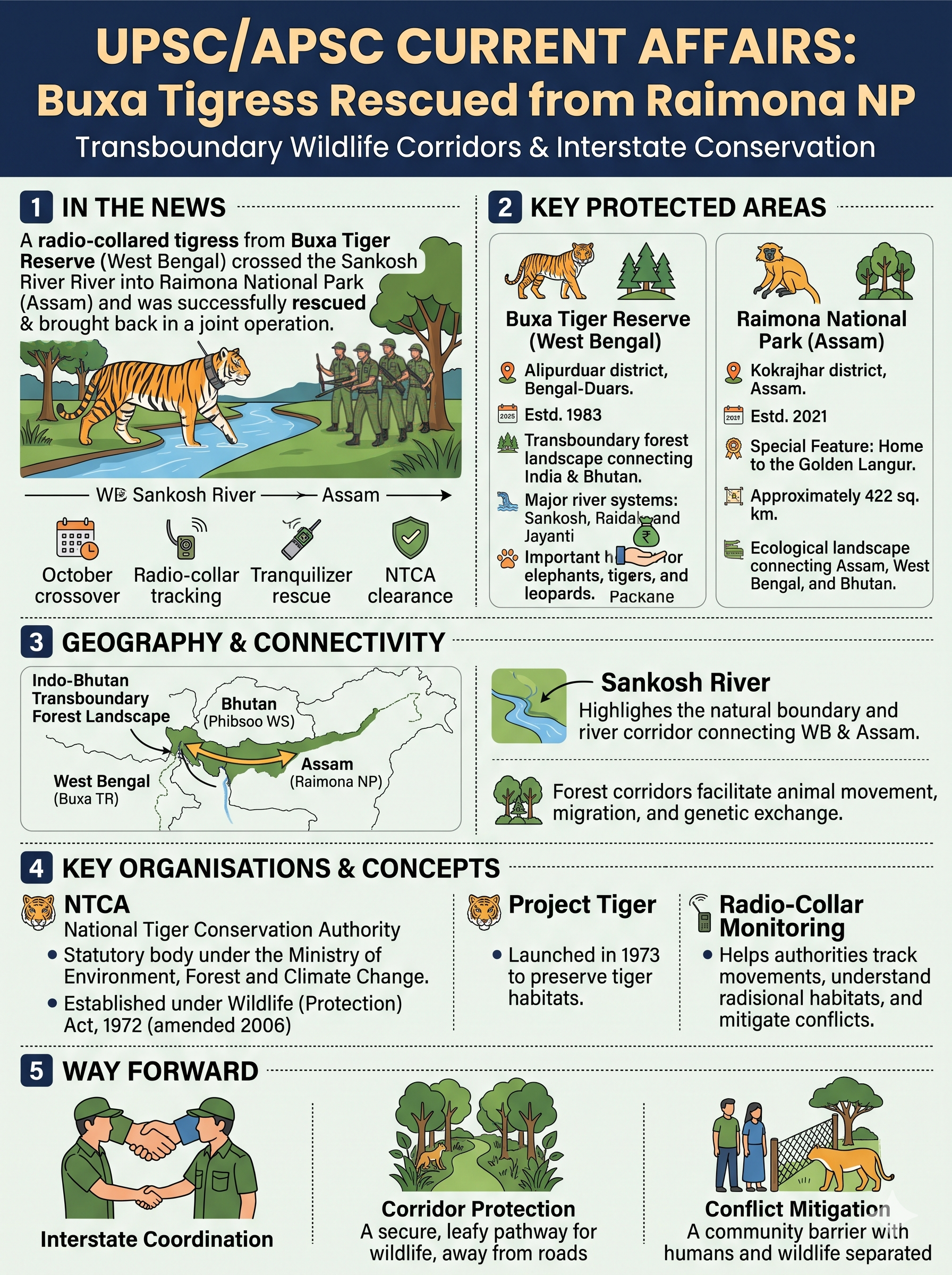
The West Bengal Forest Department has successfully brought back a tigress from Raimona National Park, Assam, to its original habitat in Buxa Tiger Reserve, West Bengal.
Key Highlights
The tigress had crossed the Sankosh River and entered Assam in October.
Its movement was monitored through a radio collar.
It was captured using a tranquiliser dart and brought back to Buxa Tiger Reserve.
The operation was conducted jointly by forest officials of Assam and West Bengal.
The operation received clearance from the National Tiger Conservation Authority (NTCA).
Buxa Tiger Reserve
Location: Alipurduar district, West Bengal.
Established: 1983 as a Tiger Reserve.
Part of: Eastern Himalayan foothills.
Major river systems: Sankosh, Raidak and Jayanti.
Ecological significance: Important habitat for elephants, tigers, leopards and other wildlife.
Connectivity: Forms part of a wider transboundary forest landscape connecting India and Bhutan.
Raimona National Park
Location: Kokrajhar district, Assam.
Declared National Park: 2021.
Area: Approximately 422 sq. km.
Important species: Golden langur, Asian elephant, tiger, clouded leopard and other wildlife.
Ecological significance: Forms an important part of the transboundary conservation landscape connecting Assam, West Bengal and Bhutan.
Special Feature: Raimona National Park is particularly important for the conservation of the golden langur.
Ecological Significance of the Incident
A. Wildlife Corridors
The movement of the tigress highlights the importance of forest corridors connecting protected areas.
Corridors facilitate animal movement, migration and genetic exchange.
B. Transboundary Conservation
Wildlife does not follow administrative boundaries.
Cooperation between Assam and West Bengal is essential for effective wildlife conservation.
C. Human-Wildlife Conflict
The tigress moved closer to human settlements.
Timely intervention helped minimise the possibility of human-wildlife conflict.
D. Radio-Collar Monitoring
Radio collars help forest authorities track animal movement.
They assist in monitoring habitat use, migration and potential threats.
Important Organisations
National Tiger Conservation Authority (NTCA)
Statutory body under the Ministry of Environment, Forest and Climate Change.
Established in 2005.
Statutory status provided under the Wildlife (Protection) Act, 1972, through the 2006 amendment.
Responsible for strengthening tiger conservation and implementing Project Tiger.
Project Tiger
Launched in 1973.
Aims to ensure the conservation of tigers and their habitats.
Promotes scientific management of tiger reserves.
Significance for Assam
Highlights the ecological importance of Raimona National Park.
Demonstrates the importance of Assam’s forest connectivity with neighbouring states and Bhutan.
Emphasises the need for coordinated wildlife management.
Highlights the importance of protecting wildlife corridors from fragmentation.
Strengthens the case for landscape-level conservation in Northeast India.
Way Forward
Protect and restore wildlife corridors.
Strengthen interstate coordination among forest departments.
Promote scientific wildlife monitoring through radio collars and camera traps.
Minimise human-wildlife conflict through community participation.
Prevent habitat fragmentation due to infrastructure development.
Practice Questions
Prelims Questions
Q1. Consider the following pairs:
No. | National Park / Tiger Reserve | State |
|---|---|---|
1. | Raimona National Park | Assam |
2. | Buxa Tiger Reserve | West Bengal |
3. | Manas National Park | Assam |
4. | Jaldapara National Park | West Bengal |
Which of the pairs given above are correctly matched?
A. 1 and 2 only
B. 1, 2 and 3 only
C. 1, 2, 3 and 4
D. 2 and 4 only
Answer: C
Mains Questions
Explain the ecological significance of wildlife corridors in maintaining biodiversity and ensuring the long-term survival of endangered species. (150 words)