Dr Bhupen Hazarika: Death Anniversary and Cultural Legacy
GS Paper I – Art & Culture
Key Highlights
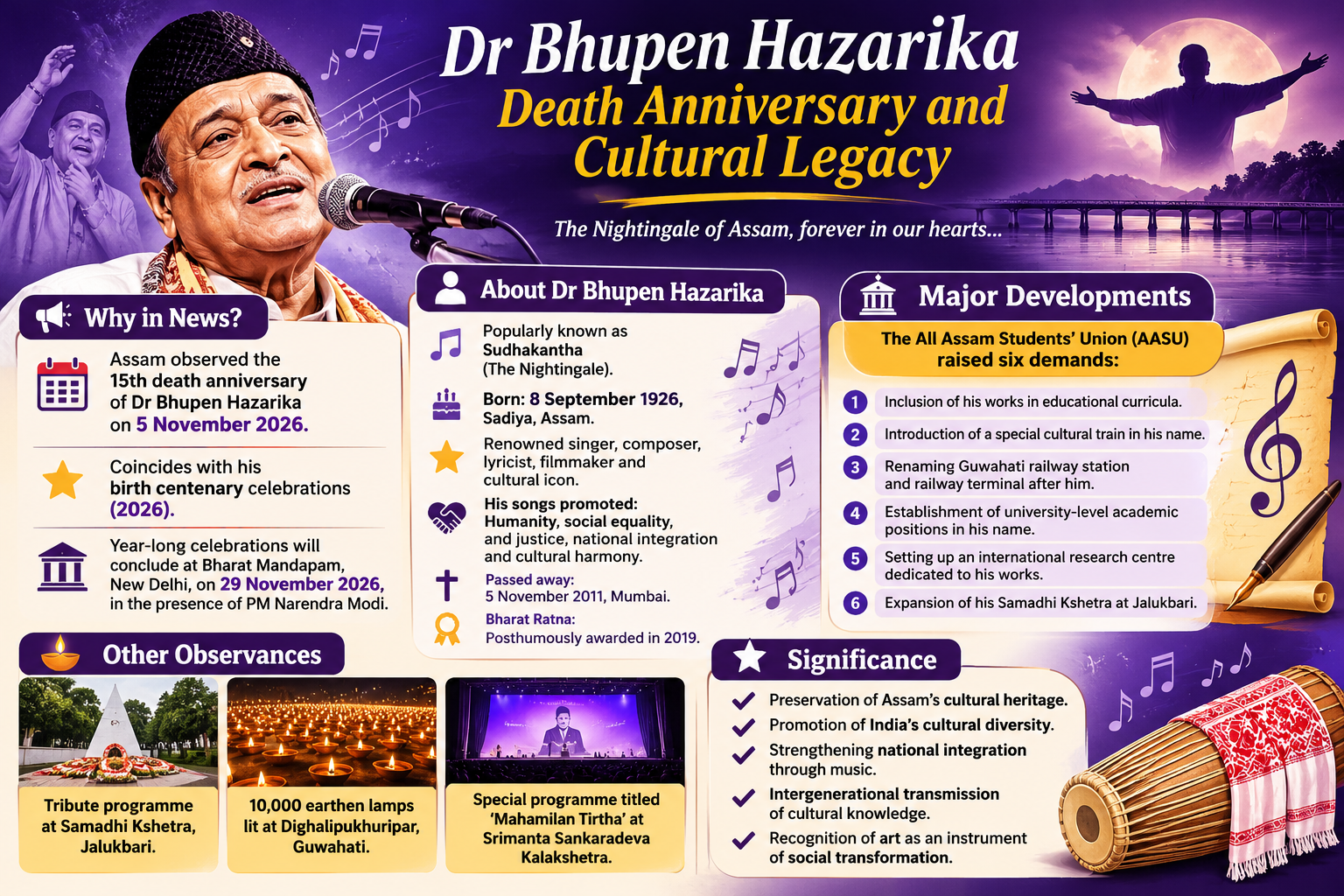
Assam observed the 15th death anniversary of Dr Bhupen Hazarika on 5 November 2026.
The occasion coincides with his birth centenary celebrations (2026).
The year-long celebrations will conclude at Bharat Mandapam, New Delhi, on 29 November 2026, in the presence of Prime Minister Narendra Modi.
About Dr Bhupen Hazarika
Popularly known as Sudhakantha (The Nightingale).
Born: 8 September 1926, Sadiya, Assam.
Renowned singer, composer, lyricist, filmmaker and cultural icon.
His songs promoted:
Humanity and universal brotherhood.
Social equality and justice.
National integration and cultural harmony.
Passed away: 5 November 2011, Mumbai.
Bharat Ratna: Posthumously awarded in 2019.
Major Developments
The All Assam Students’ Union (AASU) raised six demands before the Assam government:
Inclusion of his works in educational curricula.
Introduction of a special cultural train in his name.
Renaming Guwahati railway station and railway terminal after him.
Establishment of university-level academic positions in his name.
Setting up an international research centre dedicated to his works.
Expansion of his Samadhi Kshetra at Jalukbari.
Other Observances:
Tribute programme at Samadhi Kshetra, Jalukbari.
10,000 earthen lamps lit at Dighalipukhuripar, Guwahati.
Special programme titled ‘Mahamilan Tirtha’ at Srimanta Sankaradeva Kalakshetra.
Significance
Preservation of Assam’s cultural heritage.
Promotion of India’s cultural diversity.
Strengthening national integration through music.
Intergenerational transmission of cultural knowledge.
Recognition of art as an instrument of social transformation.
Practice Questions
Prelims Questions
Q1. Dr Bhupen Hazarika was popularly known as:
A. Kalaguru
B. Sudhakantha
C. Rupkonwar
D. Natasurya
Answer: B. Sudhakantha
Mains Questions
(10 Marks | 150 Words) Discuss the contribution of Dr Bhupen Hazarika to the cultural heritage of Assam and the promotion of national integration.
Supreme Court: Arrest Begins from the Moment of Detention
GS Paper II – Polity & Governance

Key Highlights
The Supreme Court ruled that arrest begins from the moment a person’s liberty is effectively curtailed through detention, not from the time of formal arrest.
The 24-hour period for producing an arrested person before a Judicial Magistrate starts from the actual time of detention.
The judgment was delivered by a Bench headed by Justice Ujjal Bhuyan.
Key Observations of the Supreme Court
Meaning of Arrest: Even touching a person with the intention of restraining their liberty can amount to arrest.
24-Hour Rule: The 24-hour period begins from the actual time of detention, not the formal recording of arrest.
No Illegal Detention: Police cannot detain suspects for questioning and subsequently manipulate the official arrest time.
Human Rights Protection: Detention without proper legal safeguards may lead to custodial torture and human rights violations.
Magistrate’s Responsibility: The Magistrate must record the actual date and time of detention.
Release from Illegal Detention: A person detained beyond 24 hours must be released immediately, subject to the court’s directions. Only journey time from the place of arrest to the Magistrate’s court is excluded.
Constitutional Provisions Involved
Article | Provision |
|---|---|
Article 21 | Protection of life and personal liberty |
Article 22(1) | Right to be informed of grounds of arrest and right to consult a lawyer |
Article 22(2) | Production before a Magistrate within 24 hours |
Article 20(3) | Protection against self-incrimination |
Article 22(2):
Every person arrested and detained in custody must be produced before the nearest Magistrate within 24 hours of arrest, excluding the time necessary for the journey from the place of arrest to the court.
Relevant Legal Framework
Bharatiya Nagarik Suraksha Sanhita (BNSS), 2023: Governs criminal procedure in India.
Section 58, BNSS: No police officer shall detain a person arrested without warrant for more than 24 hours without a special order of a Magistrate, excluding journey time.
Article 21: Ensures that personal liberty cannot be taken away except according to procedure established by law.
Significance of the Judgment
Strengthens constitutional protection against arbitrary detention.
Prevents manipulation of arrest records.
Promotes police accountability.
Protects individuals against custodial torture.
Reinforces the role of the judiciary in safeguarding fundamental rights.
Strengthens the rule of law and due process.
Practice Questions
Prelims Questions
Q1. With reference to Article 22 of the Indian Constitution, consider the following statements:
An arrested person must be informed of the grounds of arrest.
An arrested person has the right to consult and be defended by a legal practitioner.
Every arrested person must be produced before a Magistrate within 48 hours.
Which of the statements given above are correct?
A. 1 only
B. 1 and 2 only
C. 2 and 3 only
D. 1, 2 and 3
Answer: B. 1 and 2 only
Explanation: Article 22(2) provides that a person must be produced before a Magistrate within 24 hours, excluding the time spent on the journey.
Mains Questions
(10 Marks | 150 Words) Explain the constitutional safeguards available to individuals against arbitrary arrest and detention in India.
DRDO Successfully Flight-Tests Pralay Missile
GS Paper III – Science & Technology
Key Highlights
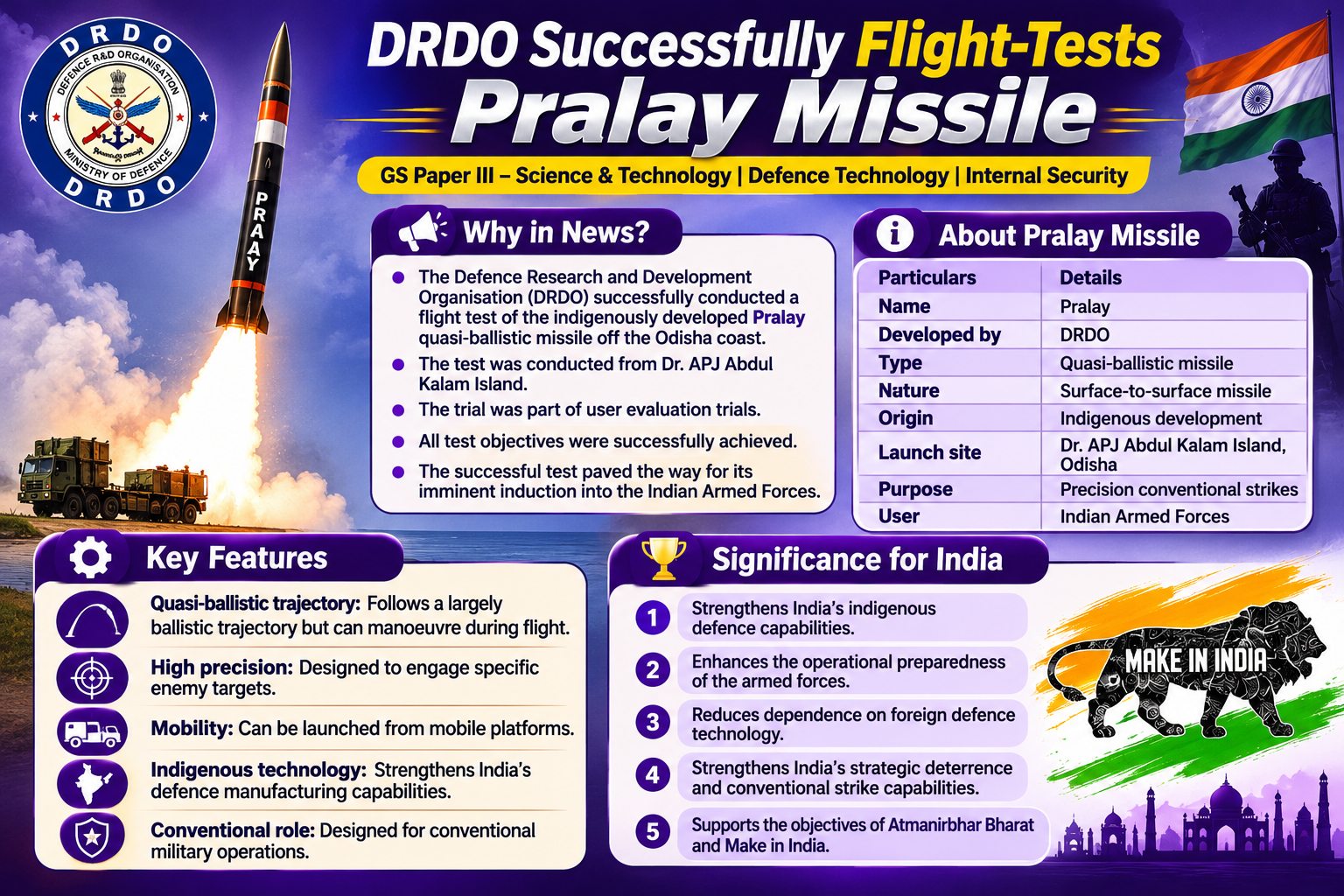
The Defence Research and Development Organisation (DRDO) successfully conducted a flight test of the indigenously developed Pralay quasi-ballistic missile off the Odisha coast.
The test was conducted from Dr. APJ Abdul Kalam Island.
The trial was part of user evaluation trials.
All test objectives were successfully achieved.
The successful test paved the way for its imminent induction into the Indian Armed Forces.
About Pralay Missile
Particulars | Details |
|---|---|
Name | Pralay |
Developed by | DRDO |
Type | Quasi-ballistic missile |
Nature | Surface-to-surface missile |
Origin | Indigenous development |
Launch site | Dr. APJ Abdul Kalam Island, Odisha |
Purpose | Precision conventional strikes |
User | Indian Armed Forces |
Key Features
Quasi-ballistic trajectory: Follows a largely ballistic trajectory but can manoeuvre during flight.
High precision: Designed to engage specific enemy targets.
Mobility: Can be launched from mobile platforms.
Indigenous technology: Strengthens India’s defence manufacturing capabilities.
Conventional role: Designed for conventional military operations.
Significance for India
Strengthens India’s indigenous defence capabilities.
Enhances the operational preparedness of the armed forces.
Reduces dependence on foreign defence technology.
Strengthens India’s strategic deterrence and conventional strike capabilities.
Supports the objectives of Atmanirbhar Bharat and Make in India.
Practice Questions
Prelims Questions
Q1. Pralay missile, recently in the news, has been developed by:
A. ISRO
B. DRDO
C. HAL
D. BHEL
Answer: B. DRDO
Mains Questions
(10 Marks | 150 Words) Discuss the significance of indigenous missile development in strengthening India’s defence capabilities.
INS Sahyadri Reaches Japan for MALABAR 2026 Naval Exercise
GS Paper II – International Relations
Key Highlights
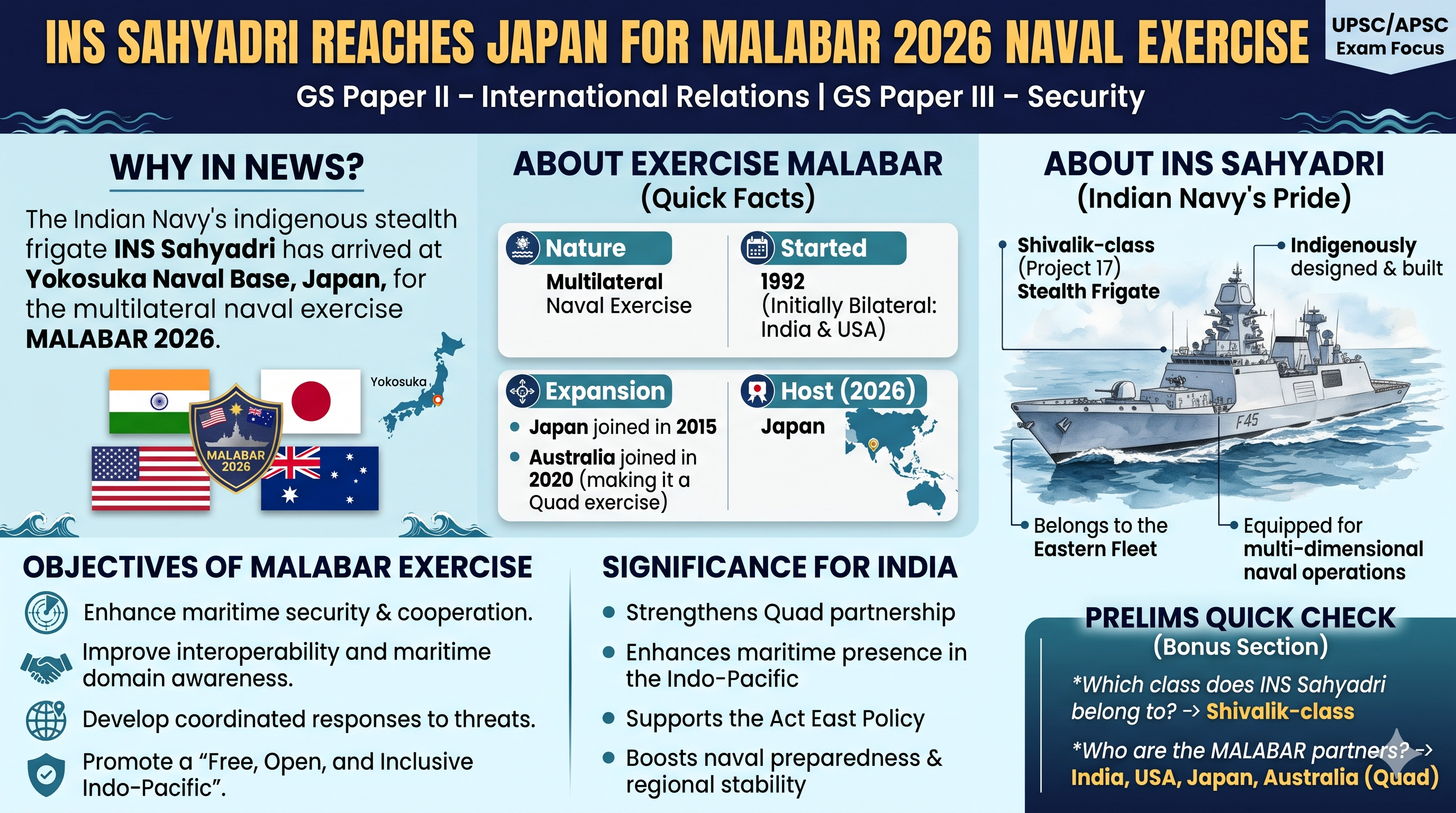
Indian Navy’s indigenous stealth frigate INS Sahyadri arrived at Yokosuka Naval Base, Japan, to participate in the multilateral naval exercise MALABAR 2026.
The exercise involves the navies of four countries:
India
Japan
United States
Australia
INS Sahyadri belongs to the Indian Navy’s Eastern Fleet.
The exercise aims to enhance maritime cooperation, interoperability and operational coordination.
About INS Sahyadri
An indigenously built stealth frigate of the Indian Navy.
Belongs to the Shivalik-class (Project 17).
Designed and developed with significant indigenous defence technology.
Part of the Eastern Fleet.
Equipped for multi-dimensional naval operations.
Objectives of MALABAR Exercise
Enhance maritime security cooperation.
Improve interoperability among participating navies.
Strengthen maritime domain awareness.
Develop coordinated responses to maritime threats.
Exchange professional expertise.
Promote a free, open and inclusive Indo-Pacific region.
Significance for India
Strengthens India’s strategic partnership with Quad countries.
Enhances India’s maritime presence in the Indo-Pacific.
Promotes regional stability and maritime security.
Strengthens naval preparedness and defence cooperation.
Supports India’s Act East Policy.
Practice Questions
Prelims Questions
Q1. Exercise MALABAR is associated with which of the following forces?
A. Air Force
B. Army
C. Navy
D. Coast Guard
Answer: C. Navy
Mains Questions
(10 Marks | 150 Words) Discuss the significance of the MALABAR naval exercise in strengthening India’s maritime security cooperation.