
Makhana Cultivation in Assam
GS Paper 3 (Agriculture)
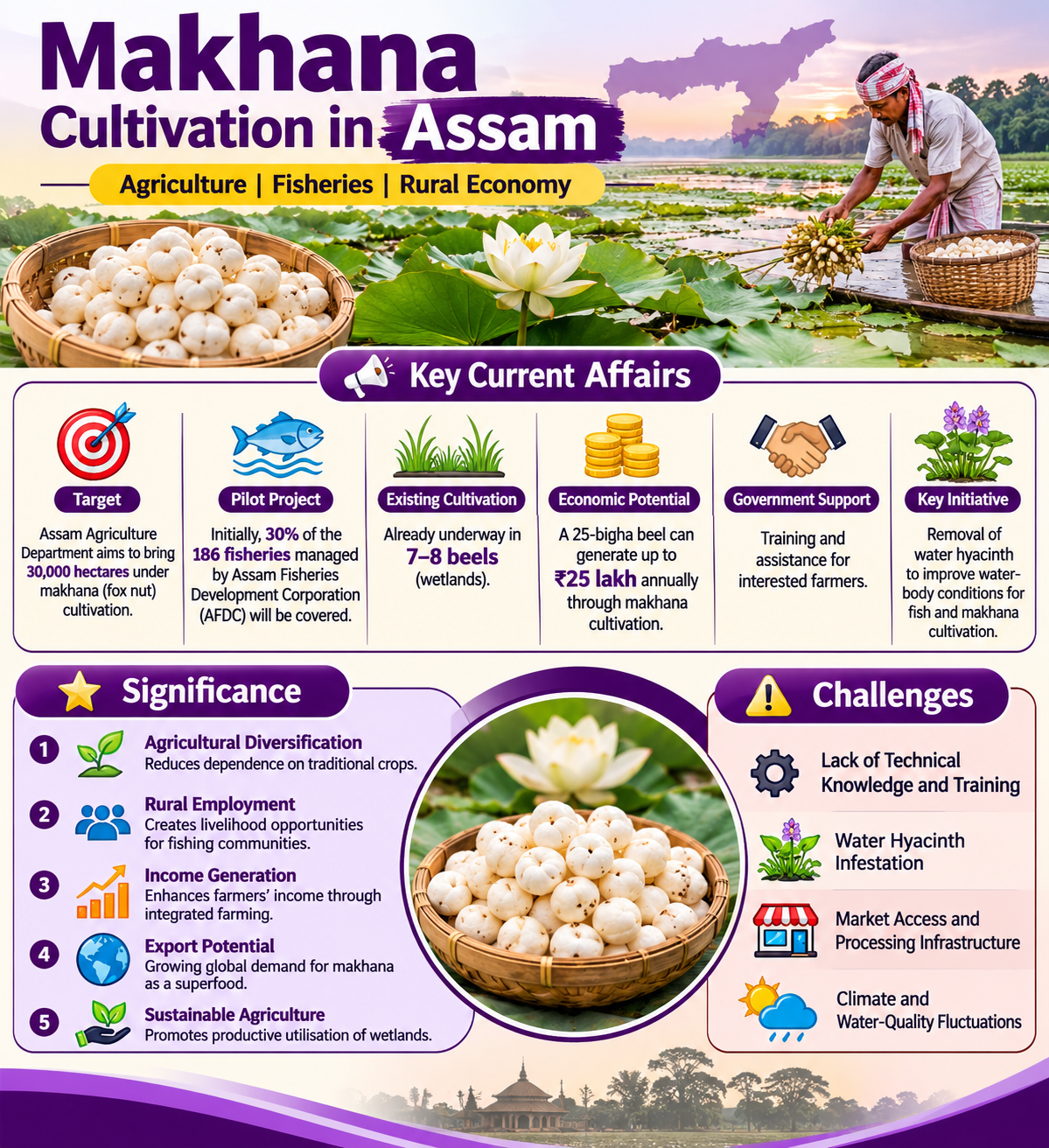
Key Highlights
Target: Assam Agriculture Department aims to bring 30,000 hectares under makhana (fox nut) cultivation.
Pilot Project: Initially, 30% of the 186 fisheries managed by Assam Fisheries Development Corporation (AFDC) will be covered.
Existing Cultivation: Already underway in 7–8 beels (wetlands).
Economic Potential: A 25-bigha beel can generate up to 25 lakh annually through makhana cultivation.
Government Support: Training and assistance for interested farmers.
Key Initiative: Removal of water hyacinth to improve water-body conditions for fish and makhana cultivation.
Significance
Agricultural diversification: Reduces dependence on traditional crops.
Rural employment: Creates livelihood opportunities for fishing communities.
Income generation: Enhances farmers’ income through integrated farming.
Export potential: Growing global demand for makhana as a superfood.
Sustainable agriculture: Promotes productive utilisation of wetlands.
Challenges
Lack of technical knowledge and training.
Water hyacinth infestation.
Market access and processing infrastructure.
Climate and water-quality fluctuations.
Practice Questions
Prelims Questions
Q1. Makhana is commonly known as:
A. Fox nut
B. Cashew nut
C. Areca nut
D. Walnut
Answer: A. Fox nut
Mains Questions
Discuss the potential of wetland-based makhana cultivation in promoting agricultural diversification, rural livelihoods and sustainable development in Assam. (150 words)
Preserving Tocklai Tea Research Institute
GS Paper III – Science & Technology
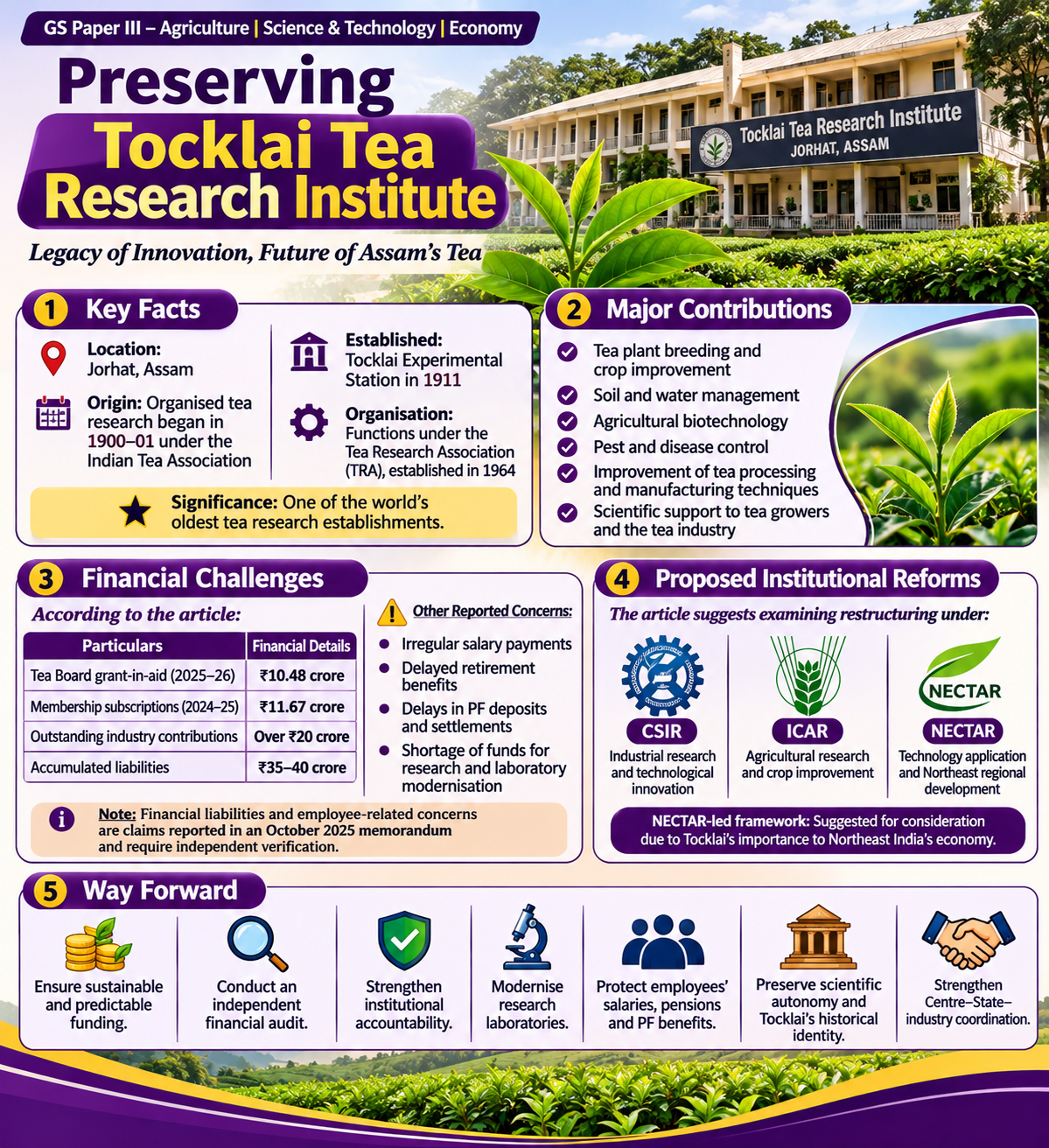
Key Facts
Location: Jorhat, Assam.
Origin: Organised tea research began in 1900–01 under the Indian Tea Association.
Established: Tocklai Experimental Station in 1911.
Organisation: Functions under the Tea Research Association (TRA), established in 1964.
Significance: One of the world’s oldest tea research establishments.
Major Contributions
Tea plant breeding and crop improvement.
Soil and water management.
Agricultural biotechnology.
Pest and disease control.
Improvement of tea processing and manufacturing techniques.
Scientific support to tea growers and the tea industry.
Other Reported Concerns
Irregular salary payments.
Delayed retirement benefits.
Delays in PF deposits and settlements.
Shortage of funds for research and laboratory modernisation.
Proposed Institutional Reforms
The article suggests examining restructuring under:
Institution | Role |
|---|---|
CSIR | Industrial research and technological innovation |
ICAR | Agricultural research and crop improvement |
NECTAR | Technology application and Northeast regional development |
Way Forward
Ensure sustainable and predictable funding.
Conduct an independent financial audit.
Strengthen institutional accountability.
Modernise research laboratories.
Protect employees’ salaries, pensions and PF benefits.
Preserve scientific autonomy and Tocklai’s historical identity.
Strengthen Centre–State–industry coordination.
Practice Questions
Prelims Questions
Q1. Tocklai Tea Research Institute is located in which district of Assam?
A. Dibrugarh
B. Jorhat
C. Sivasagar
D. Tinsukia
Answer: B. Jorhat
Mains Questions
Discuss the role of agricultural research institutions in strengthening India’s plantation economy. Examine the challenges faced by the Tocklai Tea Research Institute and suggest measures to revive it. (150 words)
NHAI Guidelines for Multi-Lane Free Flow (MLFF) Tolling
GS Paper III – Infrastructure
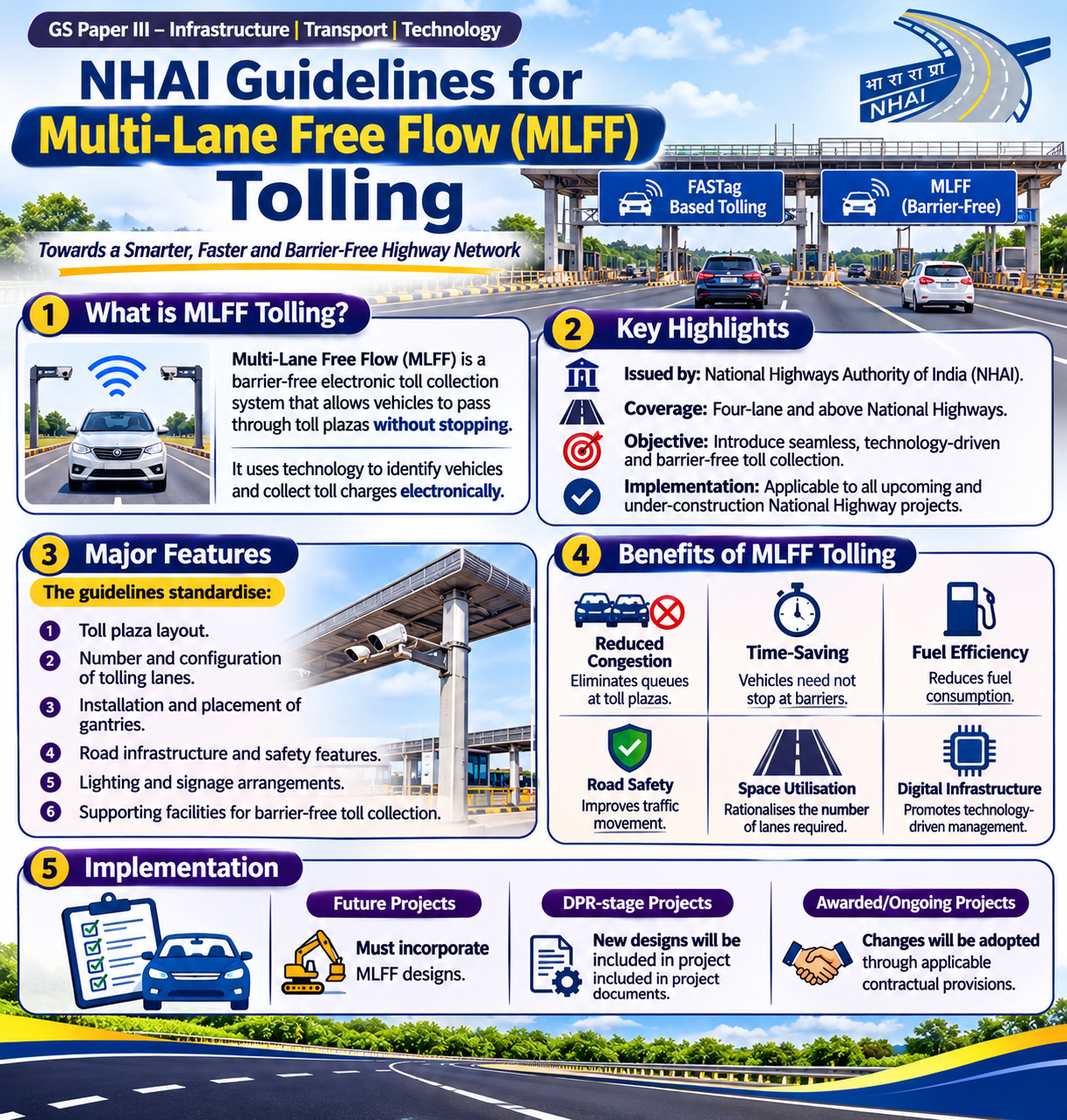
What is MLFF Tolling?
Multi-Lane Free Flow (MLFF) is a barrier-free electronic toll collection system that allows vehicles to pass through toll plazas without stopping.
It uses technology to identify vehicles and collect toll charges electronically.
Key Highlights
Issued by: National Highways Authority of India (NHAI).
Coverage: Four-lane and above National Highways.
Objective: Introduce seamless, technology-driven and barrier-free toll collection.
Implementation: Applicable to all upcoming and under-construction National Highway projects.
Major Features
The guidelines standardise:
Toll plaza layout.
Number and configuration of tolling lanes.
Installation and placement of gantries.
Road infrastructure and safety features.
Lighting and signage arrangements.
Supporting facilities for barrier-free toll collection.
Benefits of MLFF Tolling
Reduced congestion: Eliminates queues at toll plazas.
Time-saving: Vehicles need not stop at physical barriers.
Fuel efficiency: Reduces fuel consumption during waiting.
Road safety: Improves traffic movement.
Space utilisation: Rationalises the number of lanes required.
Digital infrastructure: Promotes technology-driven highway management.
Implementation
Future projects: Must incorporate MLFF designs.
DPR-stage projects: New designs will be included in project documents.
Awarded/ongoing projects: Changes will be adopted through applicable contractual provisions.
Practice Questions
Prelims Questions
Q1. Multi-Lane Free Flow (MLFF) tolling is primarily associated with:
A. Railway ticketing
B. Barrier-free electronic toll collection
C. Airport security
D. Public transport subsidies
Answer: B
Mains Questions
Discuss the role of technology-driven infrastructure in improving India’s road transport efficiency. Examine the significance of Multi-Lane Free Flow tolling. (150 words)
Assam Reduces Maternal Deaths Due to Sepsis
GS Paper II – Health
Key Highlights
Achievement: Assam’s share of maternal deaths due to sepsis declined from 21% in July to 8% in October 2026.
Recognition: Union Ministry of Health and Family Welfare invited Assam to share its infection-control model with other States.
Key Initiative: Standard Operating Procedures (SOPs) for Infection Prevention and Control (IPC) and a digital monitoring portal were introduced.
Launch: September 25, 2026, at Dibrugarh by Health Minister Ashok Singhal.
Major Measures Taken
1. Infection Prevention and Control (IPC) SOPs
Hygiene and infection-control guidelines for:
Labour rooms.
Maternity operation theatres.
Postnatal wards.
Special Newborn Care Units (SNCUs).
Newborn Stabilisation Units.
2. Digital Infection Prevention and Control Mechanism (IPCM) Portal
The portal monitors:
Daily cleaning activities through photographs.
Autoclave quality through geo-tagged images.
Microbial surveillance.
Functioning of hospital infection-control committees.
Compliance with infection-control guidelines.
Significance
Reduces preventable maternal deaths.
Improves maternal and newborn healthcare.
Strengthens hospital hygiene and accountability.
Promotes digital monitoring in public healthcare.
Provides a replicable healthcare model for other States.
Practice Questions
Prelims Questions
Q1. Maternal sepsis is primarily associated with:
A. Nutritional deficiency
B. Infection during pregnancy, childbirth or postpartum period
C. Genetic disorders
D. Hypertension alone
Answer: B
Mains Questions
Maternal mortality remains a major public health challenge in India. Discuss the role of infection prevention and digital monitoring in reducing maternal deaths. (150 words)