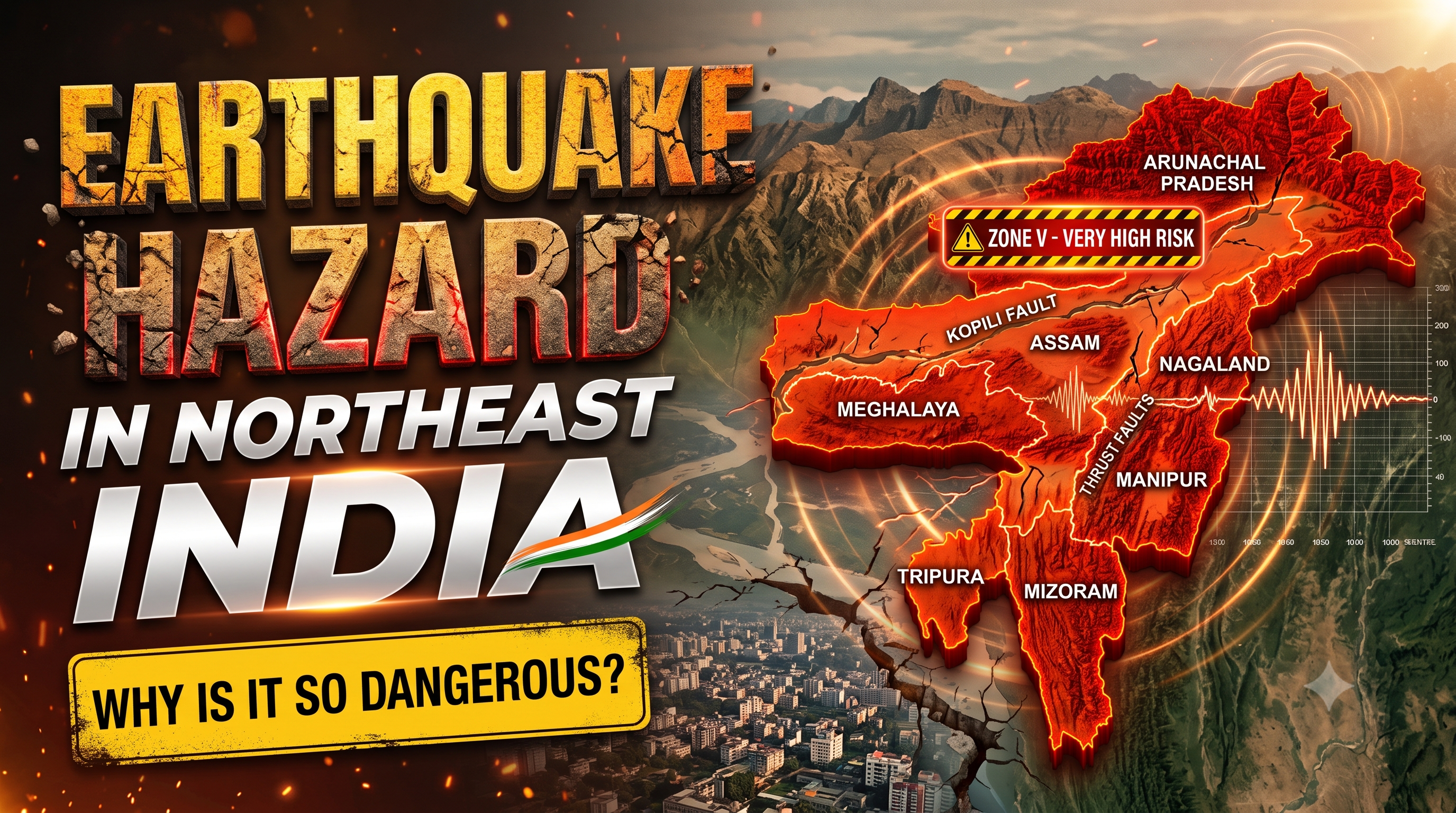
Why in News?
A new study assessed earthquake shaking hazard in Northeast India using Probabilistic Seismic Hazard Analysis (PSHA).
Key Facts
Peak Ground Acceleration (PGA) was highest at:
| Location | PGA |
|---|---|
| Dibang | 0.908 g |
| Shillong | 0.893 g |
| Guwahati | 0.811 g |
| Itanagar, Imphal, Kohima & Agartala | 0.61–0.70 g |
| Aizawl | 0.57 g (comparatively lower) |
The study used the Das Magnitude Scale instead of the conventional moment magnitude scale.
Conventional earthquake magnitude estimates could produce up to 40% higher ground-motion estimates for some medium-sized earthquakes.
Why Are Some Areas More Vulnerable?
| Area | Cause | Effect |
|---|---|---|
| Guwahati & Tezpur | Soft alluvial deposits of Brahmaputra Basin | Ground-motion amplification and liquefaction risk |
| Shillong | Hard Precambrian bedrock and active faults | Intense, high-frequency shaking |
| Kohima & Itanagar | – | Earthquake shaking and landslide risk |
| Imphal & Agartala | Alluvial/fluvio-lacustrine sediments | Basin and site effects |
| Gangtok & Aizawl | Stronger bedrock in many areas; steep slopes | Landslide risk |
Practice Questions
Prelims Question
Q. Consider the following statements regarding earthquake hazard in Northeast India:
Peak Ground Acceleration was found to be highest near Dibang among the locations studied.
Soft alluvial deposits can amplify earthquake shaking and increase liquefaction risk.
Probabilistic Seismic Hazard Analysis completely eliminates uncertainty arising from limited historical earthquake records.
Which of the statements given above is/are correct?
A. 1 and 2 only
B. 2 and 3 only
C. 1 and 3 only
D. 1, 2 and 3
Answer: A
Explanation: PSHA does not eliminate uncertainty, particularly where earthquake records are limited.
Mains Question
Q. Northeast India is one of India’s most earthquake-prone regions. Discuss the factors responsible for its seismic vulnerability and suggest measures to reduce disaster risk. (150 words)