Key Highlights
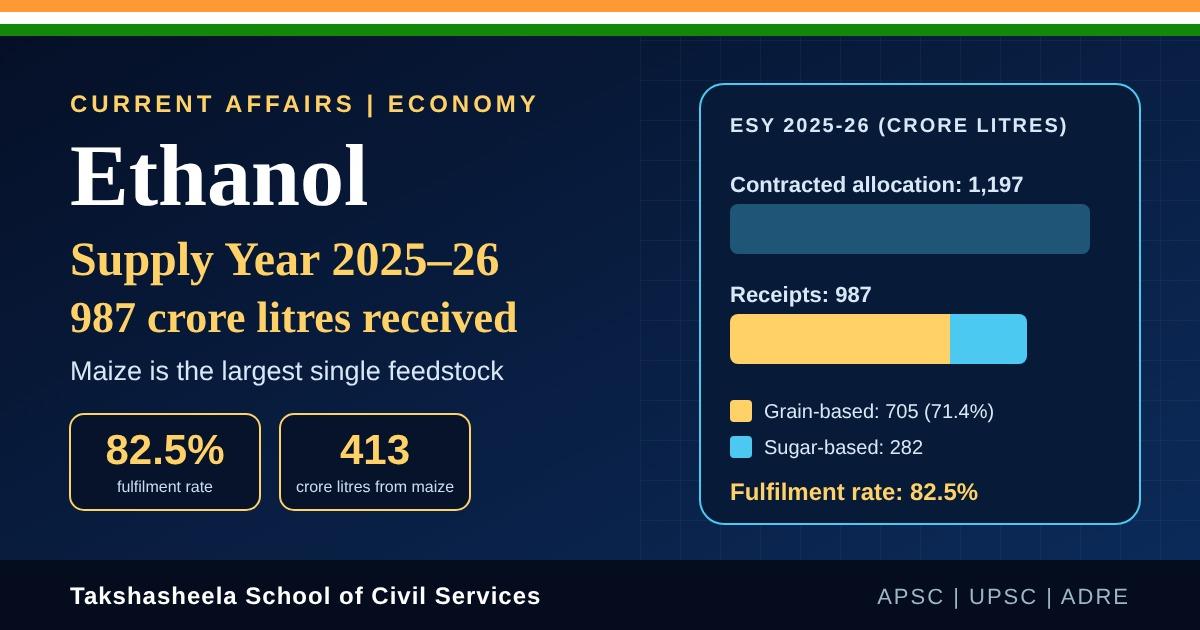
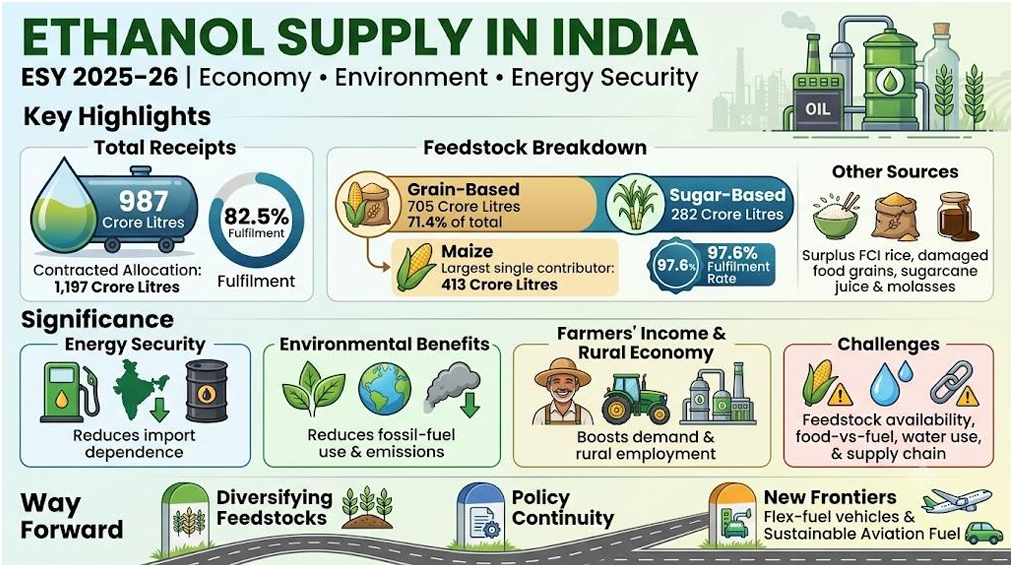
Total ethanol receipts: 987 crore litres by September 2026 under Ethanol Supply Year (ESY) 2025–26.
Total contracted allocation: 1,197 crore litres; fulfilment rate was 82.5%.
Major feedstock: Grain-based sources contributed 705 crore litres, accounting for 71.4% of total receipts.
Maize: Largest single contributor, supplying 413 crore litres.
Sugar-based feedstocks: Supplied 282 crore litres, achieving a 97.6% fulfilment rate.
Other sources: Surplus FCI rice, damaged food grains, sugarcane juice and molasses.
ESY 2025–26 at a Glance
Indicator | Value | Remark |
|---|---|---|
Total ethanol receipts | 987 crore litres | By September 2026 |
Total contracted allocation | 1,197 crore litres | Fulfilment rate 82.5% |
Grain-based sources | 705 crore litres | 71.4% of total receipts |
Maize | 413 crore litres | Largest single contributor |
Sugar-based feedstocks | 282 crore litres | Fulfilment rate 97.6% |
Significance
Energy security: Reduces dependence on imported crude oil.
Environmental benefits: Ethanol blending can reduce fossil-fuel consumption and certain vehicular emissions.
Farmers’ income: Creates additional demand for agricultural produce.
Rural economy: Supports distilleries and employment.
Challenges: Feedstock availability, food-versus-fuel concerns, water consumption and supplychain constraints.
Way Forward
Diversify feedstocks, ensure policy continuity and expand ethanol applications in flex-fuel vehicles and sustainable aviation fuel.
Practice Questions
Prelims Question
Q. Consider the following statements regarding ethanol blending in India:
Ethanol can be produced from grain-based and sugar-based feedstocks.
Ethanol blending can help reduce dependence on imported crude oil.
The Ethanol Supply Year 2025–26 runs from November to October.
Which of the statements given above is/are correct?
A) 1 only
B) 1 and 2 only
C) 2 and 3 only
D) 1, 2 and 3
Answer: D) 1, 2 and 3
Mains Practice Question
Q. Examine the role of ethanol blending in strengthening India’s energy security. Discuss the associated environmental and food-security challenges. (150 words)