Editorial Analysis | Takshasheela School of Civil Services
A Larger Shift in India's Space Programme
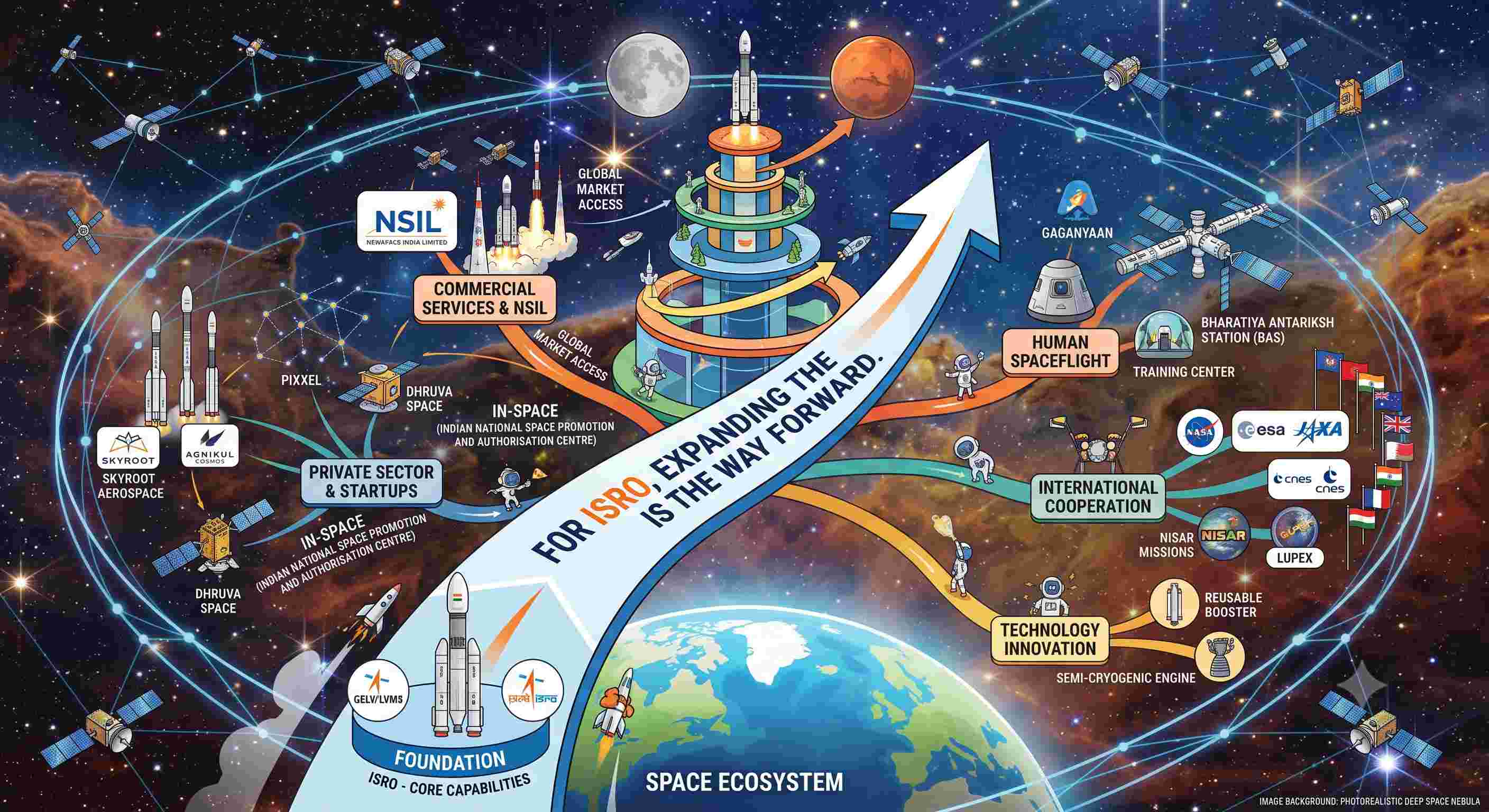
The debate over ISRO's evolving role, and the growing participation of the private sector in India's space programme, reflects something bigger than a single policy dispute — it reflects a broader shift away from a predominantly government-led model and toward an integrated space ecosystem in which the state and private industry each play distinct, complementary roles.
This shift has not gone unquestioned. Concerns have emerged over ISRO's decision to tighten norms governing the resignation and voluntary retirement of its senior scientists, as well as over suggestions that private companies may eventually take over routine launch-vehicle manufacturing altogether. Read together, these developments have raised a genuine question about where ISRO's core responsibilities end and where private industry's role begins.
The Emerging Division of Labour
Despite these concerns, the government appears to be converging on a fairly clear model: ISRO concentrates on high-end research, exploration, and ambitious missions, while private industry takes on commercial launches and routine production. Institutions such as IN-SPACe are actively facilitating this transition by promoting private participation, while ISRO continues to provide technical expertise, infrastructure, launch facilities, and technology transfer — a dynamic already visible in the transfer of SSLV technology to HAL, which moves a proven ISRO-developed launch vehicle into industrial-scale production outside the space agency itself.
What a Stronger Private Space Sector Could Deliver
A more developed private space sector carries several potential benefits. It can generate employment, attract investment, produce commercial revenue, spur technological innovation, and build a larger pool of skilled talent across the wider economy. Beyond the purely economic dimension, space capabilities also carry strategic weight — they can enhance India's strategic autonomy and its diplomatic influence, since space capacity has increasingly become a marker of national technological and geopolitical standing.
The Counter-Concern: ISRO's Own Financial Sustainability
The debate is not one-sided, however. There is a real concern that if ISRO withdraws too far from commercial activity, its own revenue base could shrink, leaving it overly dependent on government funding. This matters because commercial revenue has historically helped ISRO finance expensive research and development and retain top scientific talent. If that revenue stream weakens without a corresponding increase in guaranteed public funding, ISRO's capacity to pursue ambitious, high-risk research could actually be constrained rather than freed up — the opposite of what the reform is meant to achieve.
The Potential Positive Effects, Taken Together
Several distinct benefits emerge once these threads are drawn together. Higher investment becomes possible as private participation brings in additional domestic and foreign capital, reducing the sector's exclusive dependence on government funding. Commercialisation allows private companies to take on satellite launches, satellite services, and manufacturing, freeing ISRO to concentrate on complex research and exploration missions that only a national agency is positioned to undertake. Competition among private players can encourage innovation, efficiency, and cost reduction across the sector as a whole. A larger private space ecosystem also creates employment for engineers, scientists, entrepreneurs, and skilled technicians, widening the base of people working in the sector well beyond ISRO's own payroll. Technology transfer allows ISRO's innovations to diffuse into industry, enabling broader commercial application rather than confining advances to a single institution. And collectively, these developments could improve the global competitiveness of Indian companies, allowing them to compete more effectively in the rapidly expanding global space economy and increase India's share of that international market.
The Way Forward
The article's conclusion is carefully worded, and the distinction it draws matters: the way forward is not the privatisation of ISRO, but the expansion of the overall space ecosystem around it. In this model, ISRO remains the nation's premier research, development, and exploration institution, while private enterprises complement it in manufacturing, services, and commercial operations. The goal, in other words, is addition rather than substitution — a larger, more diverse ecosystem in which ISRO's core public mission is preserved even as private industry takes on a much larger share of the sector's overall activity.
Practice Questions
Prelims MCQ
Consider the following statements with reference to the evolving role of ISRO and India's private space sector:
- IN-SPACe is an institution set up to facilitate and promote private-sector participation in India's space programme.
- The SSLV launch-vehicle technology has been transferred by ISRO to Hindustan Aeronautics Limited for production.
- The article recommends the eventual privatisation of ISRO as the most efficient path forward for India's space programme.
- A decline in ISRO's own commercial revenue could increase its dependence on government funding for research and development.
Which of the statements given above are correct?
(a) 1, 2 and 3 only (b) 1, 2 and 4 only (c) 2, 3 and 4 only (d) 1, 3 and 4 only
Answer: (b) 1, 2 and 4 only. Statement 3 is incorrect because the article explicitly argues that the way forward is expansion of the overall space ecosystem, not privatisation of ISRO.
Mains Question
"The way forward for India's space programme lies not in the privatisation of ISRO, but in the expansion of an integrated space ecosystem." Discuss this statement with reference to the changing division of roles between ISRO and the private sector, and examine the potential benefits and risks of this transition. (GS-3, 250 words)
Takshasheela School of Civil Services — APSC | UPSC | ADRE