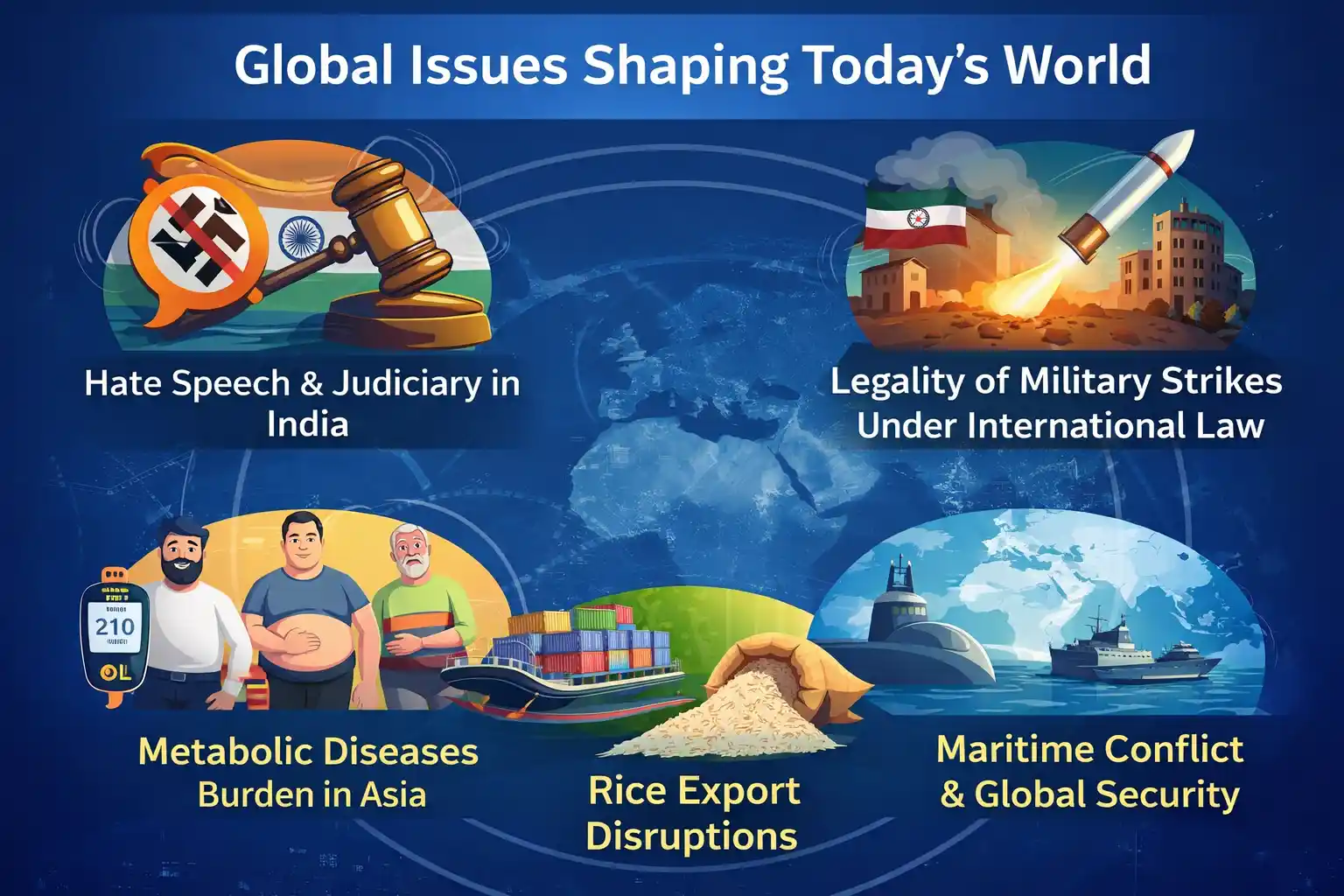
Modern global affairs are increasingly shaped by complex interactions between politics, law, health, and economics. From debates over hate speech and constitutional rights in India to international humanitarian law governing armed conflicts, several major developments highlight the challenges governments and institutions face today.
This article explores five major issues currently influencing global governance and public policy.
1. Hate Speech and the Role of the Judiciary in India
The issue of hate speech has returned to public debate after the Gauhati High Court issued a notice to Assam Chief Minister Himanta Biswa Sarma over alleged communal speeches. Petitioners had earlier approached the Supreme Court, which directed them to pursue the matter before the High Court.
What is Hate Speech?
Hate speech refers to expressions that incite discrimination, hostility, or violence against individuals or groups based on identity factors such as religion, caste, ethnicity, gender, or nationality.
Such speech often targets marginalized communities and may reinforce systemic discrimination even when it does not explicitly call for violence.
Constitutional Framework
India protects freedom of expression under Article 19(1)(a) of the Constitution. However, this freedom is not absolute. Article 19(2) allows reasonable restrictions in the interests of:
-
Public order
-
Morality and decency
-
Security of the state
-
Sovereignty and integrity of India
-
Incitement to offences
The challenge lies in balancing free speech with the need to protect vulnerable groups.
Legal Provisions Addressing Hate Speech
India currently does not have a single dedicated hate speech law. Instead, multiple provisions address the issue indirectly.
Some key laws include:
-
IPC Section 153A – Promoting enmity between groups
-
IPC Section 295A – Outraging religious feelings
-
IPC Section 505(2) – Statements creating communal hostility
Election-related hate speech is also regulated under the Representation of the People Act, 1951.
Challenges in Addressing Hate Speech
Several structural challenges complicate enforcement:
-
Ambiguity in defining hate speech
-
Risk of restricting legitimate political speech
-
Weak enforcement by police authorities
-
Political incentives that encourage divisive rhetoric
Experts suggest clearer definitions, stronger enforcement mechanisms, and greater political accountability as potential solutions.
2. The Legality of Military Strikes Under International Law
Recent military strikes involving the United States, Israel, and Iran have reignited debates about the legality of armed conflict under international law.
Reports suggest that a missile strike hit a school in Iran, raising concerns about potential violations of international humanitarian law (IHL).
07th March 2026 DSC
What is International Humanitarian Law?
International Humanitarian Law regulates the conduct of war and aims to limit human suffering during armed conflict.
Its primary goals are:
-
Protect civilians and non-combatants
-
Restrict methods of warfare
-
Ensure humane treatment of prisoners of war
The Geneva Conventions form the foundation of modern humanitarian law.
UN Charter and the Use of Force
The United Nations Charter places strict limits on when countries can use military force.
Key provisions include:
Article 2(4)
States must not use force against another state's territorial integrity or political independence.
Article 51
Allows the use of force only in self-defence after an armed attack.
Principles Governing Warfare
International humanitarian law is guided by several key principles:
Distinction
Combatants must distinguish between military targets and civilians.
Proportionality
Attacks must not cause excessive civilian harm relative to the expected military advantage.
Military Necessity
Force must only be used to achieve legitimate military objectives.
Precaution
All possible steps must be taken to minimize civilian casualties.
Violations of these principles can amount to war crimes, particularly when civilian infrastructure such as schools or hospitals is targeted.
3. The Growing Burden of Metabolic Diseases in Asia
Beyond geopolitics, public health is also undergoing dramatic shifts.
A recent study based on the Global Burden of Disease (GBD) data shows that India and China account for the largest metabolic disease burden in the Asia-Pacific region.
07th March 2026 DSC
What Are Metabolic Diseases?
Metabolic diseases affect how the body processes energy from food.
Major examples include:
-
Type 2 diabetes
-
Hypertension
-
Obesity
-
High cholesterol
-
Fatty liver disease
These conditions significantly increase the risk of cardiovascular disease and premature mortality.
Understanding DALYs
The burden of disease is often measured using Disability-Adjusted Life Years (DALYs).
DALYs combine:
-
Years of life lost due to premature death
-
Years lived with disability
One DALY represents one lost year of healthy life.
India recorded around 21 million DALYs in 2023 due to metabolic diseases.
Major Risk Factors
Several factors are driving the rise of metabolic diseases:
-
Sedentary lifestyles
-
High consumption of processed foods
-
Urbanization
-
Ageing populations
-
Rising obesity rates
Economic Impact
The effects extend beyond health.
Metabolic diseases lead to:
-
Higher healthcare expenditure
-
Reduced workforce productivity
-
Long-term strain on public health systems
Governments are increasingly focusing on preventive healthcare strategies such as nutrition awareness, active lifestyle promotion, and better urban planning.
4. Trade Disruptions and India’s Rice Export Challenges
India is the world’s largest rice exporter, accounting for nearly 40% of global rice exports.
However, ongoing geopolitical conflicts in West Asia have disrupted shipping routes, leaving thousands of containers of basmati rice stuck at Indian ports.
07th March 2026 DSC
Approximately 60,000 tonnes of rice shipments have been delayed due to shipping disruptions.
Why West Asia Matters
West Asia is one of the most important markets for Indian rice.
Major buyers include:
-
Saudi Arabia
-
UAE
-
Iran
-
Iraq
-
Yemen
The basmati rice export market to West Asia alone is worth roughly ₹25,000 crore annually.
Economic Consequences
Shipping disruptions have led to:
-
Increased freight costs
-
Export delays
-
Supply chain uncertainty
-
Risk of losing market share to competitors like Pakistan and Thailand
Exporters have requested the government to declare the situation as force majeure, which could protect them from contractual penalties.
5. Maritime Conflict and Global Security
Another emerging concern involves naval warfare and maritime law after reports of a U.S. submarine sinking an Iranian warship near Sri Lanka.
This incident raises important questions about international maritime law and the legality of naval attacks.
Legal Framework Governing Maritime Warfare
Maritime conflicts are regulated by multiple international frameworks, including:
-
United Nations Convention on the Law of the Sea (UNCLOS)
-
United Nations Charter
-
Geneva Conventions
-
San Remo Manual on Naval Warfare
UNCLOS defines maritime zones such as:
| Zone | Distance from Coast |
|---|---|
| Territorial Sea | Up to 12 nautical miles |
| Contiguous Zone | Up to 24 nautical miles |
| Exclusive Economic Zone | Up to 200 nautical miles |
Beyond these zones lie the high seas, which are open to all states.
Strategic Importance for India
The Indian Ocean is critical for global trade and energy supply.
-
Nearly 90% of India’s trade by volume moves through sea routes.
-
Around 80% of global seaborne oil trade passes through the region.
Any escalation of naval conflict in this region could threaten shipping lanes and global energy supply chains.
Conclusion
The issues discussed above illustrate the interconnected nature of modern global challenges.
From hate speech debates within democracies to the legality of military operations, rising lifestyle diseases, and disruptions to international trade, governments must navigate increasingly complex policy landscapes.
Addressing these challenges will require stronger legal frameworks, improved governance, international cooperation, and sustainable public policies.
The ability of institutions—both national and international—to adapt to these realities will shape the future of global stability.