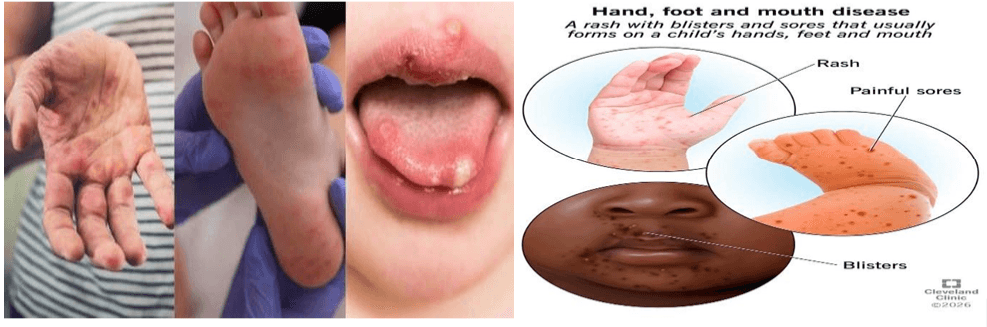
What Is HFMD?
HFMD is a highly contagious viral infection, mainly affecting young children, especially those below 5 years.
It is commonly caused by enteroviruses, particularly Coxsackievirus A16 and Enterovirus 71 (EV-A71).
In Guwahati, cases are reportedly increasing as the seasonal pattern picks up.
Usually resolves within 7–10 days.
Key Symptoms
Fever
Painful mouth ulcers/blisters
Red spots/vesicles on:
Palms & fingers
Soles & toes
Sometimes arms, legs and buttocks
Mouth pain can reduce fluid intake and lead to dehydration.
HFMD vs Chickenpox
HFMD | Chickenpox |
|---|---|
Mouth ulcers, hand/foot lesions characteristic | Generalised itchy rash |
Palms and soles commonly affected | Usually begins on trunk/face |
Lesions often less itchy | Usually intensely itchy |
Painful mouth sores may cause refusal to drink | Rash appears in successive crops |
Caused by enteroviruses | Caused by Varicella-zoster virus |
Transmission
HFMD spreads through:
Respiratory/nasal and oral secretions
Contaminated hands and surfaces
Blister fluid
Fecal–oral route
Contaminated toys, utensils and other objects
Prevention & Control
Frequent handwashing with soap and water
Avoid sharing bottles, cups, food, utensils and towels
Clean/disinfect frequently touched surfaces
Schools should identify clusters and inform parents
Keep symptomatic children away from close contact during the acute phase.
Treatment
No specific antiviral treatment for routine HFMD
Focus on supportive care and adequate hydration
Cold fluids and soft foods may be easier to tolerate.
Watch for dehydration: very low urine output, dry mouth, absence of tears, lethargy and persistent vomiting.
Neurological complications are rare, but seizures, confusion, difficulty walking or abnormal movements require urgent medical attention.
Practice Questions
Prelims Question
1. Consider the following statements about HFMD:
It is a viral infection.
It mainly affects young children.
Palms and soles can be commonly affected.
Antibiotics are the specific treatment for HFMD.
Which of the statements given above are correct?
A. 1, 2 and 3 only
B. 1 and 4 only
C. 2 and 3 only
D. 1, 2, 3 and 4
Answer: A
Mains Questions
“School-based disease surveillance and hygiene are important components of controlling highly contagious childhood infections.” Discuss with reference to HFMD. (10 marks, 150 words)