The Core Question
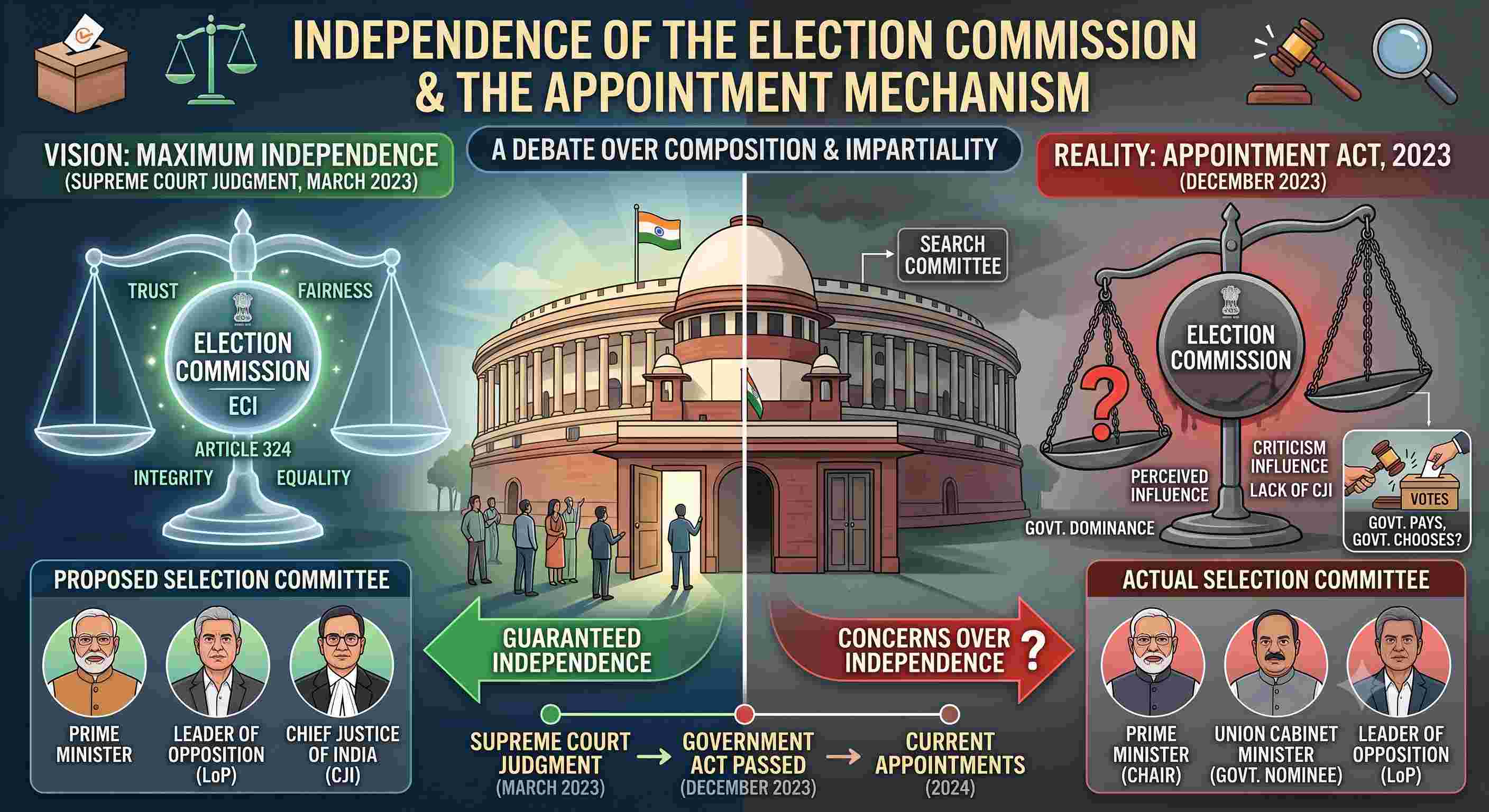
The debate over the appointment of Election Commissioners raises a fundamental constitutional question: how can the independence and neutrality of the Election Commission of India (ECI) be protected while retaining Parliament's power to determine the statutory appointment mechanism?

Constitutional Framework
Article 324 establishes the Election Commission of India and vests it with the superintendence, direction and control of elections.
Article 324(2) provides that the President appoints the Chief Election Commissioner (CEC) and Election Commissioners (ECs), subject to parliamentary law.
Thus, the Constitution itself contemplated that Parliament could prescribe the appointment procedure through legislation.
The independence of the ECI is considered essential for maintaining free and fair elections, which form part of the Basic Structure of the Constitution.
Judicial Intervention & the 2023 Act
The Supreme Court had devised an interim selection mechanism involving the Prime Minister, Leader of Opposition and Chief Justice of India.
However, this mechanism was judicially created as an interim arrangement, rather than being an immutable constitutional requirement.
Parliament subsequently enacted the Chief Election Commissioner and Other Election Commissioners Act, 2023, replacing the earlier judicial arrangement.
The 2023 framework gives the government a stronger role in the selection process.
Major Constitutional Concern
The key issue is the composition of the Selection Committee. If the government has a dominant position in selecting Election Commissioners, questions may arise regarding:
Institutional independence
Perceived executive influence
Impartiality of Election Commissioners
Public confidence in electoral institutions
The concern becomes particularly significant because the ECI regulates elections involving the same political executive that participates in the appointment process.
Basic Structure Dimension
Free and fair elections are regarded as an essential constitutional principle. Therefore:
Parliament can legislate on the appointment mechanism, but such legislation cannot undermine the constitutional requirement of an independent and impartial electoral process.
This creates a distinction between:
Parliament's legislative power ↓ Appointment mechanism
and
Constitutional limitation ↓ Preservation of free and fair elections
Possible Reform: Consensus-Based Selection
One suggested approach is to require broad consensus or unanimity within the Selection Committee. This could:
Reduce unilateral executive influence.
Encourage bipartisan appointments.
Improve institutional credibility.
Strengthen public confidence in the ECI.
Protect the perception of neutrality.
However, unanimity could also create deadlocks, making a carefully designed consensus mechanism preferable to an absolute veto.
Way Forward
Ensure a genuinely balanced Selection Committee.
Provide transparent and objective eligibility criteria.
Establish a publicly defensible process for shortlisting candidates.
Ensure security of tenure and adequate institutional autonomy.
Strengthen financial and administrative independence of the ECI.
Create mechanisms for bipartisan consultation without paralysing appointments.
Maintain judicial review to ensure that the appointment framework does not undermine constitutional principles.
Practice Questions
Prelims Questions
Q. With reference to the Election Commission of India, consider the following statements:
Article 324(2) contemplates a role for Parliament in determining the appointment process for Election Commissioners.
Free and fair elections are regarded as an element of the Basic Structure of the Constitution.
Any appointment mechanism enacted by Parliament is completely immune from judicial review.
Which of the statements given above is/are correct?
(a) 1 only (b) 1 and 2 only (c) 2 and 3 only (d) 1, 2 and 3
Answer: (b) 1 and 2 only
Explanation: Article 324(2) permits Parliament to legislate on appointments. Free and fair elections are a fundamental constitutional principle. However, parliamentary legislation remains subject to constitutional scrutiny and judicial review.
Mains Question
Q. "The independence of the Election Commission is indispensable for free and fair elections, but institutional independence depends significantly on the manner in which Election Commissioners are appointed." Discuss. (150 words, 10 marks)