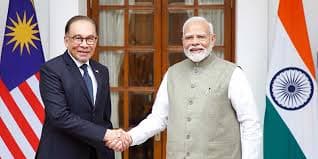
Why in News ?
Recent Bilateral Developments
India and Malaysia signed 11 agreements in 2026 covering defence, semiconductors, energy, and digital cooperation. This shows a shift from traditional trade toward high-technology and security cooperation.
Both countries encouraged trade settlement in local currencies (₹–Ringgit) amid global de-dollarisation, aiming to reduce foreign exchange risk and transaction costs in a bilateral trade relationship already exceeding US$20 billion annually.
Relevance
GS 2 (International Relations)
- India–ASEAN relations, Act East Policy
- Bilateral diplomacy, UNSC reforms
- Indo-Pacific strategy, maritime cooperation
- De-dollarisation and currency diplomacy
GS 3 (Economy & Security)
- Semiconductor supply chains and technology sovereignty
- Defence cooperation and maritime security
- Energy and digital economy partnerships
Basics & Core Keywords
Strategic Partnership
A strategic partnership involves continuous cooperation in defence, technology, and diplomacy. India and Malaysia upgraded their ties in 2015 to an Enhanced Strategic Partnership, establishing annual dialogues and sector-based cooperation.
Local Currency Trade
Local currency settlement reduces dependence on the US dollar. India has similar arrangements with the UAE and Sri Lanka, reflecting the RBI’s effort to internationalise the rupee across more than 18 partner countries.
Semiconductor Cooperation
Semiconductor collaboration aligns with India’s US$10 billion Semiconductor Mission (2021) and Malaysia’s established role in global chip assembly, where it manages about 13% of global testing and packaging.
Indo-Pacific
The Indo-Pacific accounts for 60% of global GDP and 50% of global trade, making India–Malaysia maritime cooperation important for securing sea lanes.
Historical & Civilisational Links
Maritime & Cultural Ties
Trade and migration during the Chola period created strong links. Today, about 2 million people of Indian origin live in Malaysia, forming one of Southeast Asia’s largest Indian diasporas.
Diaspora Diplomacy
The Indian diaspora contributes significantly to Malaysia’s services and political sectors, strengthening soft power and business connections.
Political & Diplomatic Dimension
UNSC Support
Malaysia reaffirmed support for India’s permanent membership in the UNSC, strengthening India’s reform narrative backed by major ASEAN partners.
High-Level Engagement
Prime Minister-level visits and CEO forums support business deals. Malaysia is among India’s top 15 global trading partners.
Economic Dimension
Trade & Investment
Bilateral trade has crossed the US$20–25 billion range in recent years, dominated by palm oil, petroleum products, electronics, and machinery.
Currency Diversification
Rupee–ringgit trade can reduce hedging costs by 2–3% of transaction value, benefiting SMEs and stabilising trade flows.
Supply Chain Resilience
Cooperation in semiconductors and electronics reduces overdependence on East Asian hubs, a key lesson from the 2020–22 global chip shortages.
Security & Defence Dimension
Counter-Terrorism
Both countries cooperate through intelligence sharing under ASEAN-led frameworks. Southeast Asia remains vulnerable to extremist networks such as Jemaah Islamiyah, making coordination necessary.
Maritime Security
The Malacca Strait handles about 25% of global trade, making maritime cooperation vital for anti-piracy and SLOC security.
Defence Engagement
India provides defence training and capacity-building to ASEAN states, including Malaysia, through ADMM-Plus mechanisms.
Technology & Innovation Dimension
Digital & AI Cooperation
India’s digital economy is projected to reach US$1 trillion by 2030, making technology partnerships attractive for Malaysia’s innovation ecosystem.
Health & Food Security
Joint cooperation in agri-tech and pharmaceuticals aligns with India’s role as the “pharmacy of the world,” supplying vaccines and generic medicines globally.
Geopolitical Significance
Act East Policy
Malaysia is a key ASEAN economy. ASEAN–India trade is around US$110 billion, making Malaysia important for regional integration.
China Factor
China is ASEAN’s largest trade partner with trade exceeding US$900 billion, encouraging India to deepen bilateral ties for strategic balance.
Indo-Pacific Stability
Both countries support a rules-based maritime order in line with UNCLOS and freedom of navigation principles.
Challenges
Trade Imbalance
India often runs a trade deficit due to palm oil imports, with Malaysia among its top suppliers.
Geopolitical Sensitivities
ASEAN centrality requires India to expand influence without engaging in bloc politics.
Implementation Gap
Past MoUs have faced slow implementation due to regulatory and financing delays.
Way Forward
Institutional Dialogue
Annual reviews and sectoral working groups can improve implementation tracking.
Tech Skill Ecosystem
Joint semiconductor skill hubs and R&D centres can support long-term cooperation.
Maritime Cooperation
Expanding HADR operations and joint naval exercises can strengthen sea-lane security.
Value Addition
- Malaysia is India’s 3rd largest trading partner in ASEAN after Singapore and Indonesia
- FDI from Malaysia to India is about US$1.2–1.5 billion, mainly in infrastructure and construction
- Over 60 Indian companies operate in Malaysia in IT, pharma, and manufacturing
- India imports about 6–7 million tonnes of palm oil annually, with Malaysia among the top two suppliers
- ASEAN accounts for about 11% of India’s total global trade
- The Indian Ocean carries 80% of global oil trade, highlighting maritime cooperation importance