Key Highlights
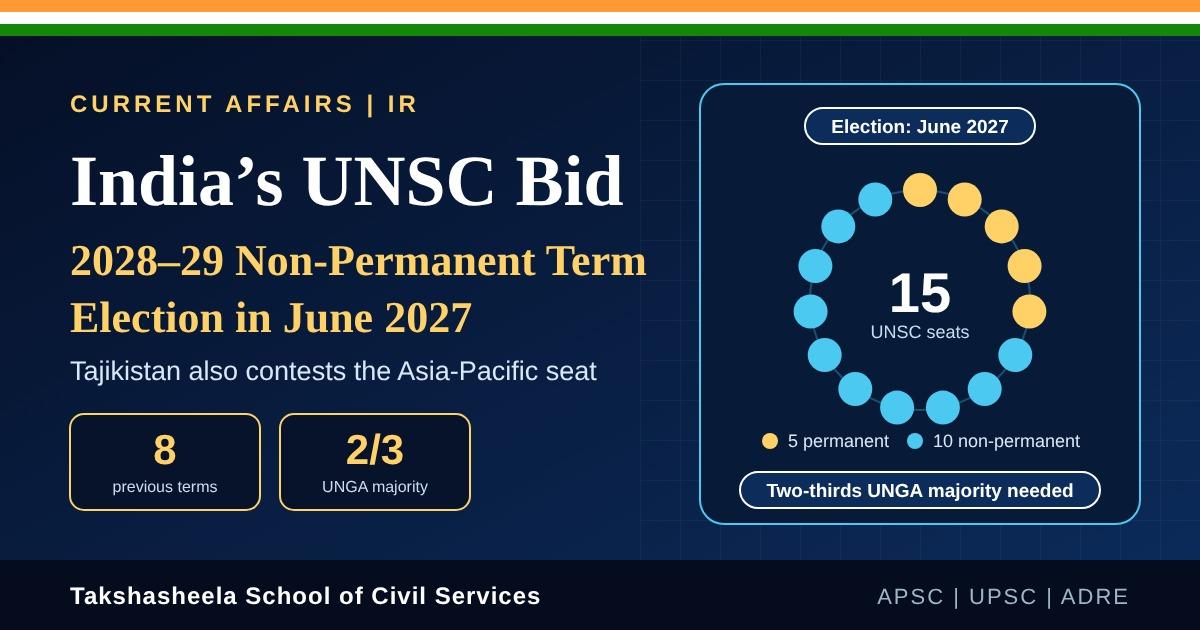
Election: June 2027 for the 2028–29 non-permanent term of the UN Security Council (UNSC).
India’s candidature: Announced by External Affairs Minister S. Jaishankar.
Main challenge: Tajikistan is also contesting for the Asia-Pacific seat.
Required votes: At least a two-thirds majority of UNGA members present and voting; the article estimates 129 votes in a 193-member Assembly.
India’s previous memberships: Eight terms—1950–51, 1967–68, 1972–73, 1977–78, 198485, 1991–92, 2011–12 and 2021–22.
India’s objective: Promote counter-terrorism, UNSC reforms and greater representation for developing countries.
Why Is the Election Challenging for India?
Competition from Tajikistan: Tajikistan is seeking its first UNSC membership.
Global South’s expectations: Smaller countries want fairer representation in global institutions.
Regional support: Tajikistan has support from Central Asian countries and the Organisation of Islamic Cooperation (OIC).
Foreign policy considerations: India’s relations with Israel and major powers may influence some countries’ voting decisions.
Previous electoral setbacks: India lost contested elections in 1975 and 1996.
Way Forward
Strengthen diplomatic engagement with Global South countries.
Advocate reforms that improve the representation of developing nations.
Highlight India’s contributions to UN peacekeeping and international development.
Maintain strategic autonomy and build consensus on counter-terrorism.
Balance immediate electoral ambitions with long-term diplomatic relationships.
Practice Questions
Prelims Question
Q. Consider the following statements about the United Nations Security Council (UNSC):
The UNSC has 15 members, including five permanent members.
The UN General Assembly elects non-permanent members for two-year terms.
All decisions of the UN General Assembly require a two-thirds majority.
Which of the statements given above is/are correct?
A) 1 and 2 only
B) 2 and 3 only
C) 1 and 3 only
D) 1, 2 and 3
Answer: A) 1 and 2 only
Explanation: Article 18 of the UN Charter requires a two-thirds majority for important questions, while other questions generally require a simple majority of members present and voting.
Mains Question
Q. India’s quest for a permanent seat in the United Nations Security Council reflects the need for reforms in global governance. Discuss the challenges and suggest a way forward. (150 words)