Current Issue
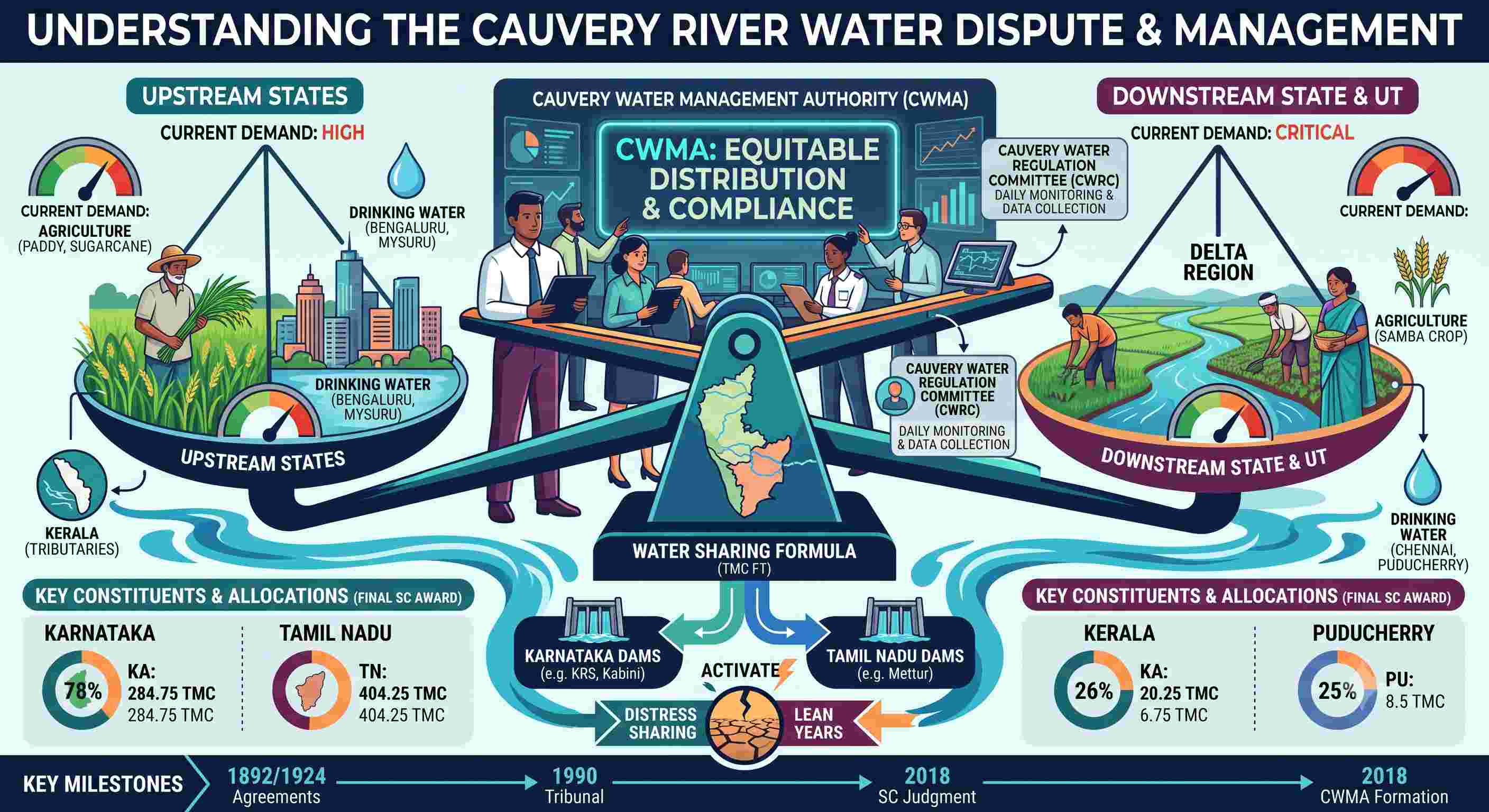
The Supreme Court has sought Karnataka's response to Tamil Nadu's plea alleging a 20,000 million cubic feet shortfall in Cauvery water. Karnataka cited a severe drought and said it had made its best efforts to fulfil its obligations as an upper-riparian state.
The dispute highlights the continuing challenge of balancing drinking-water and agricultural needs of an upper-riparian State with the legally determined water-sharing obligations towards a lower riparian State.
Important Points for UPSC, APSC
1. Cauvery River
Origin: Talakaveri, Karnataka
Flows through Karnataka and Tamil Nadu, with the basin also extending into Kerala and Puducherry.
Ultimately drains into the Bay of Bengal.
Important for agriculture, especially in the Cauvery delta of Tamil Nadu.
2. Constitutional Provisions
Article 262: Parliament may provide for adjudication of disputes relating to waters of inter-State rivers.
Article 262(2): Parliament can exclude the jurisdiction of the Supreme Court and other courts in such disputes.
Inter-State River Water Disputes Act, 1956: Provides for tribunals for adjudication of such disputes.
3. Cauvery Water Disputes Tribunal (CWDT)
Constituted in 1990.
Final award was given in 2007.
Supreme Court modified the allocation in its 2018 judgment.
The judgment increased Karnataka's share by 14.75 TMC and reduced Tamil Nadu's corresponding share.
4. Cauvery Water Management Authority (CWMA)
Established following the Supreme Court's 2018 judgment.
Responsible for implementing the water-sharing arrangements.
Works with the Cauvery Water Regulation Committee (CWRC).
Why Important for UPSC/APSC?
Federalism: Conflict between State interests and constitutional mechanisms.
Cooperative federalism: Need for States to comply with institutional mechanisms.
Water security: Increasing variability in rainfall can intensify disputes.
Climate change: Changing monsoon patterns and droughts can increase water stress.
Agriculture: Cauvery water is crucial for irrigation in southern India.
River-basin management: Water should ideally be managed at the basin level, rather than purely according to political boundaries.
Prelims Question
Q1. With reference to inter-State river-water disputes in India, consider the following statements:
Article 262 deals with adjudication of disputes relating to waters of inter-State rivers.
Parliament can provide for exclusion of the jurisdiction of the Supreme Court in such disputes.
The Inter-State River Water Disputes Act, 1956 provides for adjudication through water-dispute tribunals.
Which of the statements given above are correct?
A. 1 and 2 only
B. 2 and 3 only
C. 1 and 3 only
D. 1, 2 and 3
Answer: D
Mains Question
Q. Inter-State river-water disputes pose a challenge to cooperative federalism in India. Discuss with reference to the Cauvery water dispute. (150 words)