GS PAPER III — ENVIRONMENT & BIODIVERSITY · March 15–16, 2026 · 7 min read
With fewer than 3,500 individuals remaining in the wild, the Western Tragopan — the rarest pheasant in Asia — is losing ground to roads, dams, and a warming Himalaya. A conservation analysis of what is at stake and what must change.
Key Facts at a Glance
| Detail | Information |
|---|---|
| Scientific Name | Tragopan melanocephalus |
| Common Names | Jujurana (King of Birds), Horned Pheasant |
| Family | Phasianidae (pheasants, partridges, junglefowl) |
| IUCN Status | Vulnerable — population declining |
| Global Population | 2,500 – 3,500 individuals |
| Largest Stronghold | Great Himalayan National Park — 500+ breeding pairs |
| Habitat Elevation | 2,400 – 3,600 metres (temperate & subalpine forests) |
| Legal Protection (India) | Schedule I — Wildlife Protection Act, 1972 |
1. A Bird Like No Other
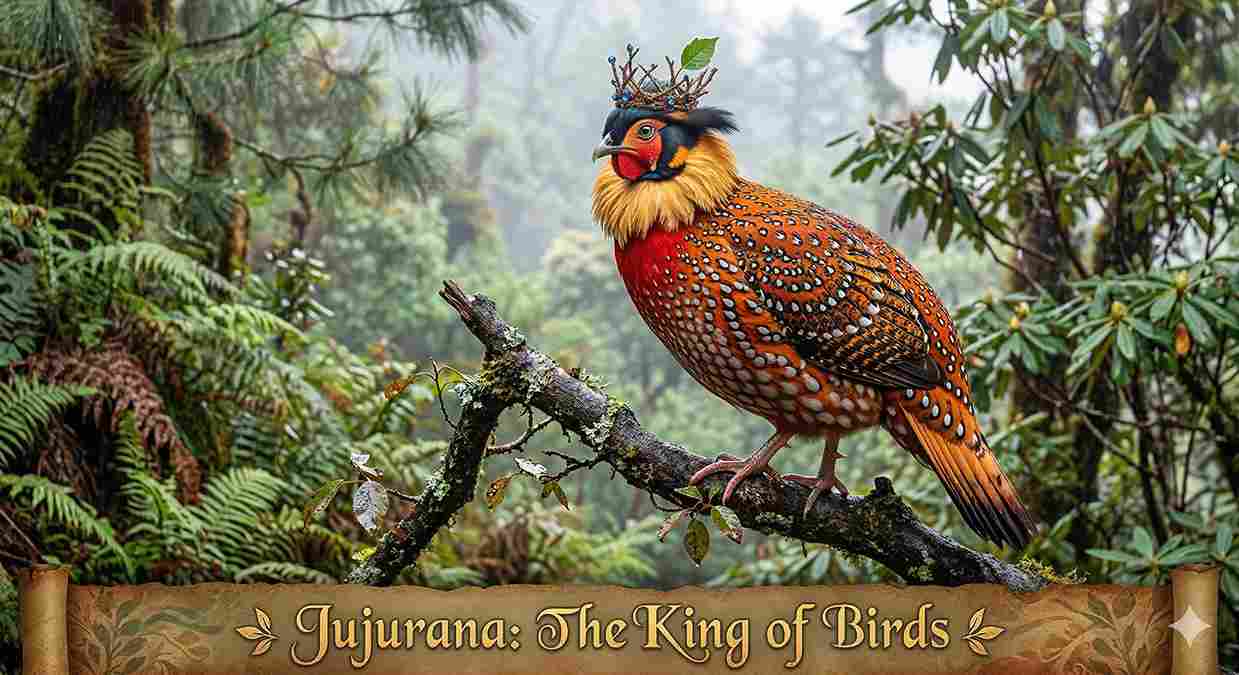
In the dense temperate forests of the Western Himalayas, at elevations where oak gives way to fir and deodar, lives one of the most extraordinary birds on Earth. The Western Tragopan — known locally as Jujurana, meaning "king of birds" in the Kullu region of Himachal Pradesh — is a bird that seems almost invented for mythology. During breeding season, the male unfurls fleshy blue horns above its head and inflates a vivid, jewel-like throat lappet, transforming its face into a spectacle of deep blue, crimson, and orange against a backdrop of dark plumage dotted with white markings.
It is also one of the rarest pheasants in the world. Fewer than 3,500 individuals are estimated to remain globally, distributed across a fragmented range stretching from Pakistan's Swat Valley through Jammu & Kashmir, Himachal Pradesh, and into Uttarakhand. Its population continues to decline. The Great Himalayan National Park (GHNP) in Himachal Pradesh — a UNESCO World Heritage Site since 2014 — supports more than 500 breeding pairs, making it the single most important refuge for the species on the planet.
The Western Tragopan does not merely inhabit the Himalayan forest — it embodies it. Where the Tragopan thrives, the ecosystem is intact. Where it disappears, something irreplaceable has been lost.
2. Biology and Behaviour
The Western Tragopan belongs to the family Phasianidae — the same family as peacocks, junglefowl, and common pheasants. Adult males measure approximately 68–73 cm in length, with dark plumage scattered with white ocelli (eye-like spots), a crimson hindneck, blue throat, and vivid orange fore-neck. The species earned the name "horned pheasant" for the distinctive fleshy blue horns males extend during courtship, alongside brilliantly coloured inflatable throat lappets used to attract females.
The bird's courtship call — a distinctive nasal "khuwaah" — carries through dense forest canopies during the breeding season from May to June. Females lay three to six eggs per clutch, incubated for approximately 28–30 days. Nesting takes place either on the ground under dense vegetation or in low tree cavities, both of which are highly sensitive to human disturbance during the critical breeding window.
The species is omnivorous, feeding on berries, leaves, seeds, bamboo shoots, fallen fruits, and insects — a dietary flexibility that reflects the diversity of its forest habitat. It prefers dense oak, fir, spruce, and deodar forests with thick undergrowth, descending to around 2,000 metres in winter months when higher elevations become inaccessible.
3. The Threats Closing In
Habitat Loss and Fragmentation
The single greatest threat to the Western Tragopan is the progressive fragmentation of its forest habitat by infrastructure development. Hydropower projects, road expansion, and tunnel construction — including the Atal (Rohtang) Tunnel corridor in Himachal Pradesh — have penetrated previously undisturbed areas of the Western Himalayas, bringing with them increased human activity, noise, and ecological disruption. Forest fragmentation does not merely reduce the area available to the species; it isolates populations, prevents genetic exchange, and increases vulnerability to local extinction events.
Human Disturbance During Breeding Season
Tourism, grazing pressure, and forest resource extraction in and around protected areas have disrupted the Tragopan's breeding habitats and reduced suitable nesting sites. Human presence during the May–June breeding season is particularly damaging: it can trigger nest abandonment, reduce reproductive success, and force birds away from optimal nesting locations. The very infrastructure that brings tourists to the region — roads, tunnels, hotels — also multiplies the disturbance footprint in ways that were previously impossible.
Climate Change
The Western Himalayas are warming faster than the global average. Climate change is shifting vegetation zones and altering forest composition, potentially reducing suitable habitat for a species with highly specific altitudinal requirements. Changes in snow cover, temperature patterns, and monsoon precipitation affect both the availability of food sources and the timing of breeding cycles. For a species already confined to a narrow altitudinal band, even modest shifts in habitat suitability can translate into significant range contraction.
4. Why It Matters Beyond the Bird Itself
The Western Tragopan is more than a charismatic species — it is an ecological indicator. Its presence signals intact temperate Himalayan forest with minimal pollution, low pesticide use, and stable ecological conditions. Its absence signals the opposite. Protecting the Tragopan means protecting the dense oak-fir-deodar forests that regulate water flow for rivers across the Western Himalayas, maintain carbon stores, and support associated biodiversity including musk deer, Himalayan monal, and snow leopard habitats.
The Western Himalayas form part of one of the world's most important biodiversity hotspots — a region that supplies water to hundreds of millions of people across South Asia. Conservation of its flagship species is not a luxury; it is integral to the ecological security of the region.
India is one of the world's 17 megadiverse countries. Yet megadiversity without active stewardship is merely a statistic. The Tragopan's decline is a test of whether that stewardship is real.
5. Protected Areas: The Last Line of Defence
| Protected Area | State | Significance |
|---|---|---|
| Great Himalayan National Park | Himachal Pradesh | Primary stronghold; 500+ breeding pairs; UNESCO WHS (2014) |
| Daranghati Wildlife Sanctuary | Himachal Pradesh | Important secondary refuge with dense temperate forest |
| Rupi Bhaba Wildlife Sanctuary | Himachal Pradesh | Contiguous habitat buffer supporting Tragopan populations |
The GHNP provides the dense temperate forests and minimal human disturbance that the species requires. Its UNESCO World Heritage status offers an additional layer of international recognition and scrutiny — but not immunity from the pressures of infrastructure expansion and tourism growth that increasingly encroach on its buffer zones.
6. What Conservation Science Recommends
Flagship Species Status
Conservation experts recommend granting the Western Tragopan flagship species status for the Western Himalayan temperate forest ecosystem. This would direct dedicated funding, policy attention, and monitoring resources toward its habitat, with cascading benefits for the entire biodiversity of the region.
Long-Term Ecological Monitoring
Sustained population monitoring in key habitats — particularly GHNP — is essential to track trends, identify emerging threats, and evaluate the effectiveness of protection measures. Radio-tagging of individuals would significantly improve our understanding of migration corridors, breeding success rates, and habitat use patterns that are currently poorly understood.
Survey of Under-Studied Areas
Systematic surveys across the Pir Panjal range and other under-studied Himalayan regions are urgently needed to identify additional populations, assess their viability, and determine conservation priorities beyond the known strongholds. Current population estimates may themselves be incomplete.
Infrastructure Planning with Ecological Sensitivity
Environmental impact assessments for infrastructure projects in the Western Himalayas must rigorously account for the Tragopan's habitat requirements, breeding seasonality, and sensitivity to noise and human disturbance. The current trajectory — where road and tunnel construction proceeds with minimal consideration for the ecological cost to fragile mountain biodiversity — is incompatible with meaningful conservation outcomes.
Conclusion: A Kingdom Worth Saving
The Western Tragopan has survived in the Himalayas for millennia, long enough to earn a name that means "king of birds" from communities who have lived alongside it for generations. It has survived the advance of agriculture, the retreat of forest, and the disruption of traditional land use. What it may not survive is the accelerating combination of infrastructure-driven habitat fragmentation and climate-driven habitat shift that now characterises the Western Himalayas.
India has the legal framework — Schedule I of the Wildlife Protection Act, a network of protected areas, and an international commitment to biodiversity conservation. What it requires is the political will and institutional follow-through to ensure that these protections translate into the undisturbed forest and reduced human pressure that the Jujurana needs to persist. A country that cannot protect its rarest, most spectacular pheasant in a UNESCO World Heritage site is not making a minor conservation error. It is failing a fundamental test of ecological stewardship.
The king of birds does not need a throne. It needs a forest — intact, undisturbed, and large enough to sustain a future.
Prelims Quick Reference
| Point | Detail |
|---|---|
| Scientific name | Tragopan melanocephalus |
| Common name | Jujurana / Horned Pheasant |
| IUCN status | Vulnerable |
| Family | Phasianidae |
| Range | Western Himalayas — India & Pakistan only (endemic) |
| Habitat elevation | 2,400 – 3,600 m (descends to ~2,000 m in winter) |
| Key Indian habitats | GHNP, Daranghati WS, Rupi Bhaba WS (all Himachal Pradesh) |
| Legal protection | Schedule I, Wildlife Protection Act 1972 |
| GHNP status | UNESCO World Heritage Site since 2014 |
Sources: Takshashila DSC 15–16 March 2026 · IUCN Red List · BirdLife International · Wildlife Protection Act, 1972 · UNESCO World Heritage Centre · Wildlife Institute of India