Context
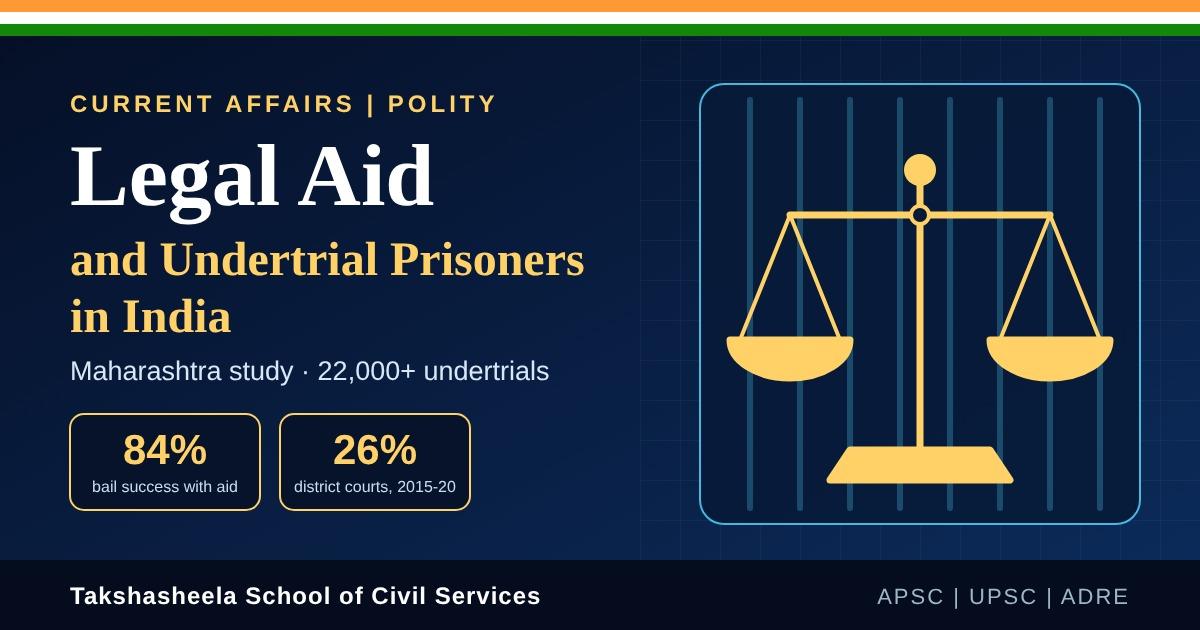
A study of over 22,000 undertrial prisoners assisted in eight Maharashtra prisons between 2018 and 2023 highlights how timely legal aid can improve access to bail and reduce the economic burden of detention.
Key Findings
High undertrial population: More than three-quarters of India’s prisoners in 2022 were undertrials.
Improved bail outcomes: 84% of programme participants’ bail applications succeeded, compared with 26% across the same district courts during 2015–2020.
Delayed assistance: Participants spent an average of 171 days in jail before entering the programme and another 115 days in custody before release on bail.
Economic burden: Prolonged detention results in lost wages, income insecurity and financial hardship for vulnerable families.
Social vulnerability: Poor, less-educated people, casual workers, women and marginalised communities face significant barriers to legal representation.
Major Challenges
Low awareness of free legal aid.
Delayed identification of eligible prisoners.
Shortages and uneven quality of legal assistance.
Procedural delays and difficulties meeting bail conditions.
Way Forward
Provide legal assistance from arrest, strengthen legal aid institutions, improve awareness, and ensure timely bail hearings.
Important Constitutional Provisions
Article 14: Equality before the law and equal protection of the laws.
Article 21: Protection of life and personal liberty.
Article 22: Protection against arbitrary arrest and detention, including specified procedural safeguards.
Article 39A: Directs the State to ensure equal justice and provide free legal aid so that opportunities for securing justice are not denied because of economic or other disabilities.
Legal Services Authorities Act, 1987
Provides the statutory framework for free legal services to eligible sections of society.
Established the National Legal Services Authority (NALSA) framework.
NALSA was constituted in 1995.
Legal services institutions operate at national, state, district and subordinate levels.
Who is Eligible for Free Legal Services?
Under Section 12 of the Legal Services Authorities Act, eligible categories include:
Members of Scheduled Castes and Scheduled Tribes.
Victims of trafficking or begar.
Women and children.
Persons with disabilities.
Victims of mass disasters, ethnic violence, caste atrocities, floods, droughts, earthquakes or industrial disasters.
Industrial workmen.
Persons in custody.
Persons meeting the prescribed income criteria.
Important distinction: Article 39A is a Directive Principle of State Policy, while Articles 14 and 21 are Fundamental Rights.
Practice Questions
Prelims Questions
Q1. Article 39A of the Indian Constitution deals with:
A. Uniform Civil Code
B. Equal justice and free legal aid
C. Separation of the judiciary from the executive
D. Protection against arbitrary arrest
Answer: B. Equal justice and free legal aid
Mains Question
Q. “Timely legal aid is essential for ensuring access to justice and reducing unnecessary detention of undertrial prisoners.” Discuss. (150 words)