Editorial Analysis | Takshasheela School of Civil Services Based on an article in The Indian Express | Puja Kakati, Faculty
The Central Argument
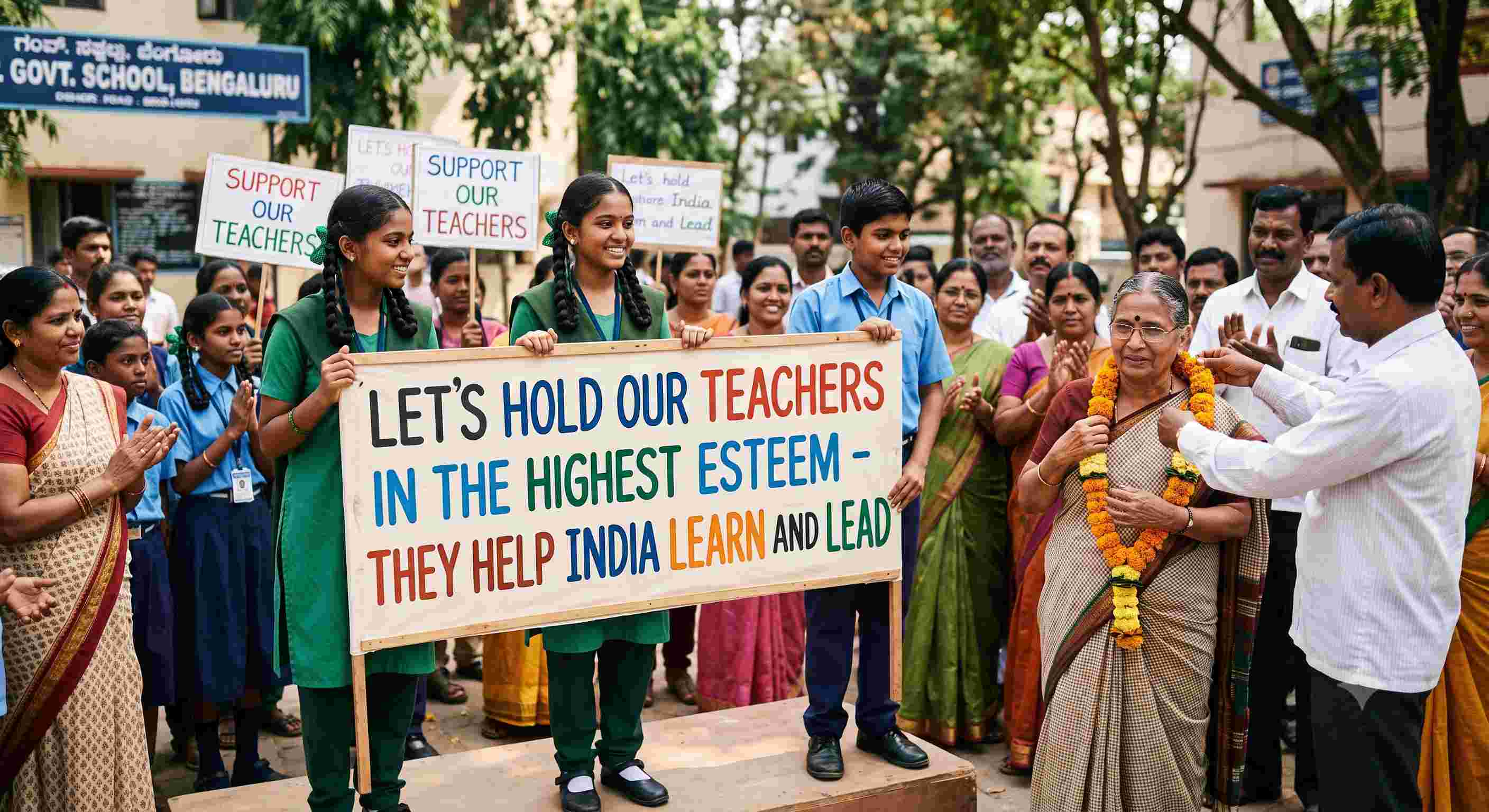
The editorial’s core claim is that teachers shape destinies, and that their role extends far beyond delivering a prescribed curriculum. A good teacher develops knowledge and skills, curiosity and independent thinking, ethical values, confidence and resilience, the capacity for judgement and reasoning, and a sense of social and national responsibility. Teachers matter, in other words, not merely because they produce academically successful students, but because they help create responsible citizens.
A Civilisational Value, Not Just an Administrative Norm
The editorial roots this argument in the Indian concept of “Acharyadevo Bhava” — the idea that the teacher occupies a position akin to the divine — which reflects the extraordinarily high status accorded to teachers in Indian thought. Ancient Indian texts held that teachers should treat students fairly, be patient, understand each student’s individual abilities, put students’ welfare first, and guide them through affection and example rather than through authority alone. Respect for teachers, the editorial argues, is therefore not a modern administrative requirement invented by policy documents — it is a deep-rooted civilisational value that predates the modern education system by a considerable margin.
Teaching Through Conduct, Not Just Through Words
One of the editorial’s strongest ideas is that teachers teach through their conduct as much as through what they say in the classroom. A teacher becomes, in effect, a mentor, a role model, a well-wisher, and a guide all at once. Students constantly observe how their teachers behave, how they respond to difficulty, and how they treat other people — and a teacher’s character, attitude, and behaviour can leave a lasting imprint on a student’s personality long after the specific content of a lesson is forgotten. This is what makes teaching a position of considerable ethical responsibility, and not simply a technical or informational one.
From Memorisation to Independent Judgement
The editorial highlights an important shift in what education is meant to achieve. It should not simply train students to memorise information for recall. Instead, teachers should cultivate a chain that runs from curiosity to questioning, from questioning to reasoning, from reasoning to independent judgement, and ultimately from independent judgement to innovation. This progression matters more than ever in an era defined by rapid technological change, artificial intelligence, and fast-evolving employment opportunities, where the ability to reason independently is becoming more valuable than the ability to recall facts. The underlying objective, in this framing, is to produce students capable of becoming scientists, entrepreneurs, artists, researchers, innovators, and responsible citizens — not simply examination-passers.
Trust and Encouragement, Not Fear
The editorial advocates for a teacher-student relationship built on trust, affection, and encouragement, rather than one built on fear. Parents entrust teachers with a central role in their children’s development, and that trust carries a corresponding responsibility: teachers must ensure that their conduct does not generate fear, damage students’ confidence, create feelings of inferiority, discourage questioning, or suppress individuality. Instead, teachers should help students become the best versions of themselves. This idea connects directly to the contemporary concept of student-centred education, in which the student’s growth and individuality — rather than compliance with a fixed instructional model — becomes the organising principle of teaching.
Teachers and India’s Human Capital
The editorial’s deeper message ties the quality of teaching directly to India’s developmental trajectory. Infrastructure, technology, and economic growth all matter, but none of them can substitute for citizens who possess a combination of knowledge, skills, values, ethics, scientific temper, and social responsibility. Teachers are the people primarily responsible for developing that combination in the next generation. Respecting teachers, the editorial concludes, is therefore not simply about honouring a profession — it is about recognising their direct contribution to India’s future.
Practice Questions
Prelims MCQ
Consider the following statements with reference to the editorial “Let’s hold our teachers in the highest esteem”:
- The concept of “Acharyadevo Bhava” reflects a modern administrative approach to teacher welfare rather than a civilisational value.
- The editorial argues that a teacher’s conduct and behaviour can shape a student’s personality independently of the content taught.
- The editorial associates student-centred education with a teaching approach built on trust and encouragement rather than fear.
- According to the editorial, the progression from curiosity to innovation passes through questioning and reasoning.
Which of the statements given above are correct?
(a) 1, 2 and 3 only
(b) 2, 3 and 4 only
(c) 1, 3 and 4 only
(d) 2 and 4 only
Answer: (b) 2, 3 and 4 only. Statement 1 is incorrect because the editorial explicitly frames “Acharyadevo Bhava” as a deep-rooted civilisational value, not a modern administrative requirement.
Mains Question
“The quality of a nation’s human capital depends less on its infrastructure and more on the quality of its teachers.” Discuss this statement with reference to the evolving role of teachers in shaping knowledge, values, and independent judgement among students in India. (GS-1/Essay, 250 words)
Takshasheela School of Civil Services — APSC | UPSC | ADRE