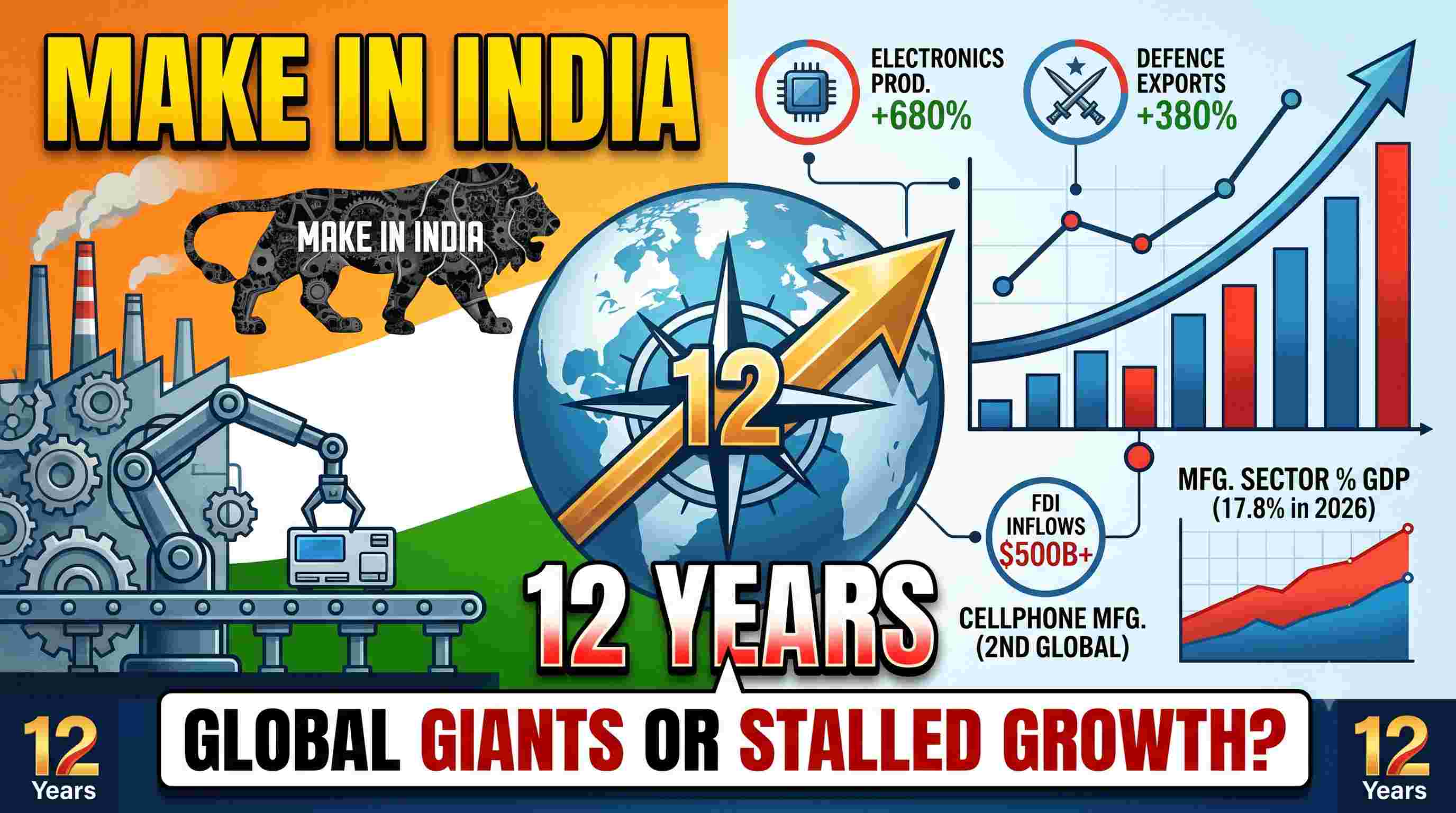
Why in News?
After 12 years, an assessment of Make in India shows a mixed/patchy performance. Manufacturing has made progress in some areas, particularly through PLI schemes, but its overall contribution to growth, employment and global exports remains a challenge.
Major Investment Concentration:
Solar modules
Pharmaceuticals
Automobiles & components
Speciality steel
Large-scale electronics manufacturing
Major Challenges
Low manufacturing share
Limited job creation
Weak private investment
Low global export share
Import dependence in some sectors
Other Challenges:
Infrastructure and logistics costs
Skill gaps
MSME constraints
Technology dependence
Limited integration into global value chains
Need for greater R&D and innovation
Way Forward
Strengthen MSME–large industry linkages
Reduce logistics and compliance costs
Promote labour-intensive manufacturing
Increase R&D and technology adoption
Diversify PLI benefits across sectors
Integrate India more deeply into Global Value Chains (GVCs)
Improve skilling and industrial infrastructure
Prelims Question
Q1. Consider the following statements regarding Make in India:
It was launched in 2014.
PLI schemes were introduced across 14 sectors.
PLI incentives are designed to promote domestic manufacturing and investment.
Which of the statements given above are correct?
A. 1 only
B. 1 and 2 only
C. 2 and 3 only
D. 1, 2 and 3
Answer: D
Mains Question
Q. "Make in India has achieved sector-specific successes, but its broader manufacturing transformation remains incomplete." Discuss.