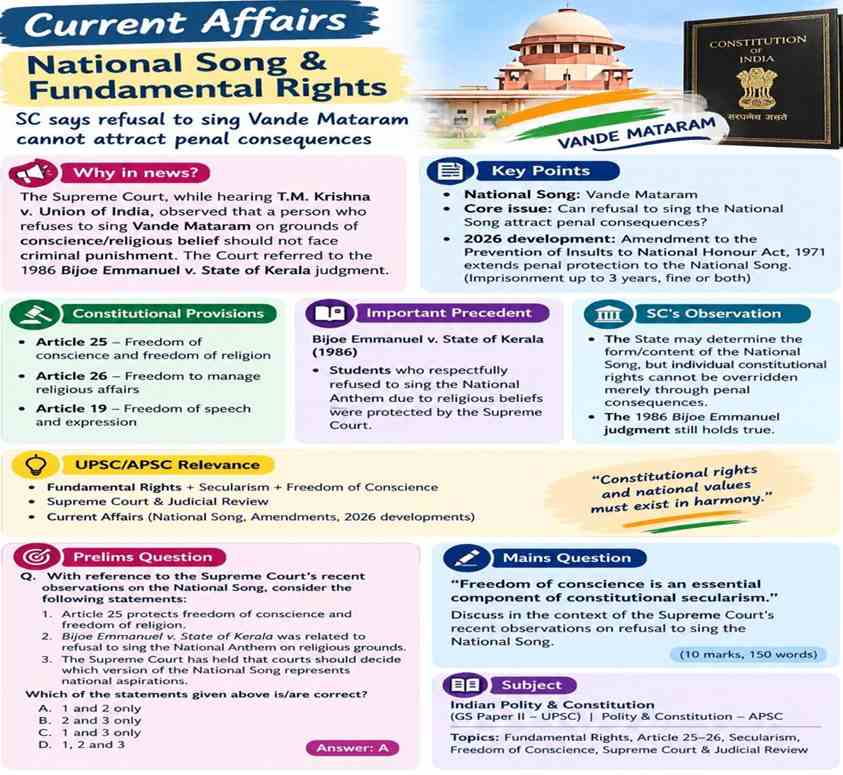
Why in News?
The Supreme Court, while hearing T.M. Krishna v. Union of India, observed that a person who refuses to sing Vande Mataram on grounds of conscience/religious belief should not face criminal punishment. The Court referred to the 1986 Bijoe Emmanuel v. State of Kerala judgment.
Key Points
National Song: Vande Mataram
Core issue: Can refusal to sing the National Song attract penal consequences?
Constitutional Provisions
Article 25: Freedom of conscience and freedom of religion
Article 26: Freedom to manage religious affairs
Article 19: Freedom of speech and expression
Important Precedent
Bijoe Emmanuel Case (1986) — students who respectfully refused to sing the National Anthem due to religious beliefs were protected by the Supreme Court.
2026 Development
Amendment to the Prevention of Insults to National Honour Act, 1971 extends penal protection to the National Song; the amended provision can involve imprisonment up to 3 years, fine, or both for intentionally preventing/disrupting rendition.
SC's Observation
The State may determine the form of the National Song, but individual constitutional rights cannot be overridden merely through penal consequences.
Practice Questions
Prelims Question
Q. With reference to the Supreme Court's recent observations on the National Song, consider the following statements:
Article 25 protects freedom of conscience and freedom of religion.
Bijoe Emmanuel v. State of Kerala was related to refusal to sing the National Anthem on religious grounds.
The Supreme Court has held that courts should decide which version of the National Song represents national aspirations.
Which of the statements given above is/are correct?
A. 1 and 2 only B. 2 and 3 only C. 1 and 3 only D. 1, 2 and 3
Answer: A
Mains Question
"Freedom of conscience is an essential component of constitutional secularism." Discuss in the context of the Supreme Court's recent observations on refusal to sing the National Song. (10 marks, 150 words)