Why in News?
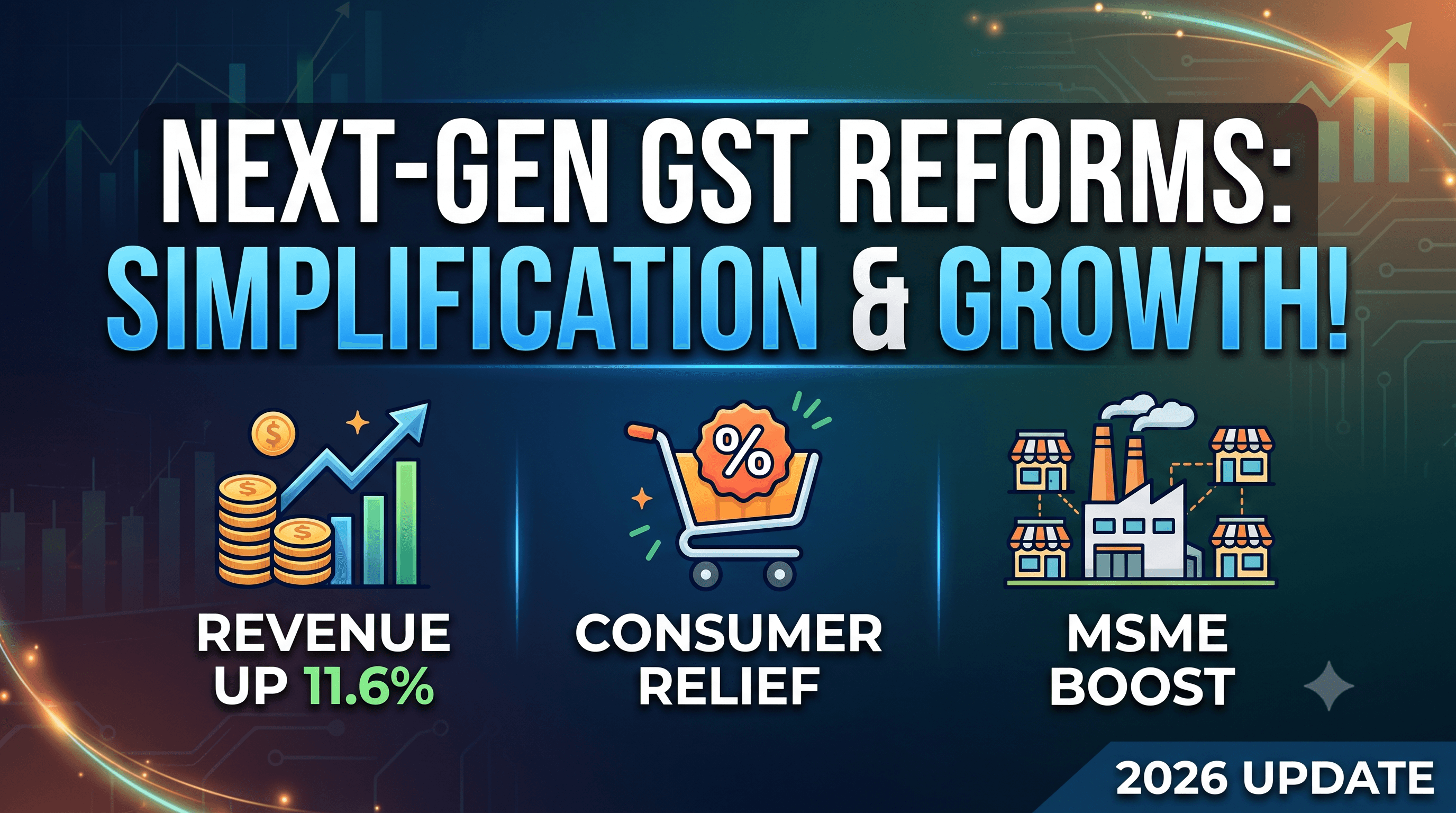
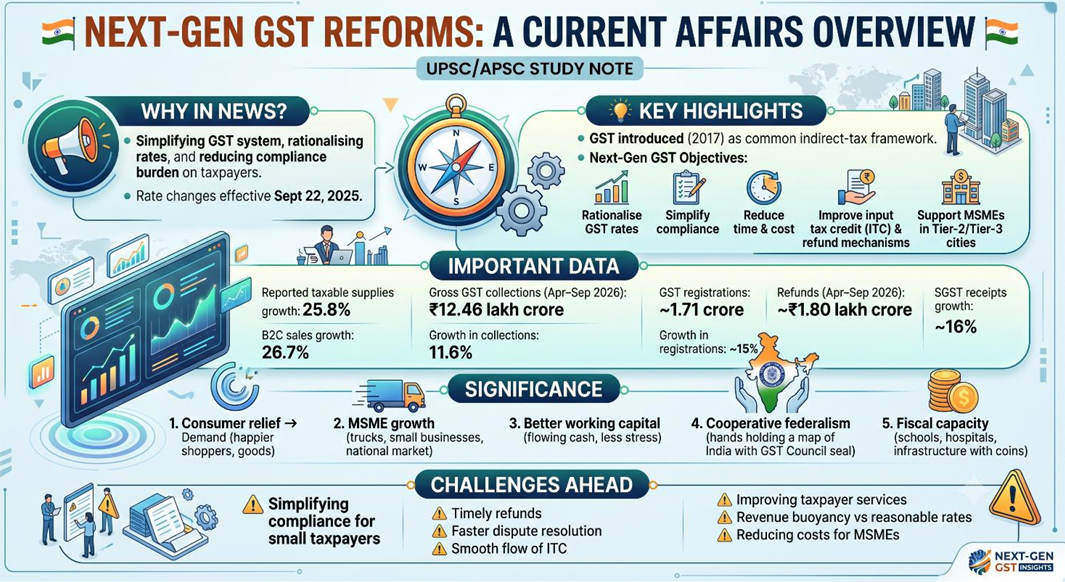
The Next-Gen GST reforms aim to simplify the GST system, rationalise tax rates, and reduce the compliance burden on taxpayers. The rate changes took effect on 22 September 2025, while further process reforms are proposed to the GST Council.
Key Highlights
Background: GST was introduced in 2017 as a common indirect-tax framework across India.
Next-Gen GST Objectives:
Rationalise GST rates
Simplify compliance
Reduce time and cost for taxpayers
Improve input tax credit (ITC) and refund mechanisms
Support MSMEs and businesses in Tier-2/Tier-3 cities
Important Data
Indicator | Key Figure |
Reported taxable supplies growth | 25.8% |
Gross GST collections (Apr–Sep 2026) | ₹12.46 lakh crore |
Growth in gross GST collections | 11.6% |
GST registrations | 1.71 crore |
Growth in registrations | 15% |
Refunds (Apr–Sep 2026) | ₹1.80 lakh crore |
SGST receipts growth | 16% |
Significance
Consumer Relief & Demand: Lower tax burden → greater household purchasing power → higher consumption → stronger demand.
MSME Growth: A unified national market allows small businesses to reach customers beyond their local markets.
Better Working Capital: Efficient Input Tax Credit (ITC) and faster refunds reduce the working-capital burden on businesses.
Cooperative Federalism: The GST Council administers GST, where the Centre and States participate jointly in decision-making.
Fiscal Capacity: Despite rate rationalisation, GST collections and State revenues continue to expand, securing resources for public expenditure.
Challenges Ahead
Simplifying GST compliance for small taxpayers
Ensuring timely processing of refunds
Accelerating dispute resolution
Ensuring an uninterrupted flow of ITC
Enhancing taxpayer-facing digital services
Maintaining revenue buoyancy while keeping tax rates reasonable
Lowering ongoing compliance overhead for MSMEs
Prelims Facts: GST Council
Constitutional Status: Established under Article 279A.
Enabling Legislation: Enacted via the 101st Constitutional Amendment Act, 2016.
Effective Date: GST officially came into force on 1 July 2017.
Governance Model: Serves as a premier institutional forum for cooperative federalism.
Mains Question
Q. “Next-Gen GST seeks to move beyond tax-rate rationalisation towards improving the overall taxpayer experience.” Discuss its potential significance for MSMEs, consumers, and cooperative federalism. (150 words)