Why in News?
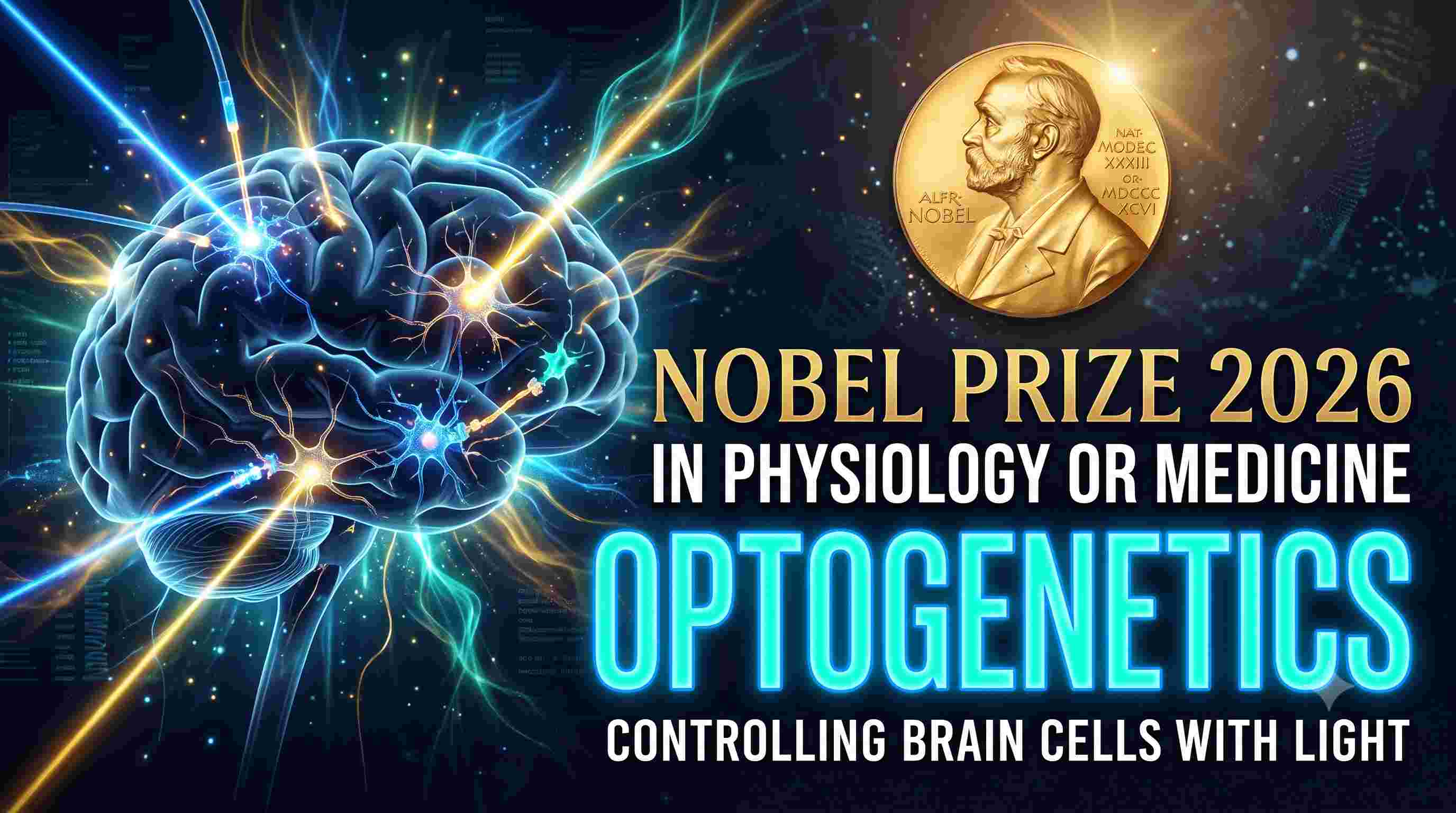
Karl Deisseroth, Peter Hegemann and Georg Nagel won the 2026 Nobel Prize in Physiology or Medicine for discoveries that enabled optogenetics—a technique to control specific nerve cells using light.
What Is Optogenetics?
A neuroscience technique that combines genetics and optics (light).
Specific neurons are genetically modified to produce light-sensitive proteins.
Light can then activate or inhibit selected neurons, allowing scientists to study their role in behaviour, emotions and diseases.
Key Scientific Discovery
Hegemann and Nagel studied the microscopic alga Chlamydomonas.
They identified light-sensitive proteins called channelrhodopsins.
Channelrhodopsin-2 (ChR2) opens when exposed to light, allowing positively charged ions to enter the cell and generate an electrical signal.
Deisseroth’s team demonstrated the technique in rat neurons (2005) and later in living mice.
Applications
Study of schizophrenia, depression, Alzheimer’s and Parkinson’s disease.
Understanding neural circuits involved in pain, sleep, memory, attention and social behaviour.
Potential applications in restoring vision and hearing.
Practice Questions
Q1. Consider the following statements about optogenetics:
It uses light to control specific neurons.
Channelrhodopsins are light-sensitive proteins used in the technique.
It can be used only for studying vision-related disorders.
Which of the statements given above is/are correct?
A. 1 and 2 only
B. 2 and 3 only
C. 1 and 3 only
D. 1, 2 and 3
Answer: A
Mains Question: “What is optogenetics? Discuss its significance in understanding neurological disorders and neural circuits.” (10 marks)