
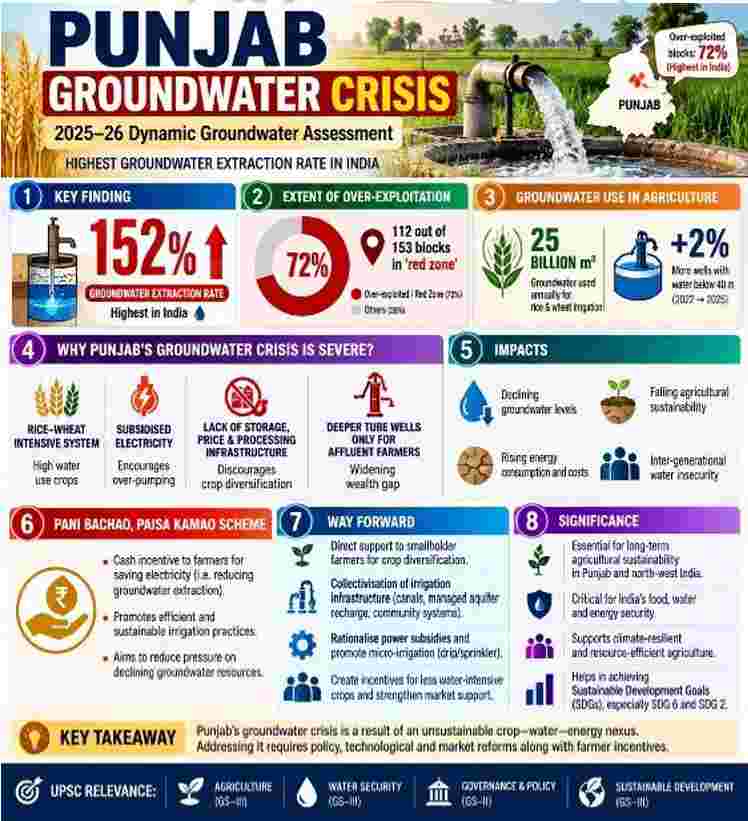
What Is the Issue?
Punjab's groundwater extraction rate reached 152% according to the 2025–26 Dynamic Groundwater Assessment.
72% of the 153 assessment blocks are classified as overexploited/red-zone areas.
Around 25 billion cubic metres (BCM) of groundwater is used annually for rice and wheat cultivation.
Observation wells recording water levels below 40 metres increased between 2022 and 2025.
Major Drivers
Rice–Wheat Cycle: Water-intensive paddy cultivation followed by wheat has created excessive dependence on groundwater.
Assured Procurement: MSP/procurement incentives make paddy economically attractive despite its high water requirement.
Free/Subsidised Power: Cheap electricity reduces the marginal cost of groundwater pumping.
Limited Crop Diversification: Lack of assured markets, storage, processing and price support discourages farmers from shifting to alternative crops.
Groundwater as Open-Access Resource: Individual farmers have limited incentives to conserve a shared aquifer.
The Water-Wealth Divide
Deepening Inequality: Falling groundwater levels require increasingly deep tube wells.
Large Farmers: Better-capitalised farmers can afford deeper borewells and powerful pumps.
Small & Marginal Farmers: Increasingly dependent on purchasing water from better-off farmers.
Unequal Water Productivity: Larger farms may not necessarily achieve proportionately higher groundwater productivity in paddy cultivation.
Thus, groundwater depletion becomes not only an environmental crisis but also an agrarian inequality crisis.
Government Initiatives
Pani Bachao, Paisa Kamao Scheme: Provides financial incentives to farmers for saving electricity used in groundwater pumping.
Direct Support: Greater focus on supporting small and marginal cultivators.
Irrigation Collectivisation: Collective management of irrigation infrastructure can improve equitable access and reduce duplication.
Crop Diversification: Encouraging maize, pulses, oilseeds, millets and other less water-intensive crops.
Challenges to Crop Diversification
Absence of assured procurement and remunerative prices for alternative crops.
Inadequate storage and processing infrastructure.
Established farmer–market linkages for rice and wheat.
Dependence on agriculture for rural livelihoods.
Subsidies often linked to land/pump ownership rather than actual cultivation, excluding tenants.
Way Ahead
Diversify cropping patterns: Shift from water-intensive paddy towards pulses, oilseeds, maize, millets and horticulture.
Reform subsidies: Move from electricity/pumping subsidies towards direct income support and conservation incentives.
Reward water saving: Scale up schemes such as Pani Bachao, Paisa Kamao.
Strengthen alternative value chains: Develop procurement, storage, food processing and assured markets for diversified crops.
Promote efficient irrigation: Expand drip/sprinkler irrigation and precision water management.
Regulate groundwater extraction: Introduce aquifer-based, participatory groundwater governance.
Ensure equity: Benefits should reach actual cultivators, tenants and small farmers, not only landowners or pump owners.
Improve water accounting: Use groundwater monitoring, remote sensing and local aquifer mapping for evidence-based management.
Key Concepts
Dynamic Groundwater Assessment: Assessment by the Central Ground Water Board (CGWB) of groundwater availability, recharge and extraction.
Over-exploited Block: Area where groundwater extraction exceeds the level considered sustainable relative to annual recharge.
Aquifer: Geological formation capable of storing and transmitting groundwater.
Water–Energy–Food Nexus: Interdependence between water availability, energy consumption and agricultural production.
Pani Bachao, Paisa Kamao: Incentive-based approach encouraging farmers to reduce electricity use for groundwater pumping.
UPSC Relevance
GS-I: Groundwater distribution, agricultural geography and regional resource stress.
GS-III: Agriculture, irrigation, groundwater depletion, subsidies and sustainable resource management.
Essay: Water security, climate resilience and sustainable agriculture.
Keywords: Aquifer depletion, crop diversification, water-use efficiency, groundwater governance, agrarian inequality.
Conclusion
Punjab's groundwater crisis demonstrates that agricultural prosperity based on resource over-exploitation is not sustainable. The solution lies in aligning procurement, pricing, electricity subsidies and farmer incentives with water conservation, while ensuring that the transition does not disproportionately burden small and tenant farmers.
Practice Questions
Prelims Questions
Q. With reference to groundwater depletion in Punjab, consider the following statements:
The rice–wheat cropping system is a major driver of groundwater over-extraction in Punjab.
Subsidised electricity for irrigation reduces the cost of groundwater pumping and can encourage excessive extraction.
Crop diversification is constrained by the absence of assured markets and adequate processing infrastructure for alternative crops.
Which of the statements given above is/are correct?
(a) 1 and 2 only (b) 2 and 3 only (c) 1 and 3 only (d) 1, 2 and 3
Answer: (d)
Explanation: All three statements are correct. Water-intensive paddy cultivation, subsidised electricity and inadequate market infrastructure for alternative crops together reinforce Punjab's groundwater crisis.
Mains Question
Q. "Punjab's groundwater crisis is not merely an ecological problem but also an emerging challenge of agrarian inequality." Examine the causes and suggest measures for sustainable and equitable groundwater management. (150 words, 10 marks)