Context
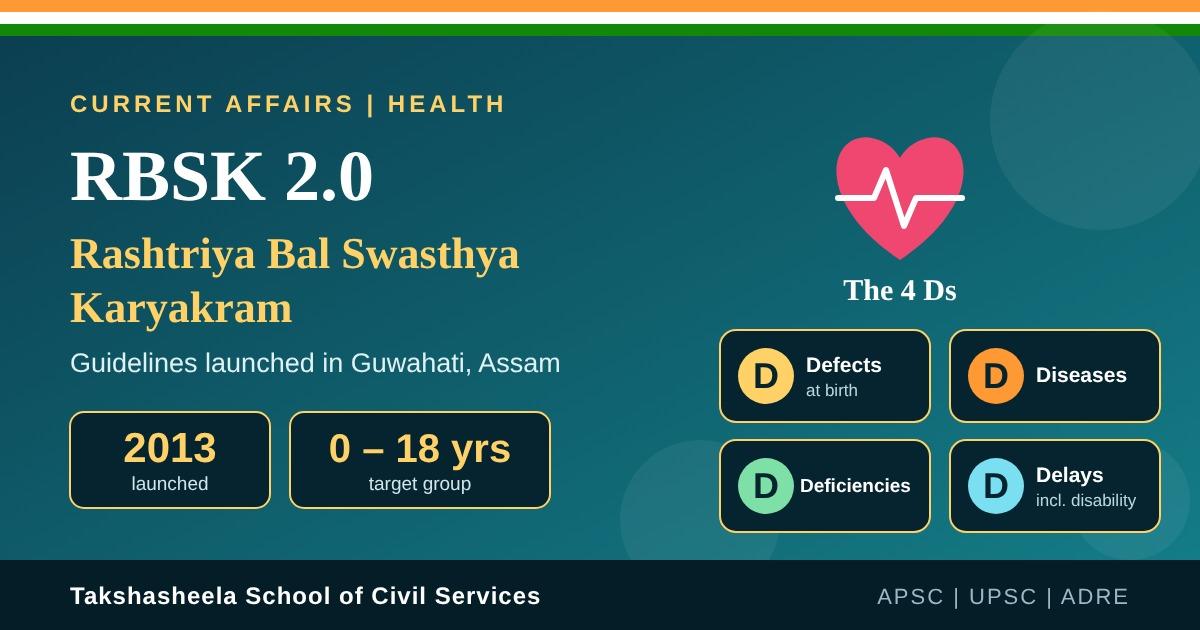
Assam Health and Family Welfare Minister Ashok Singhal launched the guidelines for Rashtriya Bal Swasthya Karyakram (RBSK) 2.0 at Pragjyotish Medical College and Hospital, Guwahati.
Key Features of RBSK 2.0
Early detection: Birth defects, diseases, developmental delays and malnutrition.
Emerging health concerns: Children’s mental health, diabetes and hypertension.
Timely treatment: Appropriate medical care and follow-up for identified health problems.
Health awareness: Promotes proper nutrition, hygiene, physical activity and healthy lifestyles.
School health: Strengthens school health club activities.
Interdepartmental coordination: Encourages cooperation among health, education and other relevant departments.
Objective: Improve children’s health, ensure early intervention, and promote holistic child development.
Prelims Facts
Rashtriya Bal Swasthya Karyakram (RBSK)
Launched: 2013.
Ministry: Ministry of Health and Family Welfare, Government of India.
Scheme type: Child health screening and early intervention programme under the National Health Mission (NHM).
Target group: Children from birth to 18 years.
Core approach: Early identification and intervention for the 4 Ds:
Defects at birth
Diseases
Deficiencies
Developmental delays, including disability
Practice Questions
Prelims Questions
Q1. Consider the following statements about RBSK:
It focuses on early identification and intervention for child health conditions.
It covers children from birth to 18 years.
It addresses the 4 Ds of child health.
Which of the statements given above are correct?
A. 1 only
B. 1 and 2 only
C. 2 and 3 only
D. 1, 2 and 3
Answer: D. 1, 2 and 3
Mains Question
Q. Discuss the significance of early screening and intervention programmes in improving child health in India, with special reference to Assam. (150 words)