Why in News?
A recent investigation reported disagreements within the three-member Election Commission of India (ECI) over electoral-roll management and alleged unilateral administrative decisions. It also reported that 97 eligible voters in Goa were excluded from electoral rolls due to limitations in the ECINet software.
This has revived the debate: Should the Right to Vote be made a Fundamental Right?
Constitutional & Legal Framework
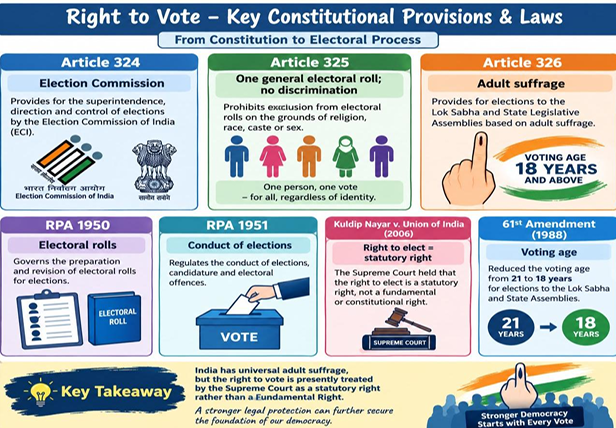
Provision | Significance |
|---|---|
Article 324 | ECI has superintendence over elections |
Article 325 | No exclusion from electoral rolls |
Article 326 | Elections based on adult suffrage |
RPA, 1950 | Preparation and revision of electoral rolls |
RPA, 1951 | Conduct of elections, candidature etc. |
Section 62, RPA 1951 | Right to vote/elect is governed as a statutory right |
Important: In Kuldip Nayar v. Union of India (2006), the Supreme Court held that the right to elect is a statutory right, not a fundamental or constitutional right.
Universal Adult Suffrage in India
India adopted universal adult suffrage from the beginning of the Republic, unlike many Western democracies where voting rights were gradually expanded.
Article 326: Citizens aged 18 years or above can participate in elections.
Earlier, the voting age was 21 years, reduced to 18 years by the 61st Constitutional Amendment Act, 1988.
Significance
Political equality
Inclusive democracy
Participation irrespective of gender, caste, religion, education or property
Strengthens representative government
Important Supreme Court Cases
Kesavananda Bharati v. State of Kerala (1973)
Democracy is part of the Basic Structure of the Constitution.
Kuldip Nayar v. Union of India (2006)
Right to elect = statutory right.
Not a fundamental right.
Rajbala v. State of Haryana (2015)
A two-judge Bench referred to the right to vote as a constitutional right, but this does not override the larger Bench position in Kuldip Nayar.
Anoop Baranwal v. Union of India (2023)
The majority did not reopen the settled position on the legal status of the right to vote.
Justice Ajay Rastogi's dissent linked the right to vote with Article 19(1)(a) and the essence of Article 21.
Lakshmi Charan Sen v. A.K.M. Hassan Uzzaman (1985)
Emphasised the importance of maintaining accurate electoral rolls and participation in ensuring electoral integrity.
Should Right to Vote Become a Fundamental Right?
Arguments Supporting Elevation
Voting is central to representative democracy.
Stronger judicial protection against arbitrary restrictions.
Greater protection against wrongful exclusion.
Reinforces Articles 325 and 326.
Makes electoral participation less dependent on ordinary legislation.
Arguments Requiring Consideration
Parliament needs legislative flexibility to regulate elections.
Voting involves eligibility conditions and electoral administration.
A fundamental right could increase judicial scrutiny of electoral processes.
Electoral-roll purification must continue to prevent fraud and ineligible entries.
Practice Questions
Prelims Questions
Q1. Consider the following statements:
Article 326 provides for elections based on adult suffrage.
The voting age in India was reduced from 21 to 18 years by the 61st Constitutional Amendment Act.
The Supreme Court has held the right to vote to be a Fundamental Right.
Which of the statements given above is/are correct?
A. 1 and 2 only B. 2 and 3 only C. 1 and 3 only D. 1, 2 and 3
Answer: A
Q2. Which of the following correctly describes Article 325?
A. Establishes the Election Commission of India B. Provides for adult suffrage C. Prohibits exclusion from electoral rolls on specified grounds such as religion, race, caste or sex D. Provides for reservation of seats for SCs and STs
Answer: C
Q3. With reference to Kuldip Nayar v. Union of India, consider the following statement:
The Supreme Court held that the right to elect is:
A. A Fundamental Right B. A statutory right C. An absolute constitutional right D. A natural right
Answer: B
Mains Question
Q. "Universal adult suffrage is meaningful only when every eligible citizen is able to exercise the right to vote." Discuss in the context of electoral roll accuracy in India. (10 Marks)