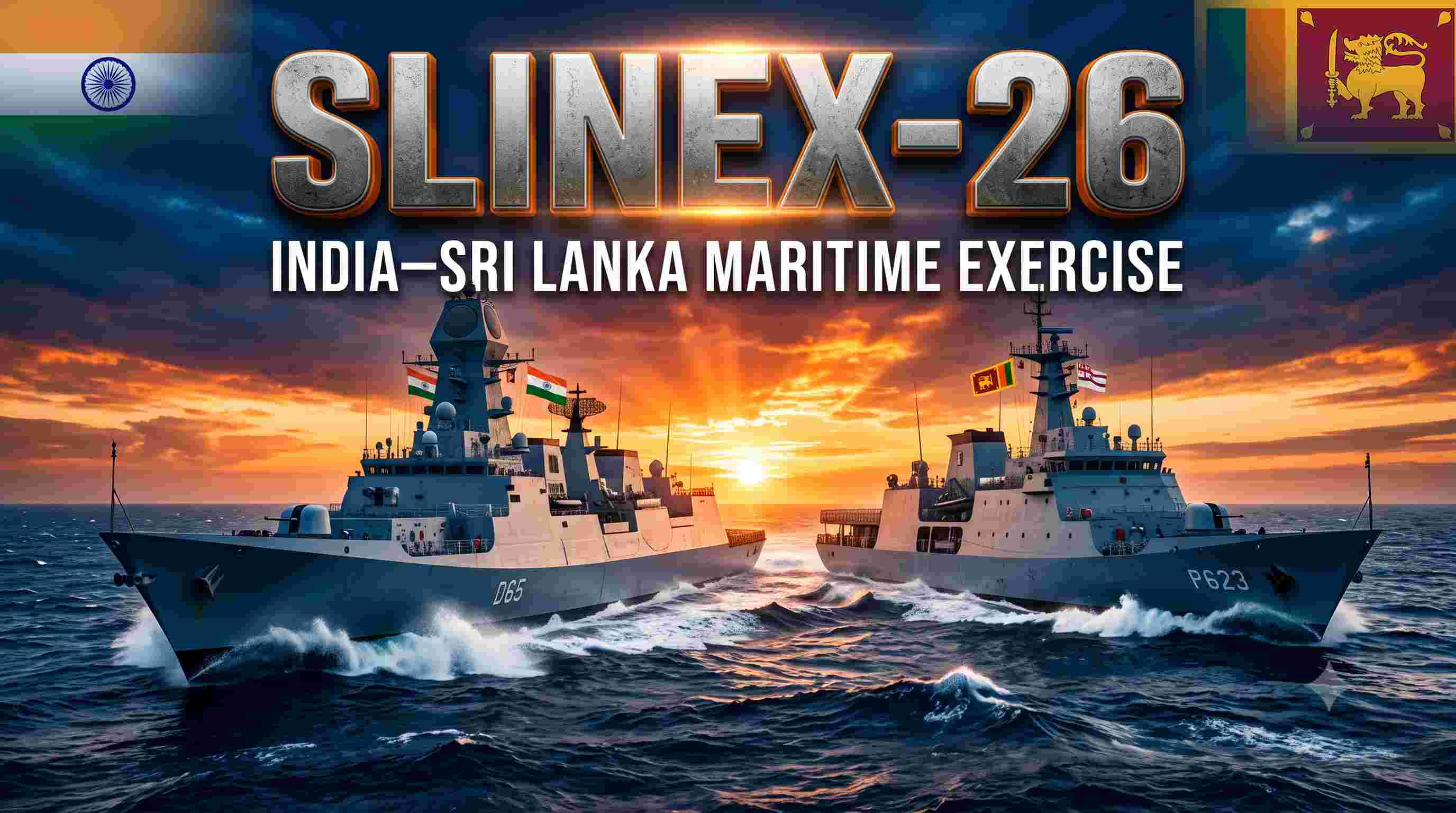
Context: The 13th edition of the India–Sri Lanka bilateral maritime exercise, SLINEX-26, is being conducted at Visakhapatnam under the Eastern Naval Command of the Indian Navy. The exercise seeks to strengthen maritime interoperability, defence cooperation, and joint responses to emerging security challenges in the Indian Ocean Region.
About SLINEX-26
What is it?
SLINEX is the flagship bilateral maritime exercise between the Indian Navy and the Sri Lanka Navy.
The exercise was instituted in 2005 and has evolved from basic naval drills into a multidimensional maritime exercise.
The 13th edition, SLINEX-26, is hosted by India at Visakhapatnam, Andhra Pradesh.
It is conducted under the operational command of the Eastern Naval Command (ENC) of the Indian Navy.
Members
Indian Navy
Sri Lanka Navy
Aim
Enhance maritime interoperability and operational coordination.
Strengthen mutual trust between the two navies.
Exchange professional knowledge and best practices.
Improve capabilities to address traditional and non-traditional maritime threats.
Strengthen cooperation in the Indian Ocean Region (IOR).
Key Features
1. Two-Phase Exercise
SLINEX follows a structured format comprising:
Harbour Phase -------> Sea Phase
Harbour Phase: Focuses on professional interactions, knowledge exchange, and coordinated planning.
Sea Phase: Involves practical naval manoeuvres and operational drills.
2. Multi-Dimensional Maritime Training
The exercise involves activities related to:
Anti-Submarine Warfare (ASW)
Maritime interdiction
Tactical communications
Search and Rescue (SAR)
Replenishment and logistics
Coordinated naval manoeuvres
3. Operational Interoperability
Enables both navies to operate together more effectively.
Improves coordination during maritime security operations and humanitarian emergencies.
Significance of SLINEX-26
Strengthens Neighbourhood First:
Sri Lanka is a key maritime neighbour of India.
Regular naval exercises deepen defence cooperation and strategic trust.
Supports India's Neighbourhood First policy.
Indian Ocean Security:
Sri Lanka occupies a strategically important position close to major Indian Ocean Sea Lanes of Communication (SLOCs).
Enhanced naval cooperation contributes to maritime domain awareness, protection of sea lanes, counter-piracy operations, combating trafficking, and preventing illegal fishing.
Non-Traditional Security:
Helps strengthen cooperation against piracy, smuggling, human trafficking, irregular migration, maritime terrorism, and natural disasters.
HADR Cooperation:
Naval interoperability facilitates coordinated responses during cyclones, tsunamis, floods, maritime accidents, and other humanitarian emergencies.
SLINEX & India's Maritime Vision
SLINEX contributes to India's broader maritime outreach through key frameworks:
SAGAR (Security and Growth for All in the Region): Emphasises mutual security, economic prosperity, respect for sovereignty, capacity building, and maritime cooperation.
MAHASAGAR (Mutual and Holistic Advancement for Security and Growth Across Regions): Seeks to strengthen engagement through security cooperation, development partnerships, disaster resilience, and regional connectivity.
SLINEX → Bilateral Naval Cooperation → SAGAR/MAHASAGAR → Secure Indian Ocean
Strategic Importance for India
Maritime Geography: Sri Lanka's location near major shipping routes is crucial for India's maritime security, energy security, trade routes, coastal security, and regional connectivity.
Palk Strait & Gulf of Mannar: Enhanced cooperation reinforces security in India's immediate maritime neighbourhood.
China Factor: External infrastructure engagements in the region make deeper bilateral maritime cooperation vital for maintaining stability. India's approach focuses on cooperative regional security rather than bloc-based confrontation.
Challenges in India–Sri Lanka Maritime Cooperation
Strategic presence of external powers in Sri Lankan ports and maritime spaces.
Fishermen disputes involving Indian and Sri Lankan communities.
Maritime boundary and resource-management issues.
Illegal fishing and trafficking.
Sri Lanka's policy of balancing relations among external partners.
Need for greater maritime domain awareness and real-time information sharing.
Way Ahead
Expand Maritime Domain Awareness: Improve information-sharing mechanisms and coordinated surveillance.
Strengthen HADR Cooperation: Develop joint mechanisms for rapid disaster response in the Indian Ocean.
Address Fishermen Issues: Combine diplomatic dialogue, sustainable fisheries management, and livelihood support.
Enhance Capacity Building: Support Sri Lanka through training, equipment, technical assistance, and hydrographic cooperation.
Expand Multilateral Maritime Cooperation: Leverage platforms such as IORA, Colombo Security Conclave, and Indian Ocean naval engagements.
Maintain an Inclusive Indian Ocean Architecture: Promote a rules-based, inclusive, and cooperative maritime order.
Prelims Quick Revision
Parameter | Key Fact |
Exercise | SLINEX-26 |
Edition | 13th |
Participants | Indian Navy & Sri Lanka Navy |
Host | India |
Venue | Visakhapatnam, Andhra Pradesh |
Command | Eastern Naval Command |
First Instituted | 2005 |
Phases | Harbour Phase + Sea Phase |
Major Focus | Maritime interoperability & security |
Key Drills | Anti-Submarine Warfare (ASW), SAR, maritime interdiction, logistics |
Regional Framework | SAGAR & MAHASAGAR |
Conclusion
SLINEX-26 reflects the deepening of India–Sri Lanka maritime cooperation and India's broader effort to build a secure, resilient, and cooperative Indian Ocean Region. Beyond conventional naval preparedness, the exercise strengthens capabilities against piracy, trafficking, disasters, and other non-traditional threats. Regular exercises of this nature reinforce Neighborhood First, enhance interoperability, and contribute to India's vision of Security and Growth for All in the Region (SAGAR).
Answer Writing Practice Question
"Maritime cooperation with Sri Lanka is central to India’s vision of a secure and inclusive Indian Ocean Region."
Discuss the strategic significance of exercises such as SLINEX in strengthening India’s neighbourhood and maritime security architecture.