Logo
Takshasheela School Of Civil ServicesCurrent Affairs
Our CoursesOur BlogsDaily QuizMagazinesGallery
Takshasheela Logo
Takshasheela School Of Civil Services

Takshasheela School Of Civil Services is a premier institute dedicated to grooming the next generation of civil servants. We provide comprehensive coaching for UPSC and APSC exams with a focus on conceptual clarity and ethical leadership.

Quick Navigation

  • Editorial
  • Prelims
  • Mains
  • Current Affairs
  • Test Series

Contact Us

  • Email

    contact@takshashilascs.com
  • Phone

    +91 98765 43210
  • Location

    Guwahati, Assam, India

© 2026 Takshasheela School Of Civil Services. All rights reserved.

Space Was Never a Sanctuary. Now Nobody Is Pretending Otherwise.

Space Was Never a Sanctuary. Now Nobody Is Pretending Otherwise.

September 15, 2026
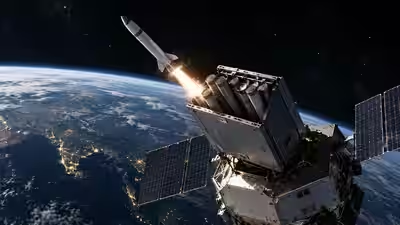
On 15 September, US Air Force Secretary Troy Meink told an audience at the Air, Space and Cyber Conference something that officials in Washington have spent two decades carefully avoiding saying out loud: the United States now has weapons in orbit, and it is prepared to use them. “The United States now has on-orbit space control weapons capable of defending the Joint Force against hostile adversary action,” he said. No specifics were offered — not what the weapons are, not when they were placed in orbit, not how many exist. The ambiguity was almost certainly the point. Within a day, China’s foreign ministry spokesman Guo Jiakun had issued a pointed rebuke, urging Washington to “stop preparing for war” in space and warning against “turning space into a battlefield.” Russia, named alongside China in the Space Force’s own threat assessment as a country that “views space as a warfighting domain,” has offered its own history of similar objections. The exchange was sharp, but it was not surprising. It was the public acknowledgment of a reality that has been building, quietly and deliberately, for years.

The End of Strategic Ambiguity

What makes this moment different from the routine sparring that has characterized US-China-Russia relations in orbit for a decade is not the existence of space weapons — all three powers have been developing and testing counterspace capabilities for years, from China’s 2007 anti-satellite missile test to Russia’s Cosmos 2576 “inspector” satellite that shadowed a US government satellite in 2024. What is different is that the United States has now formally confirmed, for the first time, that it possesses and has deployed offensive capability of its own. Washington has moved from warning about what adversaries might do to declaring what it has already done. That shift matters because so much of the fragile stability in space until now has rested on a kind of managed ambiguity. Nobody officially confirmed what everybody privately assumed. Confirming it removes a layer of deniability that, however thin, gave all sides room to maneuver without triggering the kind of formal escalation that public confirmation invites.

A Treaty Built for a Different Era

The legal architecture governing all of this dates to 1967, when the Outer Space Treaty banned the placement of weapons of mass destruction in orbit and declared space open for peaceful use. That treaty has proven durable in exactly the narrow sense its drafters intended — nobody has parked a nuclear warhead in orbit. But it was never built to address the kind of conflict now unfolding: kinetic and non-kinetic “space control” capabilities designed to disrupt, degrade, or destroy an adversary’s satellites without crossing the WMD threshold the treaty actually prohibits. Jamming, laser dazzling, robotic “inspector” satellites capable of maneuvering into an adversary’s orbit, and now, apparently, deployed weapons designed explicitly for “defending the Joint Force against hostile adversary action” all sit in territory the 1967 treaty simply does not reach. China and Russia have periodically proposed a new treaty explicitly banning the placement of weapons in space, and have accused the United States of blocking such efforts to preserve its own freedom of action. Washington, for its part, has long argued that any such treaty would be unverifiable and would constrain the United States far more than it would constrain adversaries already developing these capabilities covertly. Both positions contain enough truth to explain why, after years of proposals and counter-proposals at the UN Conference on Disarmament, no binding agreement exists.

The Satellites Underneath the Rhetoric

It is worth being clear about what is actually at stake in this dispute, because the language of “battlefields” and “warfighting domains” can obscure how deeply embedded space infrastructure already is in ordinary civilian and military life. GPS navigation, financial transaction timestamps, weather forecasting, internet and mobile communications, missile early-warning systems, and military reconnaissance all depend on satellites that were, for most of their history, treated as largely off-limits to direct attack precisely because every major power relies on similar infrastructure. The doctrine now taking shape — that space is “a war-fighting domain like the land, sea and air,” in the words of one earlier US defense assessment — implicitly accepts that this infrastructure is now a legitimate target set, not a shared commons to be protected from conflict. That is a genuinely consequential shift, and one with implications well beyond the three major space powers. Satellite constellations increasingly carry the communications and positioning data of civilian economies and military operations across the world, including in regions with no offensive space capability of their own and no say in how this contest unfolds.

Where This Goes Next

Neither Washington’s disclosure nor Beijing’s rebuke is likely to be the last word. The more important signal to watch is not the rhetorical exchange but whether this disclosure marks the start of a genuinely new phase of overt, acknowledged space militarization, or whether it settles back into the same pattern of ambiguous signaling that has characterized the last two decades — deployments hinted at, tests conducted, statements issued, and no formal accounting demanded by anyone with the standing to demand one. The Outer Space Treaty’s narrow prohibition on weapons of mass destruction was never going to be adequate to this moment, and everyone involved has known that for years. What has changed is that the pretense of restraint below that threshold — the assumption that major powers would keep their most serious space capabilities undisclosed and therefore, in some limited sense, deniable — appears to be eroding. Whether that erosion produces a serious push for a new arms-control framework, or simply normalizes an arms race that has already been under way in all but name, is the question this disclosure leaves unanswered.

Share this article

Category

Aspirant Support

Aiming for UPSC?
Begin Your Preparation Today!

"Success is not final, failure is not fatal: it is the courage to continue that counts."

— Winston Churchill

Our expert faculty provides detailed mentorship for Current Affairs, General Studies, and Answer Writing specifically tailored for UPSC and APSC requirements.

Have a Doubt?

Submit your query below and our team will get back to you within 24 hours.