State Civilian Awards 2025
GS Paper V (Assam)
Key Highlights
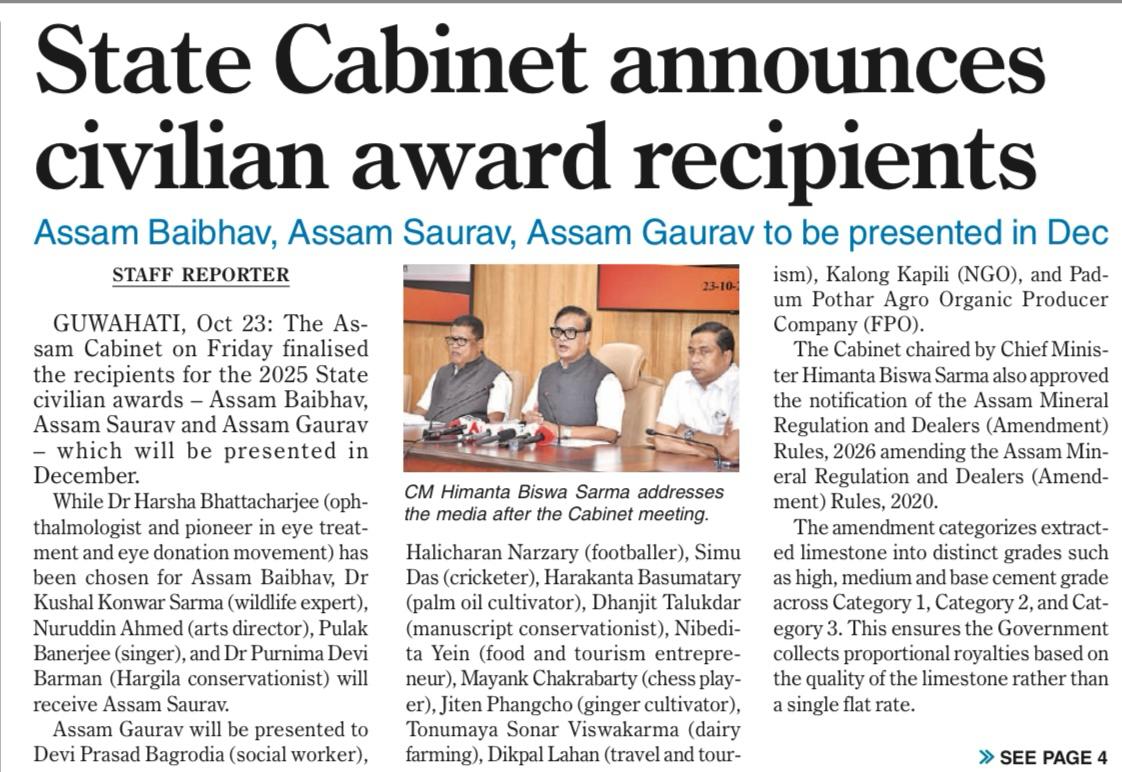
The Assam Cabinet, chaired by Chief Minister Himanta Biswa Sarma, finalised the recipients of the 2025 State Civilian Awards, which will be presented in December.
Award Recipients
Assam Baibhav
Dr Harsha Bhattacharjee (Ophthalmologist; contributions to eye treatment and the eye donation movement.)
Assam Saurav
Recipient | Field |
|---|---|
Dr Kushal Konwar Sarma | Wildlife conservation and veterinary science |
Nuruddin Ahmed | Arts direction |
Pulak Banerjee | Singing |
Dr Purnima Devi Barman | Hargila conservation |
Assam Gaurav
Recipient | Field |
|---|---|
Devi Prasad Bagrodia | Social work |
Halicharan Narzary | Football |
Simu Das | Cricket |
Harakanta Basumatary | Palm oil cultivation |
Dhanjit Talukdar | Manuscript conservation |
Nibedita Yein | Food and tourism entrepreneurship |
Mayank Chakrabarty | Chess |
Jiten Phangcho | Ginger cultivation |
Tonumaya Sonar Viswakarma | Dairy farming |
Dikpal Lahan | Travel and tourism |
Kalong Kapili | NGO activities |
Padum Pothar Agro Organic Producer Company | Farmer Producer Organisation (FPO) |
Practice Questions
Prelims Practice MCQs
Q1. Which of the following is associated with Hargila conservation?
A. Dr Harsha Bhattacharjee
B. Dr Purnima Devi Barman
C. Dr Kushal Konwar Sarma
D. Nuruddin Ahmed
Answer: B. Dr Purnima Devi Barman
Mains Question
Q. Discuss the significance of state civilian awards in recognising contributions to Assam’s social, cultural, environmental and economic development. (150 words)
Revision of Periodic Labour Force Survey (PLFS)
GS Paper III (Indian Economy)
Key Highlights
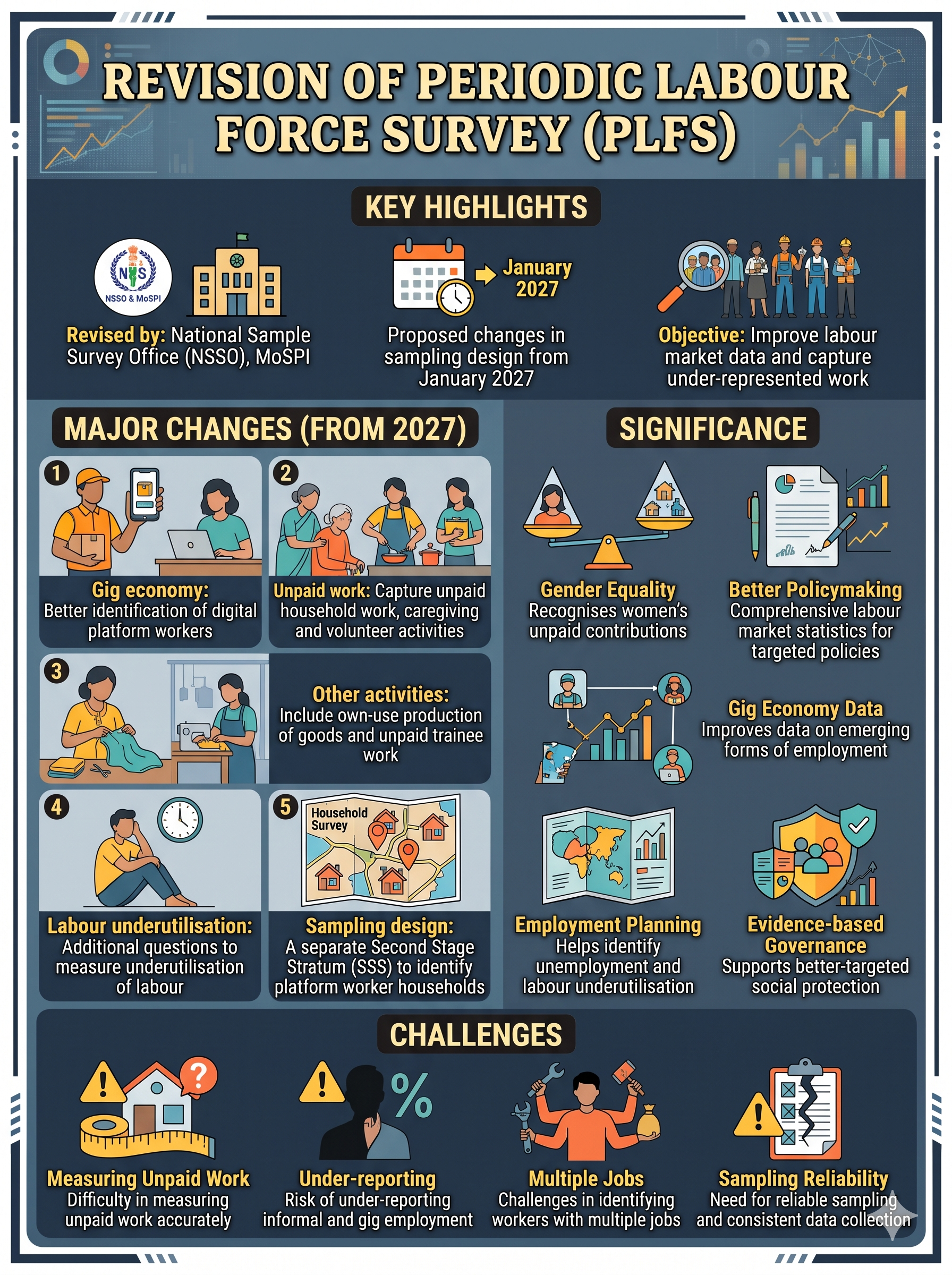
Revised by: National Sample Survey Office (NSSO), Ministry of Statistics and Programme Implementation (MoSPI).
Implementation: Proposed changes in sampling design from January 2027.
Objective: Improve labour market data and capture previously under-represented forms of work.
Major Changes
Gig economy: Better identification of digital platform workers.
Unpaid work: Capture unpaid household work, caregiving and volunteer activities.
Other activities: Include own-use production of goods and unpaid trainee work.
Labour underutilisation: Additional questions to measure underutilisation of labour.
Sampling design: A separate Second Stage Stratum (SSS) will help identify households with digital platform workers.
Significance
Gender equality: Recognises women’s unpaid household and caregiving contributions.
Better policymaking: Provides more comprehensive labour market statistics.
Gig economy: Improves data on emerging forms of employment.
Employment planning: Helps identify unemployment and labour underutilisation.
Evidence-based governance: Supports better-targeted employment and social protection policies.
Challenges
Difficulty in measuring unpaid work accurately.
Risk of under-reporting informal and gig employment.
Challenges in identifying workers with multiple jobs.
Need for reliable sampling and consistent data collection.
Practice Questions
Mains Question
Q. Why is the measurement of unpaid work and gig employment important for understanding India’s labour market? Discuss the significance of the proposed changes to PLFS. (150 words)
Delhi Pollution Hotspots
GS Paper III (Environment)
Key Highlights
Issue: Delhi’s air quality remained in the poor category, prompting targeted pollution-control measures.
Action taken: Delhi government directed officials to identify pollution hotspots and prepare location-specific action plans.
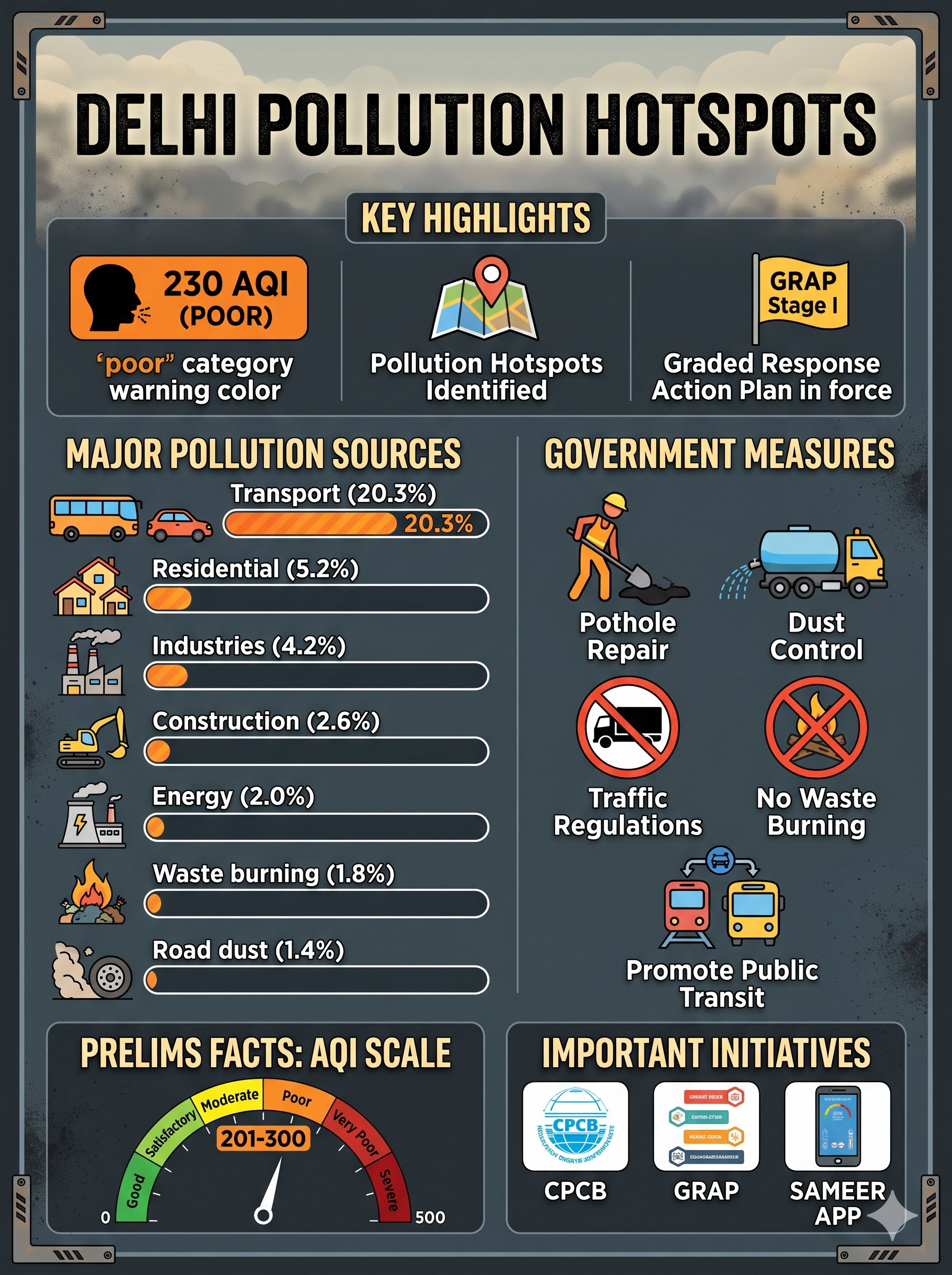
AQI: Delhi’s average AQI was 230 (Poor), according to the report.
Responsible agency: Central Pollution Control Board (CPCB) monitors air quality.
Graded Response Action Plan (GRAP): Stage I was in force.
Major Pollution Sources in Delhi (as reported)
Source | Contribution |
|---|---|
Transport | 20.3% |
Residential sources | 5.2% |
Industries | 4.2% |
Construction | 2.6% |
Energy | 2.0% |
Waste burning | 1.8% |
Road dust | 1.4% |
Measures Directed by the Government
Identify local pollution sources using AQI monitoring data.
Repair potholes and remove road encroachments.
Treat exposed roadside soil and sprinkle water to control dust.
Regulate heavy vehicles, particularly during peak hours.
Prevent garbage burning and illegal waste dumping.
Encourage public transport and carpooling.
Assign clear responsibilities and deadlines to concerned agencies.
Important Prelims Facts
Air Quality Index (AQI)
AQI range | Category |
|---|---|
0–50 | Good |
51–100 | Satisfactory |
101–200 | Moderate |
201–300 | Poor |
301–400 | Very Poor |
401–500 | Severe |
Important Institutions and Initiatives
CPCB: Central Pollution Control Board.
GRAP: Graded Response Action Plan to address deteriorating air quality in Delhi-NCR.
Sameer App: Provides air quality information and AQI updates.
Practice Questions
Mains Question
Q. Air pollution in Indian cities requires coordinated action at the local level. Discuss the major sources of urban air pollution and suggest effective control measures. (150 words)
AI-Based Attendance Verification in Rural Employment Scheme
GS Paper II (Governance)
Key Highlights
Initiative: AI-based attendance verification under the VB-G RAM G rural employment programme.
Announced by: Union Rural Development Minister Shivraj Singh Chouhan.
Objective: Prevent fake attendance, protect workers’ wages and ensure transparency in public expenditure.
Key Features
AI-based face verification and liveness detection.
Photo de-duplication to detect repeated photographs.
Anti-tampering security measures.
Automatic withholding of wage lists and Fund Transfer Orders (FTOs) when suspicious entries are detected, pending verification.
Offline attendance recording in areas with poor network connectivity.
Exception mechanisms for elderly workers, persons with disabilities and technical failures.
Background: Face authentication was introduced in the National Mobile Monitoring System in March 2026 under MGNREGA.
Practice Questions
Mains Question
Q. Discuss the role of Artificial Intelligence in improving transparency and accountability in rural employment programmes. Examine the associated challenges. (150 words)