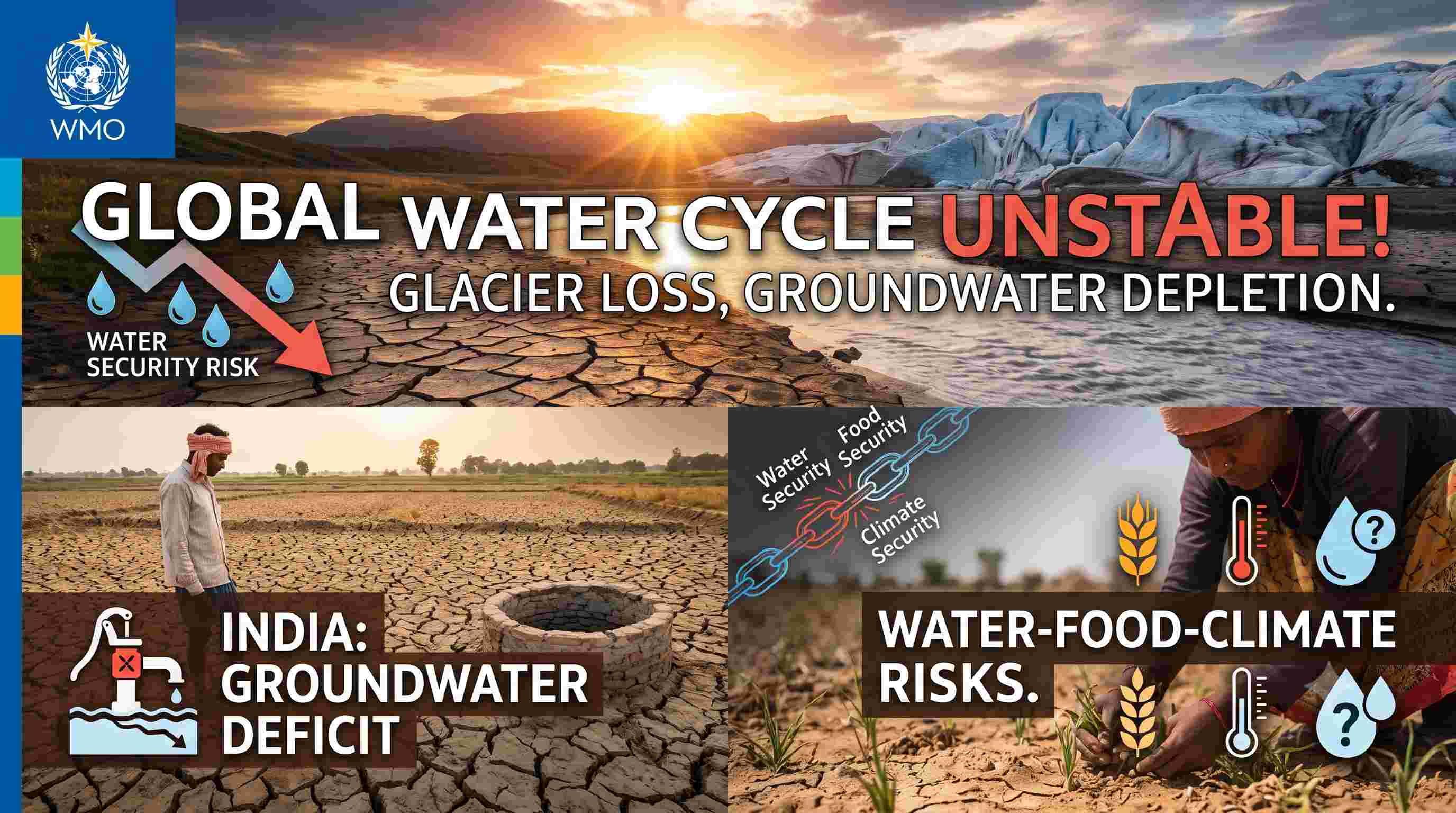
The World Meteorological Organisation (WMO) has highlighted growing instability in the global water cycle, including persistent groundwater depletion in India, declining terrestrial water storage, drier river systems and accelerating glacier loss. The findings underline the increasing risks to water, food and climate security.
About the State of Global Water Resources Report
What is it?
The State of Global Water Resources is an annual assessment published by the World Meteorological Organisation (WMO).
It assesses the availability, distribution and variability of global freshwater resources.
Over five years, its assessment framework has expanded from 3 to 15 hydrological variables.
It covers:
Groundwater
River discharge
Terrestrial water storage
Glaciers
Soil moisture
Other components of the hydrological cycle.
Key Findings
1. Rising Groundwater Stress
Around 34% of monitored groundwater stations recorded below- to much-below-normal levels in 2025.
This increased from 25% in 2024.
The trend indicates a growing shift towards groundwater deficits.
2. Persistent Groundwater Depletion in India
Parts of India experienced persistent groundwater deficits during 2022–2025.
Over-abstraction remains an important driver.
The problem is particularly significant in north-western India, where agriculture has historically relied heavily on groundwater irrigation.
3. Declining Terrestrial Water Storage
Global terrestrial water storage (TWS) has shown a persistent decline since 2014–16.
Below-normal storage continued in several regions during 2025, including parts of northern India.
4. Drier River Systems
Around 36% of the global catchment area experienced drier-than-normal conditions.
2025 was among the driest years for global river discharge in around 35 years.
5. Accelerating Glacier Loss
Global glaciers lost around 408 ± 132 gigatonnes (Gt) of mass in 2025.
This corresponds to approximately 1.1 ± 0.4 mm of sea-level rise.
It was the fourth consecutive year in which all major glaciated regions recorded net ice loss.
Why is Groundwater Depletion in India Significant?
India is highly dependent on groundwater for:
Irrigation
Drinking water
Domestic requirements
Industrial activities.
Major Drivers
Excessive groundwater extraction for irrigation.
Water-intensive crops.
Subsidised/free electricity encouraging over-pumping.
Inefficient irrigation practices.
Rapid urbanisation.
Reduced groundwater recharge due to concretisation.
Increasing climate variability.
Consequences
Groundwater depletion
Declining water tables
Higher extraction costs
Agricultural stress
Food & livelihood insecurity
Broader Implications
1. Water Security: Declining groundwater, river discharge and terrestrial water storage reduce reliable freshwater availability.
2. Food Security: Groundwater-dependent irrigation supports agricultural production. Persistent depletion can threaten:
Crop yields
Irrigation reliability
Farmer incomes
Food security.
3. Climate Resilience: Groundwater, glaciers and terrestrial water storage act as natural buffers during periods of drought and climatic variability. Their depletion reduces the resilience of societies and ecosystems.
4. Himalayan Ecosystem: Glacier loss can initially increase meltwater availability but eventually reduce long-term water availability in glacier-dependent river systems. This has implications for:
Himalayan ecosystems
Agriculture
Hydropower
Drinking water
Downstream river basins.
5. Water–Food–Energy Nexus: Water stress can simultaneously affect:
Agriculture → Food Security
Hydropower → Energy Security
Drinking Water → Human Security
Thus, water insecurity has cross-sectoral implications.
India-Specific Concerns
North-Western India
Groundwater stress is particularly important in regions such as:
Punjab
Haryana
Western Uttar Pradesh
Rajasthan
where intensive irrigation and water-intensive cropping have contributed to groundwater depletion.
Agricultural Distortions
The combination of MSP-linked cropping patterns + subsidised electricity + flood irrigation can encourage excessive groundwater extraction.
Urban Water Stress
Increasing urbanisation creates additional pressure through:
Falling recharge
Rising demand
Groundwater dependence
Loss of wetlands and recharge zones.
---
Way Ahead
1. Promote Groundwater Governance
Strengthen groundwater monitoring.
Regulate excessive extraction.
Promote aquifer-based management.
2. Improve Irrigation Efficiency
Expand:
Drip irrigation
Sprinkler irrigation
Micro-irrigation
Precision agriculture.
3. Crop Diversification
Move away from highly water-intensive crops in groundwater-stressed regions. Promote:
Millets
Pulses
Oilseeds
Less water-intensive crops.
4. Artificial Recharge
Promote:
Rainwater harvesting
Recharge wells
Watershed development
Wetland restoration
Urban recharge structures.
5. Reform Water-Energy Incentives
Rationalise electricity subsidies and encourage energy-efficient groundwater pumping without undermining farmer livelihoods.
6. Integrated River Basin Management
Water management should move from fragmented administrative approaches towards river-basin and aquifer-level planning.
7. Climate-Resilient Water Management
Integrate: Groundwater + Surface Water + Glaciers + Soil Moisture + Rainfall into a comprehensive water-security strategy.
Prelims Quick Revision
| Parameter | Key Fact |
| :--- | :--- |
| Report | State of Global Water Resources |
| Publisher | World Meteorological Organisation (WMO) |
| Hydrological variables | 15 |
| Groundwater stations below/much-below normal, 2025 | 34% |
| Same indicator, 2024 | 25% |
| Global catchment area with drier-than-normal conditions | ~36% |
| Glacier mass loss, 2025 | 408 ± 132 Gt |
| Sea-level equivalent | ~1.1 ± 0.4 mm |
| Consecutive years of net glacier loss | 4 years |
| India's persistent groundwater deficit | 2022–25 |
| Major driver in India | Over-abstraction |
Conclusion
The WMO report demonstrates that the global water crisis is no longer merely a problem of water scarcity, but increasingly one of water-cycle instability. Groundwater depletion, declining terrestrial water storage, drying rivers and glacier loss are interconnected manifestations of changing hydrological systems.
For India, the priority should be to shift from groundwater extraction to groundwater management, supported by crop diversification, efficient irrigation, aquifer recharge and integrated river-basin planning. Building water-secure and climate-resilient communities will be essential for India's long-term food, livelihood and ecological security.
Secure Answer Writing Practice Question:
“Groundwater depletion, glacier retreat and declining freshwater storage are transforming water insecurity into a major developmental challenge.” Examine the causes and implications of changing global water resources with special reference to India. Suggest a sustainable water-management strategy.