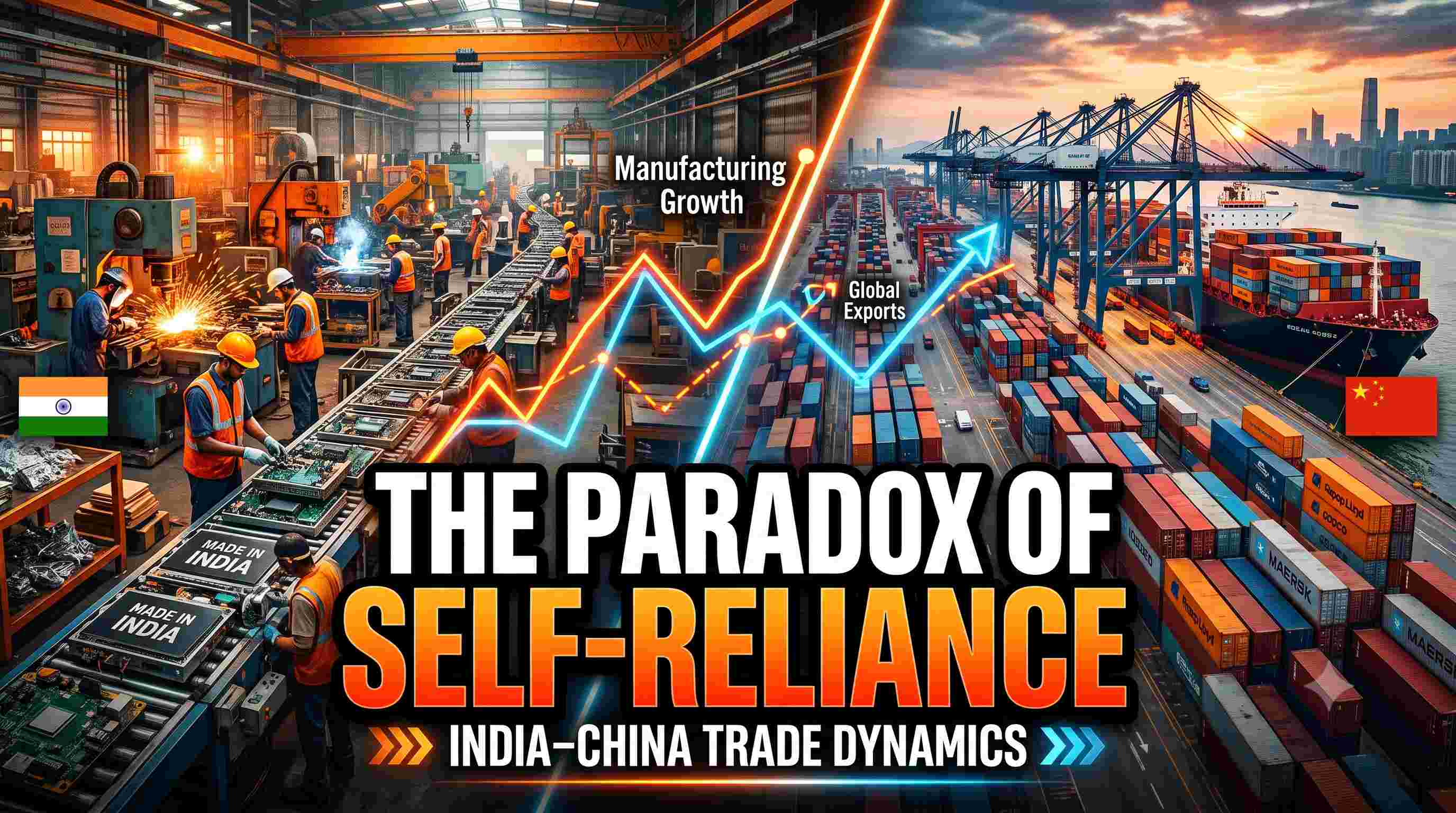
Following the meeting between Prime Minister Narendra Modi and Chinese President Xi Jinping on the sidelines of the BRICS Summit in Delhi, India and China highlighted the need to address structural trade imbalances and supply-chain issues. The issue is significant as India's expanding manufacturing sector continues to rely heavily on Chinese intermediate and capital goods.
India–China Trade: The “Assembly Trap”
What is the “Assembly Trap”?
India is rapidly expanding its manufacturing and export capabilities, particularly in electronics and mobile phones.
However, a substantial share of the components, intermediate goods, machinery and technological inputs required for this production is imported from China.
Thus, India's manufacturing growth can increase its dependence on Chinese supply chains rather than eliminate it.
This creates a paradox: India is becoming a manufacturing hub while remaining dependent on China for critical manufacturing inputs. Atmanirbhar Bharat must evolve from “assembly in India” to “capability creation in India”.
Key India–China Trade Trends
Bilateral trade: Reached around $167.6 billion in 2025.
Chinese imports into India: Increased from $87.5 billion in 2021 to $149.5 billion in 2025, an increase of around 71%.
India’s exports to China: Remained broadly stagnant during 2021–25.
The resulting imbalance reflects the persistent India–China trade deficit.
Around 70% of India's imports from China comprise intermediate goods, while around 22% constitute capital goods.
Therefore, the deficit is not merely due to imports of finished consumer products but reflects India's structural dependence on Chinese manufacturing inputs.
Why is Chinese Dependence Significant?
Electronics and Mobile Manufacturing: India has emerged as a major centre for mobile phone assembly.
Electronics Supply Chain:
Telecom equipment.
However, the share of imported parts and components in India's import basket increased from 3.3% in 2022 to 10.1% in 2025.
This indicates that domestic assembly has expanded faster than the domestic component ecosystem.
India remains dependent on Chinese imports for products and inputs such as:
Laptops and computers
Integrated circuits
Electronic components
Machinery and industrial inputs
The combined value of India's top five import categories from China increased from $19 billion in 2021 to $34.6 billion in 2025.
Intermediate and Capital Goods: Chinese machinery and components can support Indian industrialization, but prolonged dependence can create vulnerabilities in:
Production
Technology
Supply chains
Strategic sectors
Why Does the Trade Deficit Persist?
Structural Manufacturing Gap: India's domestic ecosystem for components, semiconductors, precision engineering, advanced machinery, and industrial materials remains comparatively underdeveloped.
Technology Dependence: Limited domestic technological capabilities force Indian firms to rely on imported high-value inputs.
Low Domestic Value Addition: Assembly-based production may generate employment and exports without proportionately increasing domestic value addition.
Supply-Chain Concentration: Heavy dependence on one country creates vulnerability to geopolitical tensions and supply disruptions.
Atmanirbhar Bharat: From Assembly to Value Addition
The objective of self-reliance should not be interpreted as complete import substitution or economic isolation. India needs to transition through the following stages:
Import-dependent Assembly → Domestic Component Manufacturing → Technology & R&D → Supplier Ecosystems → High Domestic Value Addition → Globally Competitive Manufacturing
Required transition: India needs to move from “Made in India” to “Designed, developed and manufactured in India.”
Are Chinese Imports Always Harmful?
Not necessarily. Imports of advanced machinery and intermediate goods can facilitate industrial upgrading by providing:
Access to technology
Productivity gains
Capital formation
Modern production techniques
Integration into Global Value Chains (GVCs)
The problem arises when:
Temporary import dependence turns into permanent structural dependence, and domestic firms fail to develop indigenous capabilities.
Therefore, self-reliance should mean resilience and competitiveness rather than isolation.
Major Concerns
Strategic Vulnerability: Dependence on China for critical inputs can become a strategic vulnerability during geopolitical tensions or supply disruptions.
Weak Domestic Component Ecosystem: India's success in final assembly has not been matched by equivalent development of upstream suppliers.
Low Value Addition: Import-intensive manufacturing limits domestic technological and economic gains.
Persistent Trade Deficit: Rapid growth of imports without a comparable increase in exports widens the bilateral trade imbalance.
Technology Dependence: Dependence on imported semiconductors, electronics and machinery can constrain India's technological sovereignty.
Risk to Atmanirbhar Bharat: Manufacturing growth without domestic capability creation can produce an “assembly trap” rather than genuine self-reliance.
Way Ahead
Build Domestic Component Ecosystems: Promote manufacturing of semiconductors, electronic components, precision machinery, advanced materials, and industrial equipment.
Move Up the Value Chain: Shift policy focus from final assembly to design, R&D and high-value component manufacturing.
Promote Research & Innovation: Increase public and private investment in semiconductor technology, advanced manufacturing, product design, artificial intelligence, and materials science.
Calibrated Tariff Policy: Use carefully designed tariffs and incentives to nurture domestic manufacturing capabilities without making Indian products globally uncompetitive.
Diversify Supply Chains: Develop alternative sources through partnerships with Japan, South Korea, ASEAN, Taiwan, and European countries.
Integrate with Global Value Chains: India should remain open to global production networks while reducing excessive dependence on a single country.
Improve Manufacturing Competitiveness: Focus on logistics, infrastructure, skill development, reliable power, ease of doing business, and faster customs clearance.
India’s Strategic Policy Choice
Approach | Limitation / Implication |
|---|---|
Complete import dependence | Strategic vulnerability |
Blanket protectionism | Higher costs and inefficiency |
Complete decoupling | Loss of global competitiveness |
Strategic self-reliance (Preferred approach) | Domestic capability + Global integration + Supply-chain diversification |
Key Data for Prelims
India–China bilateral trade (2025): $167.6 billion
Chinese imports into India: $87.5 billion (2021) → $149.5 billion (2025)
Increase in imports: ~71%
Intermediate goods: ~70% of Chinese imports
Capital goods: ~22%
Top five import categories: $19 billion (2021) → $34.6 billion (2025)
Imported parts/components share: 3.3% (2022) → 10.1% (2025)
Major policy initiatives: Make in India, Atmanirbhar Bharat, Phased Manufacturing Programme (PMP)
Conclusion
India's experience demonstrates that manufacturing growth does not automatically translate into self-reliance. The country has successfully expanded downstream assembly, particularly in electronics, but remains dependent on China for several critical components, intermediate goods and capital equipment.
The objective of Atmanirbhar Bharat should therefore be capability-based self-reliance rather than import isolation. India must build domestic technological and supplier ecosystems while remaining integrated with global value chains. Such a strategy can convert India's manufacturing expansion from an “assembly trap” into sustainable and globally competitive industrialisation.
Answer Writing Practice
Question: “India’s growing manufacturing capacity remains deeply embedded in China-centric supply chains, creating an ‘assembly trap’ rather than genuine self-reliance.” Examine the structural causes of India’s dependence on Chinese imports and suggest measures to build resilient and globally competitive manufacturing value chains.