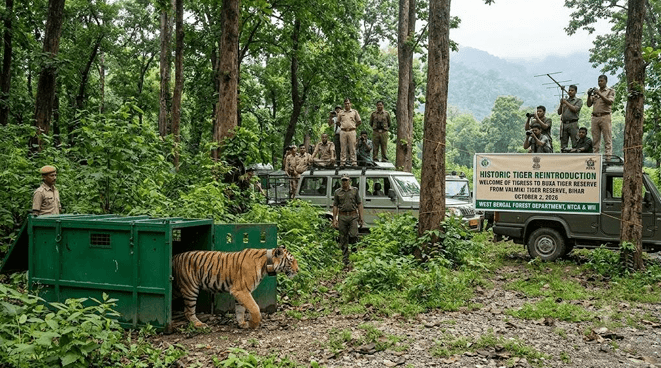
Why in News?
A 3-year-old tigress from Valmiki Tiger Reserve, Bihar, was released in Buxa Tiger Reserve, West Bengal, on 2 October 2026. This is part of a phased programme to establish a viable and self-sustaining tiger population in Buxa.
Key Facts
Buxa Tiger Reserve (BTR) – declared in 1983, India’s 15th Tiger Reserve.
Area: 760.87 sq km.
Location: Alipurduar district, West Bengal.
Important connectivity:
North: Bhutan forests
East: Kochugaon forests & Manas Tiger Reserve
West: Jaldapara National Park
Tiger population declined due to:
Habitat degradation & fragmentation
Land-use changes
Decline in prey availability
Anthropogenic pressure
Valmiki Tiger Reserve was selected because its terrain and ecological conditions are similar to Buxa.
Sundarbans was not selected because its mangrove ecosystem and terrain differ significantly from Buxa.
Major Challenges in Buxa
Human settlements and tea estates
Low prey availability
Habitat fragmentation
Railway and road infrastructure
Human–wildlife conflict
Heavy commercial traffic between Bhutan and West Bengal
Important: Around 300 families have been persuaded to relocate to facilitate the programme.
Practice Questions
Prelims Question
Q. With reference to Buxa Tiger Reserve, consider the following statements:
It is located in West Bengal.
It shares ecological connectivity with forests of Bhutan.
Valmiki Tiger Reserve was selected as the source for tiger reintroduction because of similarities in terrain.
Buxa is India’s first Tiger Reserve.
Which of the statements given above are correct?
A. 1, 2 and 3 only
B. 1 and 4 only
C. 2, 3 and 4 only
D. 1, 2, 3 and 4
Answer: A
Mains Question
Q. Tiger reintroduction can restore ecological balance, but its success depends on landscape-level conservation. Discuss with reference to Buxa Tiger Reserve. (150 words | 10 marks)