Editorial Analysis | Takshasheela School of Civil Services | Puja Kakati, Faculty
Why the Brahmaputra Is Not Just an International-Relations Issue
The Brahmaputra is often discussed as a diplomatic or strategic question between India and China, but the editorial insists that this framing is incomplete. For Assam, the river is not an abstraction of foreign policy — it directly determines the state's floods, livelihoods, agriculture, ecology, disaster management, and security.
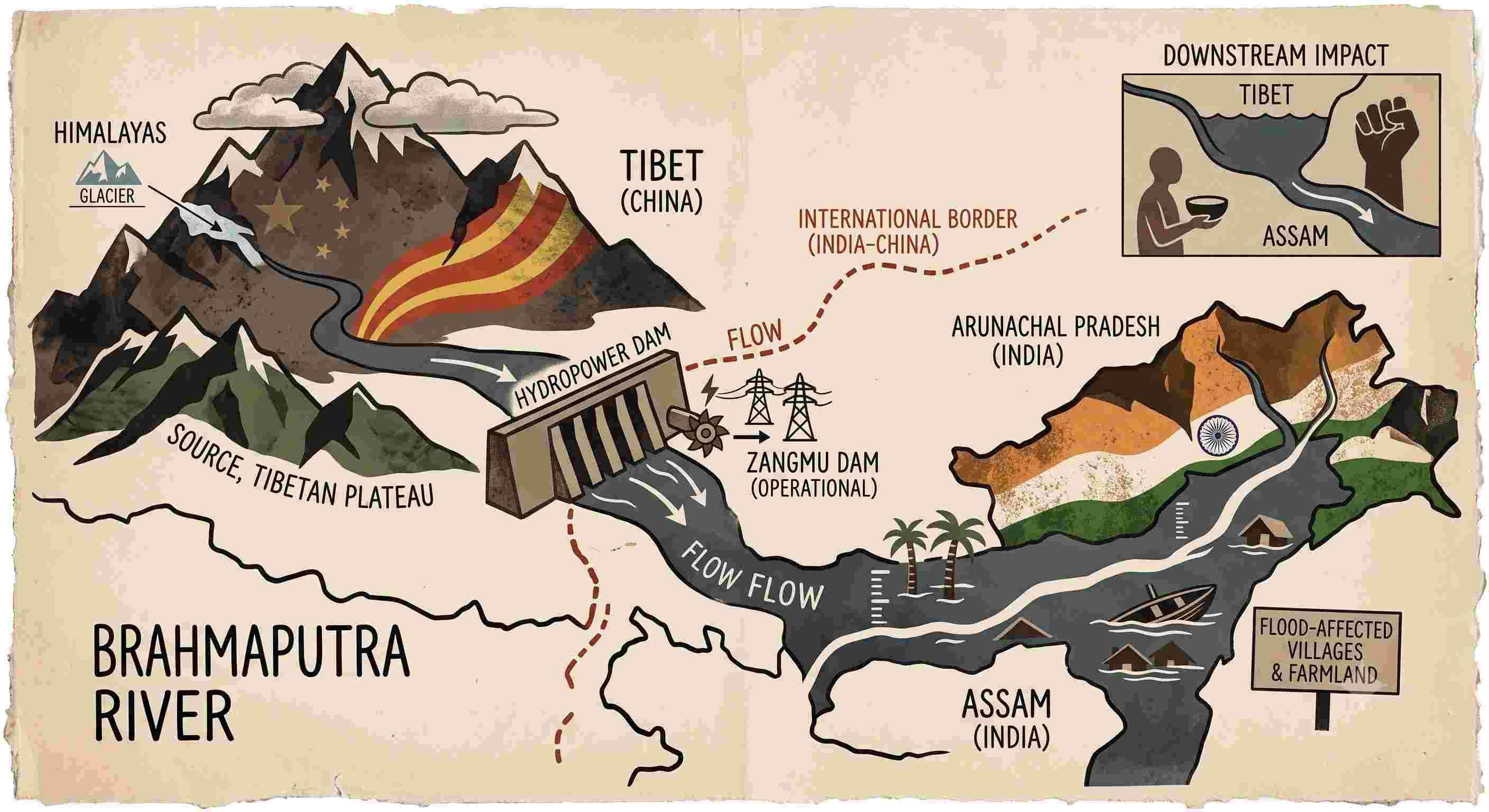
The river originates in Tibet, where it is known as the Yarlung Tsangpo. It enters India through Arunachal Pradesh as the Siang, or Dihang, before eventually flowing through Assam as the Brahmaputra. The crucial geographical fact underlying the entire editorial is simple but consequential: China is the upstream riparian, and India is the downstream riparian on this river system.
Why Hydrological Data Matters So Much
Hydrological data allows a downstream country to forecast floods, issue early warnings, evacuate vulnerable populations, manage its reservoirs, plan agricultural cycles, and prepare disaster-response systems well in advance. In other words, water data is a direct input into disaster-management capacity — and this is especially significant for Assam, where the Brahmaputra and its tributaries regularly produce devastating floods and erosion.
The Absence of a Comprehensive Water-Sharing Treaty
India and China do not have a comprehensive bilateral water-sharing treaty covering the Brahmaputra. What exists instead is a set of flood-season memorandums on hydrological information: one covering the Brahmaputra and Yarlung Tsangpo since 2002, and another covering the Sutlej since 2005. Under the 2002 memorandum, China agreed to share hydrological information — specifically water level, discharge, and rainfall data — from designated upstream stations during the flood season.
The editorial's central criticism of this arrangement is that it is inherently weak, because data sharing under these memorandums depends on the broader state of bilateral relations rather than being anchored as a permanent legal obligation. When relations sour, the arrangement has no independent legal force to keep it functioning.
Doklam and Galwan: When Data Sharing Became a Casualty of Diplomacy
The editorial uses two recent crises to demonstrate exactly how this vulnerability plays out in practice. During the 2017 Doklam standoff, China stopped sharing Brahmaputra hydrological data, citing problems with its collection stations — a suspension that occurred during a period of severe India–China tension, and one that coincided with Assam experiencing major floods at the same time. Data sharing deteriorated again following the 2020 Galwan clash, once more tracking a period of military confrontation between the two countries.
The larger lesson the editorial draws from these episodes is the heart of its entire argument: if disaster-management information can be interrupted whenever diplomatic relations deteriorate, then hydrological data functions as a geopolitical instrument rather than a purely scientific resource. Flood forecasting, in other words, becomes hostage to the state of the bilateral relationship — a troubling proposition for a state as flood-prone as Assam.
The Medog Project: A New Strategic Concern
The editorial then shifts from data to infrastructure. In July 2025, China began construction of the Medog hydropower project at the Great Bend of the Yarlung Tsangpo, immediately before the point where the river turns toward Arunachal Pradesh. The project is described as having a planned capacity of around 60 GW, which would make it potentially the largest hydropower project in the world.
This has generated concern in India for several overlapping reasons: the project sits upstream of Arunachal Pradesh, in a highly seismic region, close to the India–China border, and on a river system that is critical to both Arunachal Pradesh and Assam. Importantly, the editorial is careful to note that the concern is not simply that "China will divert the Brahmaputra" — the anxiety is broader and more structural than that single scenario.
Why the Brahmaputra Matters Beyond Geopolitics
The river's significance for Assam runs through multiple, interlocking dimensions. Large sections of Assam's agricultural economy depend directly on the Brahmaputra river system. Annual flooding affects settlements, agriculture, infrastructure, and public services across the state. The river is notorious for changing its course, causing severe riverbank erosion in the process. Its char areas — riverine islands and sandbars — support large populations whose livelihoods are highly vulnerable to shifts in river dynamics. The river also sustains an entire ecology of wetlands, forests, fisheries, and biodiversity. And because of all of this, reliable upstream data remains crucial to effective early-warning and disaster-management systems.
India's Own Position: Not Simply an Innocent Downstream Victim
One of the most mature aspects of the editorial is its refusal to present India purely as a downstream victim of Chinese behaviour. The author points out that India itself has, at times, adopted a similar approach toward its own downstream neighbours — because India is simultaneously downstream of China and upstream of Bangladesh and Pakistan.
This generates an important general principle in international river relations: a country can be both an upstream and a downstream riparian, depending on which river is being discussed. If India expects transparency and information-sharing from China, the editorial argues, it must apply the same standard to how it treats the countries downstream of itself — a point that is particularly relevant to Bangladesh, Pakistan, and Nepal. The editorial uses this symmetry to argue that India's long-term interest lies in supporting general, rule-based norms of transboundary water governance, rather than seeking exceptions carved out for its own strategic convenience.
Why a Comprehensive Treaty Remains Difficult
India and China cannot easily conclude a comprehensive Brahmaputra water treaty, because the river is tightly bound up with questions of territory, sovereignty, and national security on both sides. For China, the Brahmaputra's origin in Tibet ties its water management directly to sovereignty claims and strategic infrastructure planning. For India, the river's passage through Arunachal Pradesh and Assam links it to the Line of Actual Control, border security, livelihoods, and flood management. What looks, on the surface, like an environmental or hydrological issue is therefore, in substance, a geopolitical and strategic one — which is precisely why water security has become increasingly inseparable from national security, and why river diplomacy has become an important dimension of the broader India–China relationship.
The Way Forward
The editorial's prescription is to move beyond geopolitical mistrust toward institutionalised cooperation. Rather than treating the river as a potential instrument of strategic leverage, both countries should strengthen mechanisms for transparent and regular hydrological data sharing, advance notification of major infrastructure projects, scientific cooperation, flood forecasting, and joint disaster management. At the same time, India should strengthen its own satellite-based monitoring and flood-resilience capacity, rather than relying solely on Chinese data-sharing goodwill, while adopting a basin-wide and ecologically sustainable approach that recognises the interests of all riparian countries, including Bangladesh.
The Brahmaputra, the editorial concludes, must be understood not merely as a river, but as a shared ecological system, an economic lifeline, a disaster-risk factor, and a strategic asset all at once — and it is precisely because of this complexity that stronger institutions, rather than goodwill alone, can make cooperation possible even when political trust between the two countries remains limited.
Practice Questions
Prelims MCQ
Consider the following statements with reference to the Brahmaputra river and India–China hydrological cooperation:
- India and China have a comprehensive, legally binding treaty governing the sharing of Brahmaputra water resources.
- Under the 2002 memorandum, China agreed to share hydrological data such as water level, discharge, and rainfall from designated upstream stations during the flood season.
- China suspended sharing of Brahmaputra hydrological data during the 2017 Doklam standoff.
- India is a downstream riparian with respect to China and an upstream riparian with respect to Bangladesh and Pakistan.
Which of the statements given above are correct?
(a) 1, 2 and 3 only (b) 2, 3 and 4 only (c) 1, 3 and 4 only (d) 2 and 4 only
Answer: (b) 2, 3 and 4 only. Statement 1 is incorrect because no comprehensive bilateral water-sharing treaty exists between India and China; cooperation is limited to flood-season memorandums on hydrological information.
Mains Question
"Hydrological data sharing between upper and lower riparian states should be treated as a permanent legal obligation rather than a hostage to bilateral relations." Discuss with reference to India–China cooperation on the Brahmaputra and India's own responsibilities as an upper riparian to Bangladesh, Pakistan, and Nepal. (GS-2/GS-3, 250 words)