GS PAPER II — POLITY & GOVERNANCE / SOCIETY · March 14, 2026 · 8 min read
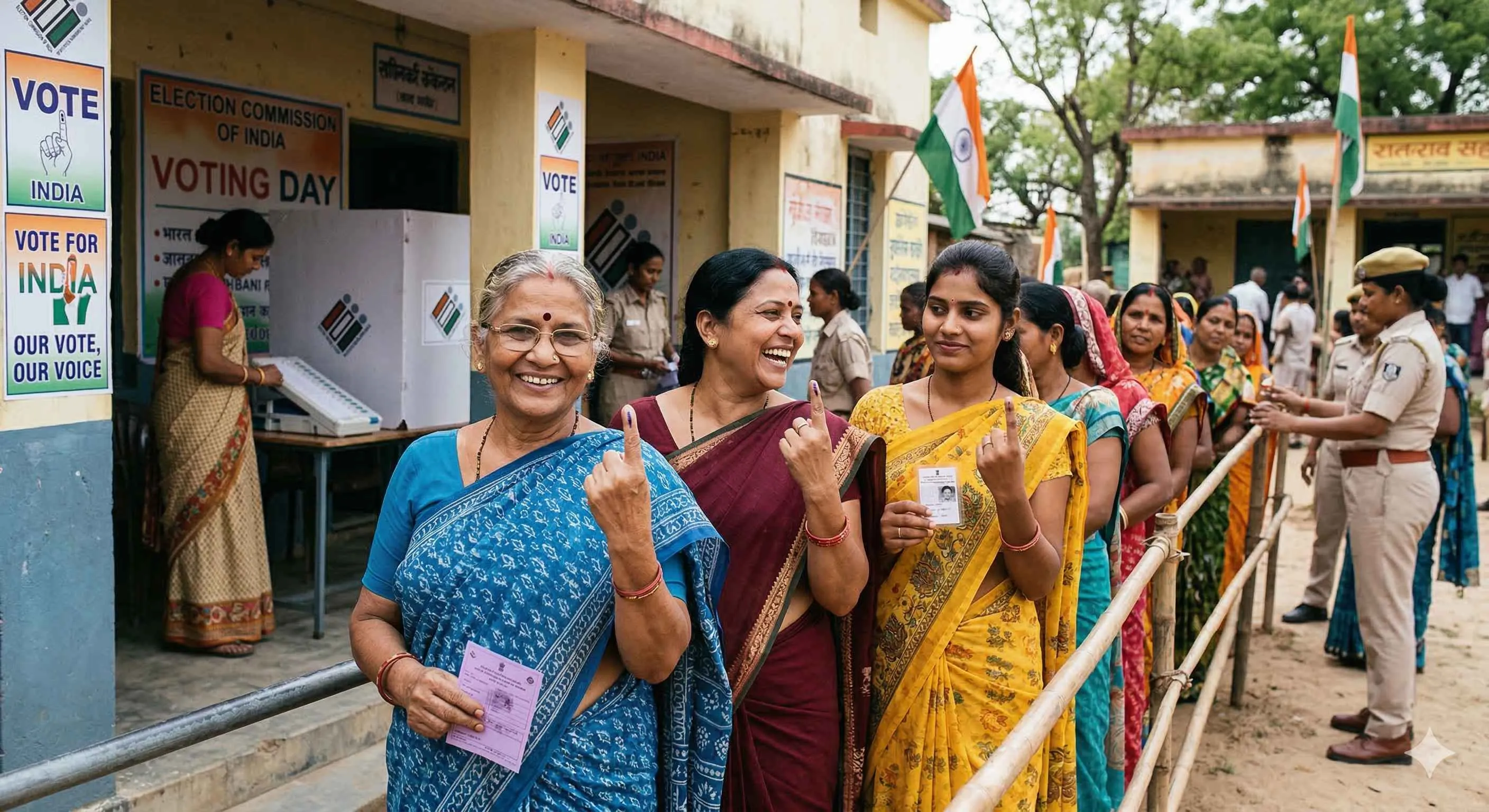
Women now vote at nearly the same rate as men — yet hold barely 14% of seats in Parliament. A policy analysis of the structural barriers, the nomination bottleneck, and the road ahead.
Key Figures at a Glance
| Indicator | Figure | Note |
|---|---|---|
| Women's share of India's electorate | ~50% | near-equal voter base |
| Women MPs in Lok Sabha (2024) | 74 | ~14% of total seats |
| Women candidates in 2024 elections | 800 | up from 45 in 1957 |
| Win rate — women vs men (2019) | 11% vs 6% | women win more when nominated |
| Women believing parties prefer male candidates | 44% | Lokniti-CSDS survey |
| Reservation under 106th Amendment Act | 33% | pending delimitation |
1. The Paradox
India has one of the most striking contradictions in global electoral politics: a country where women constitute nearly half the electorate and now vote at rates nearly identical to men, yet hold barely 14% of seats in the Lok Sabha. In the 2019 and 2024 general elections, the gender gap in voter turnout had essentially closed — and in several State Assembly elections since 2011, women's turnout has slightly exceeded men's, averaging a positive gap of 1.6 percentage points between 2020 and 2025.
Yet the 18th Lok Sabha, elected in 2024, returned only 74 women MPs — a slight decline from the historic high of 78 in 2019. At the current pace of change, India would take decades to achieve anything resembling gender-balanced representation in its national legislature.
The problem is not that women do not vote. The problem is that they are not given the chance to stand.
2. From the Ballot Box to the Campaign Trail: A Widening Gap
Electoral participation is not a single act — it spans voting, attending rallies, canvassing, donating, and standing for office. India's women have made extraordinary progress on the first of these; the others reveal a more troubling picture.
Data from Lokniti-CSDS shows that women's participation in election meetings rose from 9% in 2009 to around 16% in recent elections — meaningful progress, but still roughly half the male participation rate of 31%. Participation in processions and door-to-door canvassing follows a similar pattern. Many women continue to require family permission to attend political meetings or campaign activities, a constraint that reflects not individual choice but the persistence of patriarchal household decision-making structures that shape public political behaviour.
Campaign Participation Gap (2024)
| Activity | Women | Men |
|---|---|---|
| Election meetings / rallies | 16% | 31% |
| Participation in processions | 11% | 18% |
| Door-to-door canvassing | 11% | 19% |
3. The Nomination Bottleneck: Where Representation Is Really Lost
The most important finding from electoral data is also the least-discussed: when women are given party tickets, they win at higher rates than men. In the 2019 Lok Sabha elections, 11% of women candidates won their contests compared to just 6% of male candidates. Voter bias is not the primary obstacle to women's political representation in India. The obstacle is nomination.
Political parties function as the primary gatekeepers of representation. Despite 800 women contesting the 2024 general elections — up from a mere 45 in 1957 — male candidates still numbered in the thousands. About 44% of women surveyed by Lokniti-CSDS believe that parties prefer male candidates when distributing election tickets. A further 58% believe political entry is easier for women from political families, pointing to the dynastic capture of whatever representational space exists for women in Indian politics.
Women candidates win more often than men when given the ticket. The gatekeeping problem is inside party headquarters, not in the voting booth.
4. Structural and Social Barriers
Behind the nomination bottleneck lie deeper structural forces that make entering electoral politics difficult for women, particularly those without dynastic connections or independent financial resources.
Patriarchal Norms
Patriarchal social structures remain the single largest identified obstacle to women's political participation — cited by approximately 22% of women respondents in Lokniti-CSDS surveys. Cultural expectations around gender roles restrict mobility, limit public engagement, and narrow the leadership opportunities available to women in political spaces. These are not abstract forces: they manifest in concrete constraints on women's ability to campaign, attend party meetings, build networks, and cultivate the political relationships that electoral success requires.
Domestic Responsibilities
Unpaid care work and household responsibilities significantly reduce women's time and capacity to engage in the sustained, relationship-intensive activity that electoral politics demands. Campaigning, party organising, constituency visits, and fundraising all require time that is structurally less available to women than to men in households where domestic labour is unequally distributed.
Economic and Institutional Barriers
Electoral politics in India is resource-intensive. Limited access to financial resources, party networks, and organisational support within parties reduces the likelihood of women — especially first-generation candidates without family connections to politics — being able to mount credible campaigns. This financial barrier compounds the nomination barrier: parties hesitant to nominate women often cite electability concerns, despite the data showing the opposite.
5. The Constitutional and Policy Framework
India's constitutional architecture provides a strong formal foundation for women's political participation. Articles 14, 15, and 16 guarantee equality before law and prohibit discrimination. The 73rd and 74th Constitutional Amendments (1992) introduced one-third reservation for women in Panchayats and Urban Local Bodies, creating millions of women representatives at the grassroots level — a transformation that has had measurable downstream effects on policy priorities and local governance quality. Many states have since raised this quota to 50%.
The most significant recent development is the Constitution (106th Amendment) Act, 2023 — popularly known as the Women's Reservation Act — which provides for 33% reservation for women in the Lok Sabha and State Assemblies. However, its implementation is tied to a future delimitation exercise, meaning the reservation cannot take effect until after the next delimitation of constituencies. The timeline for that exercise remains uncertain, introducing a structural delay into what should be an urgent reform.
The 106th Amendment is a landmark — but linking its implementation to delimitation converts a constitutional promise into a deferred commitment. The urgency of the reform sits in tension with the ambiguity of its timeline.
6. Why It Matters: Governance, Policy, and Democratic Legitimacy
The case for women's political representation is not merely procedural — it is substantive. Research consistently shows that legislatures with higher female representation tend to prioritise public goods provision, healthcare, education, nutrition, and social welfare at higher rates. Women representatives bring different lived experiences to policy deliberation, and those experiences align with the policy needs of large, underserved constituencies.
There is also the question of democratic legitimacy. A legislature where women constitute 50% of the electorate but only 14% of representatives is structurally unrepresentative. The gap between electoral participation and legislative representation is not a marginal inefficiency — it is a structural distortion of democratic accountability that systematically excludes women's voices from the institutions that make law.
7. Way Forward: Four Policy Imperatives
i. Expedite the Women's Reservation Act
The delimitation-linked implementation timeline must be treated as an operational challenge to be resolved urgently, not a reason to delay. Policymakers should explore interim mechanisms — including voluntary party quotas for nominations — that can increase women's representation before delimitation is completed.
ii. Reform Party Structures from Within
Political parties are the primary bottleneck. Encouraging parties to adopt internal gender quotas, transparent candidate selection processes, and leadership development programmes for women would address the nomination gap more directly than any external legislative intervention. The Election Commission could play a facilitative role through disclosure requirements on gender distribution of candidate nominations.
iii. Build Financial and Institutional Capacity
Expand campaign financing support, leadership training programmes, and mentorship networks for first-generation women candidates. The resource barrier to electoral participation is real and measurable; targeted policy interventions can reduce it. State electoral funds or party-linked support mechanisms for women candidates in competitive constituencies could make a material difference.
iv. Address the Social Foundations
Long-term change requires investment in the social conditions that shape political participation: gender-sensitive political education in schools and colleges, awareness campaigns that challenge patriarchal norms around women's public roles, and institutional support for women who face harassment or intimidation in political spaces. The grassroots pipeline of local government — where reservation has already produced millions of women leaders — must be nurtured as a feeder system for higher legislative offices.
Conclusion: Electoral Inclusion Is Not Political Empowerment
India's story on women and electoral politics is one of genuine progress and persistent failure, often in the same breath. The closing of the voter turnout gap over seven decades represents a real transformation in women's relationship with democratic participation — one achieved against the headwinds of low literacy, mobility constraints, and patriarchal social norms. It should be acknowledged and celebrated.
But the gap between voting and governing remains vast and structural. Women vote; women are not nominated; women do not govern. Until political parties — the real gatekeepers of representation — are held accountable for their nomination choices, and until the Women's Reservation Act is operationalised with genuine urgency, India's democracy will remain one in which half the population participates as voters but is largely excluded as decision-makers.
A democracy that counts women's votes but not their voices is only half a democracy.
Sources: Lokniti-CSDS Electoral Studies · Election Commission of India Data · Constitution (106th Amendment) Act, 2023 · 73rd & 74th Constitutional Amendments · Takshashila DSC 14 March 2026 · UN Women · Inter-Parliamentary Union