Source: WHO–UNICEF Joint Monitoring Programme (JMP), Progress on Drinking Water, Sanitation and Hygiene in Schools 2015–2025
Why in News?
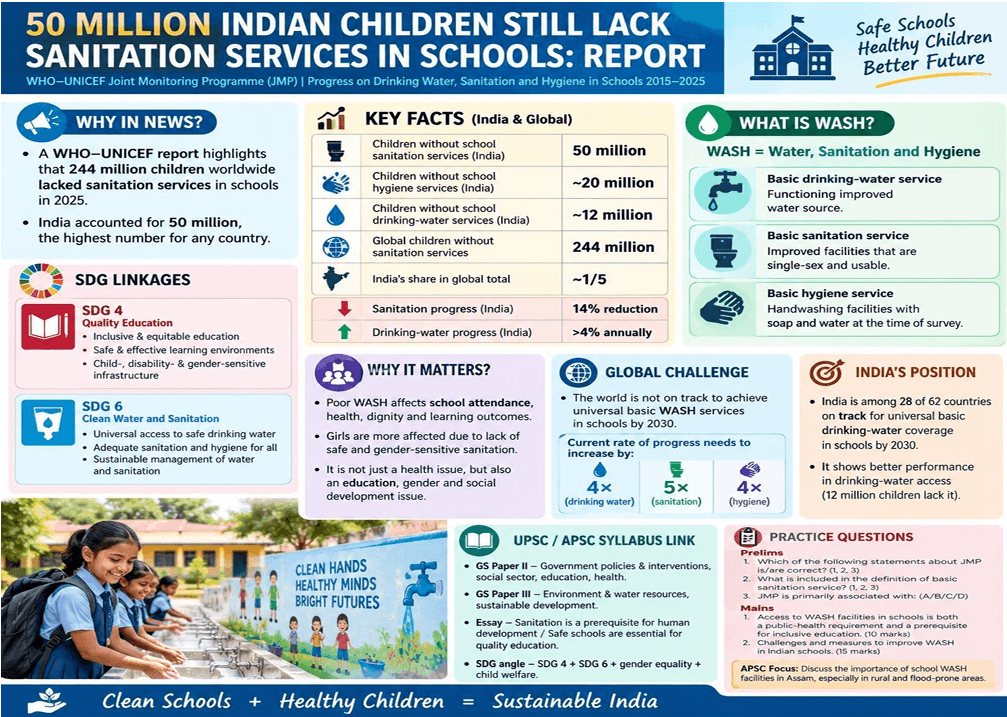
A WHO–UNICEF report highlights that 244 million children worldwide lacked sanitation services in schools in 2025. India accounted for 50 million, the highest number for any country.
Key Facts
Indicator | India, 2025 |
|---|---|
Children without school sanitation services | 50 million |
Children without school hygiene services | 20 million |
Children without school drinking-water services | 12 million |
Global children without school sanitation | 244 million |
India’s sanitation gap | 1/5 of global total |
Sanitation progress during assessed period | 14% reduction in children without sanitation service |
Drinking-water progress | >4% annually |
What Is WASH?
WASH = Water, Sanitation and Hygiene
Basic drinking-water service: Functioning improved water source.
Basic sanitation service: Improved sanitation facilities that are single-sex and usable.
Basic hygiene service: Handwashing facilities with soap and water available at the time of survey.
SDG Linkages
SDG 4 – Quality Education
Inclusive and equitable quality education.
Safe and effective learning environments.
Schools should have child-, disability- and gender-sensitive infrastructure.
SDG 6 – Clean Water and Sanitation
Universal and equitable access to safe drinking water.
Adequate sanitation and hygiene for all.
Sustainable management of water and sanitation.
India-Specific Significance
Poor WASH facilities can affect school attendance, health, dignity and learning outcomes.
Girls are particularly affected when schools lack safe, usable and gender-sensitive sanitation facilities.
WASH infrastructure is therefore not merely a health issue but also an education, gender and social-development issue.
India is among 28 of 62 countries considered on track for universal basic drinking-water coverage in schools by 2030.
Global Challenge
The world is not currently on track to achieve universal basic WASH services in schools by 2030.
Practice Questions
Prelims Questions
Q1. Consider the following statements regarding the WHO–UNICEF Joint Monitoring Programme (JMP):
It monitors progress relating to drinking water, sanitation and hygiene (WASH).
A basic hygiene service requires handwashing facilities with soap and water.
SDG 6 is exclusively concerned with drinking-water access and has no sanitation component.
Which of the statements given above are correct?
A. 1 and 2 only
B. 2 and 3 only
C. 1 and 3 only
D. 1, 2 and 3
Answer: A
Mains Questions
Q. “Access to WASH facilities in schools is both a public-health requirement and a prerequisite for inclusive education.” Discuss. (150 words)